 Ten Toe Express
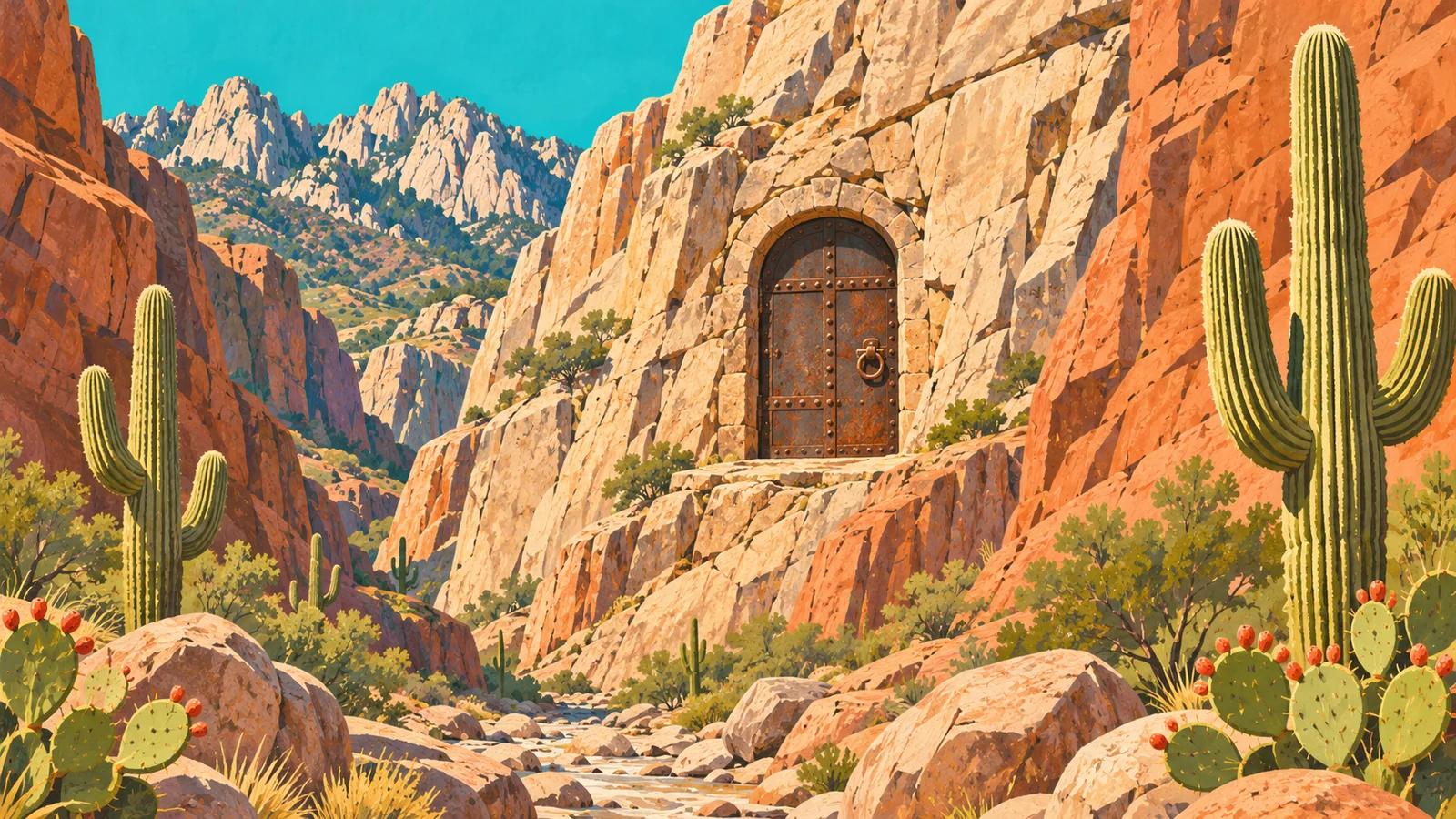
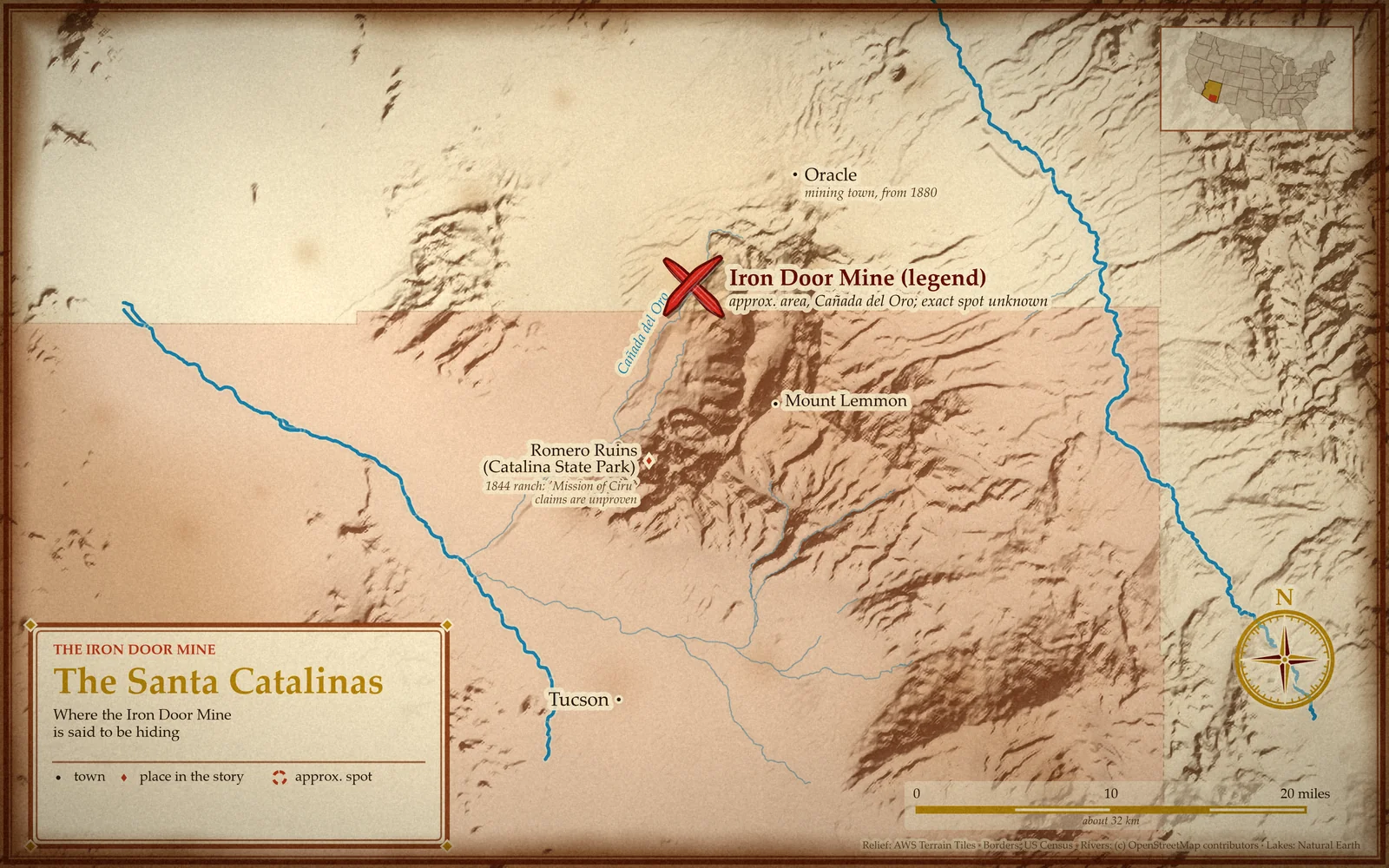
Right then. Picture a canyon north of Tucson, Arizona, somewhere in the Santa Catalina Mountains. Halfway up a cliff there's a slab of iron set into the rock like the front door of a very ambitious cottage. Behind it, the story goes, sits a Spanish mine so rich that a church somewhere above it rang golden bells to call the workers in.
That's the Lost Iron Door Mine, and it has been pulling prospectors, dreamers and at least one famous showman into the Catalinas for well over a century. Nobody has ever been reported to strike it rich from it. Plenty have walked very far to be disappointed.
The Iron Door Mine legend in a nutshell
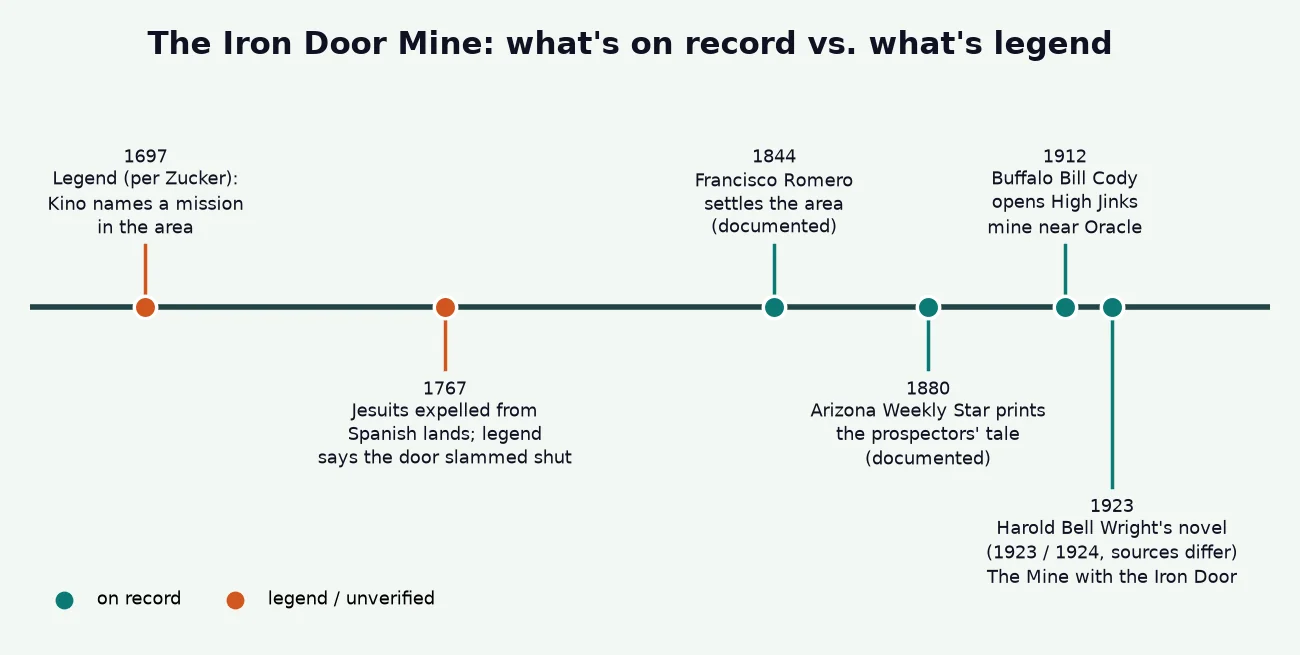
The Arizona version is simple enough to tell over a campfire. In the 1700s, Spanish Jesuit priests worked a rich mine in the Santa Catalina Mountains, using local labour (Papago workers, in some tellings). When the Jesuits were thrown out of Spanish lands in 1767, they supposedly sealed the mine behind an iron door and hid every trace of it, including the mountain city that had grown up around it. Then they left. The treasure, it's said, is still in there.
Arizona Highways tells a version in which a priest, Padre Juan Bautista Escalante, was so furious about being expelled that he "slammed the door of the mine shut and padlocked the treasure inside". It's a cracking line. It's also a legend, and the article that tells it is itself discussing "fairy tales" about buried mission treasure.
What the records actually show
Strip away the iron and there's a real history underneath. Father Eusebio Francisco Kino and other Jesuits really did found missions across southern Arizona, including San Xavier del Bac near Tucson. Spanish mining in the region is real too. Robert Zucker, co-author of Treasures of the Santa Catalina Mountains, argues that research points to a Spanish mission named by Kino in 1697 somewhere along the Cañada del Oro ("Canyon of Gold"), a creek that was famous for placer gold and that is mostly a dry bed these days. Zucker says that outpost lasted nearly 70 years and then vanished.
Here's the catch. The mine itself has never been documented, and its exact location "has never been fully documented" either, as one local-history site puts it. What exists is a mission that may or may not have stood somewhere in the area, and a very good story.
1880: the newspaper story that started the rush
The first published account turns up in the Arizona Weekly Star in 1880. Two prospectors, named in the story as Martin and Welde, said they had gone looking for a lost city called "Nueva Mia Ciudad" (Nine Mile City) on a mountain plateau. The report is dated February 24, 1880 and was published March 4, 1880.
According to one retelling, after three days of searching they found the "mine with the iron door", followed a vein for some 400 feet and found gold nuggets lying on the floor. A reporter apparently saw about 100 pounds of gold and silver the men said came from it. The article described a city with a large church and golden bells that summoned laborers. Details like these are exactly what you'd expect of a tale that grows nicely in the retelling, so treat them as the story as printed, not as inventory.
What can be said safely is that the article helped fuel a wave of prospecting. Mining claims filled the area from the 1880s into the 1940s, and Oracle, on the north side of the range, was a mining town from about 1880.
Buffalo Bill and the Cody Stones
Then the showman arrived. Buffalo Bill Cody took an interest in the Oracle area, and the town's High Jinks mine opened in 1912 with his name attached. KGUN reports he owned part of the Campo Bonito Mining District south of Oracle and sold 361,000 shares for as little as a dollar each, and that he went looking for the Iron Door Mine with a man named William Neal. By every account he never found it. A road near Oracle still carries his name.
Later came William "Flint" Carter, a prospector who told Zucker about the legend and made what he called "Cody Stones", quartz with silver and gold in it. Carter claimed to know where the mine was. When he died, Zucker says, the location went with him. Which is rather inconvenient, if you were hoping for a map.
The novel that made it famous
The legend's biggest boost came from fiction. Harold Bell Wright's novel The Mine with the Iron Door was published in the 1920s (sources give 1923 and 1924), and it was filmed as a silent movie in 1924 and remade in 1936. Wright had spent time in the Catalinas, and the book is a novel, not a field report. Still, it put an iron-doored mine into American heads for good, and the name stuck. You can now eat at an Iron Door Restaurant on Mount Lemmon and ride an Iron Door Mine attraction at Old Tucson.
The clues, such as they are
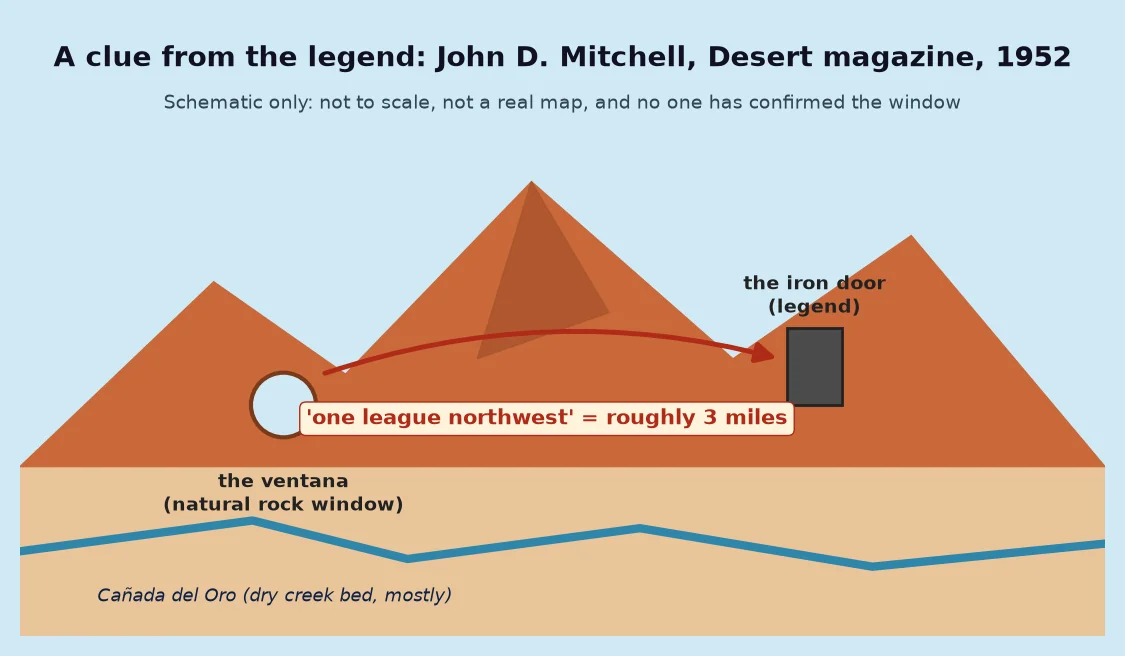
The best-known directions come from John D. Mitchell, writing in Desert magazine in July 1952. He put the treasure vault near the south bank of the Cañada del Oro and described a ventana, a natural rock window, with the mine "one league northwest" of it, roughly three miles. In his telling Apaches raided the camp in June 1796 and killed the Papago workers. Mitchell's account is storytelling that has never been backed by records, so file it under legend.
The Mission of Ciru and the Romero Ruins
Some writers tie the legend to a "Mission of Ciru" supposedly near the Romero Ruins, in what is now Catalina State Park. The Romero ranch itself is real: Francisco Romero settled the area in 1844 and had trouble with Apache raids. The mission is another matter. The ruins people point to on a mesa between Montrose and Romero canyons were described in 1927 by Donald Page, whose notes are held by the Arizona Historical Society, and they include stone-lined pit houses and adobe walls. But a team that later checked the spot found no trace of a mission, and most historians disagree with Page. The ruins are real, and the mission is a maybe.
The theories, weighed
- It was real, and it's buried. Zucker believes an Iron Door Mine existed, but thinks the shaft has probably collapsed and been covered by the mountain. The idea fits the facts, because it can't be disproved.
- It's the Escalante mine. Writer Eugene Corotto linked the Lost Escalante Mine to the Iron Door legend, with Papago workers labouring for the Jesuits before 1767. That connection is a claim, not a documented fact.
- It's a tall tale that grew. A newspaper story, a showman, a bestselling novel and a century of retelling would make a legend out of far less. This is the sceptic's choice, and a fair one.
Where it stands today
The Catalinas are a very large range, and parts of them are Catalina State Park and national forest land, not open ground for a spot of digging. Taking artifacts or breaking ground in protected places is not something this site is cheering for. If you'd like to go and look, the Romero Ruins are an actual, legal, signposted walk, and the scenery will have earned its keep long before any iron door turns up.
The Iron Door Mine, meanwhile, remains exactly where it has always been: somewhere between a cliff and a campfire.
...and if you find it, remember who encouraged your questionable life choices.
The short version of this story is on YouTube at @TenToeExpress.
Deep dive yourself
- Iron Door Mine · Entertainment Magazine (Tucson history)
- The Mission of Ciru · Entertainment Magazine
- Legend has it that somewhere deep in the Catalina Mountains lies the lost "Mine With the Iron Door" · Arizona Daily Star
- Legend of the Iron Door Mine · KGUN 9
- Arizona's Ghost Gold · Arizona Highways
- The Mine with the Iron Door · Wikipedia