 Ten Toe Express
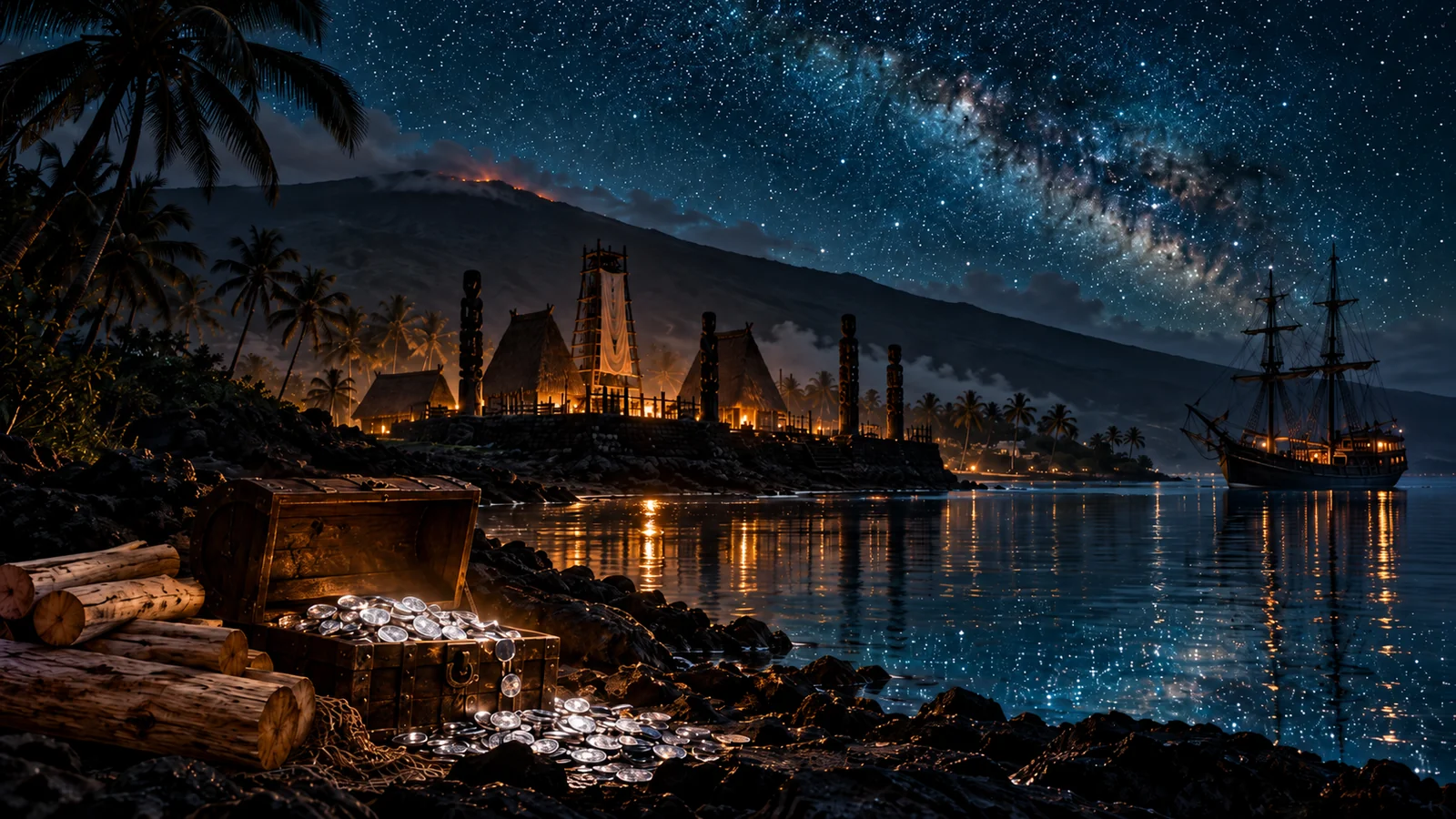
Kailua Bay, Hawaiʻi Island, May 1819. The most powerful man the islands have ever known is dying at his seaside home at Kamakahonu. He has united the whole Hawaiian chain under one rule, out-traded hard-nosed Yankee sea captains, and filled royal storehouses with trade goods and hard silver. And he has given two of his most trusted men one last order: when the time comes, hide me where nobody will ever find me.
They did. That man was Kamehameha I, Kamehameha the Great, and more than two centuries later Hawaii still holds two royal mysteries in one. The first is the stuff of treasure lists: King Kamehameha's lost treasury, the wealth of a sandalwood king that seems to melt away after his death. The second is far older, far deeper and not a treasure hunt at all: the hidden resting place of the king himself.
Right then. Let's sort the silver from the stories, and be clear from the start about which of these mysteries is fair game for curiosity and which one belongs to the Hawaiian people.
Who was King Kamehameha I?
Nobody is quite sure when Kamehameha was born. Historians put it anywhere between about 1736 and 1761. Legend has a much better answer: he arrived on a stormy night in the 1750s as a bright comet (often said to be Halley's, which passed in 1758) blazed across the sky, just as the priests had foretold that a great uniter would be born. The ruling chiefs were not thrilled by prophecies of that sort, so the story goes that the baby was raised in secret. He grew up in Kohala, at the northern tip of Hawaiʻi Island.
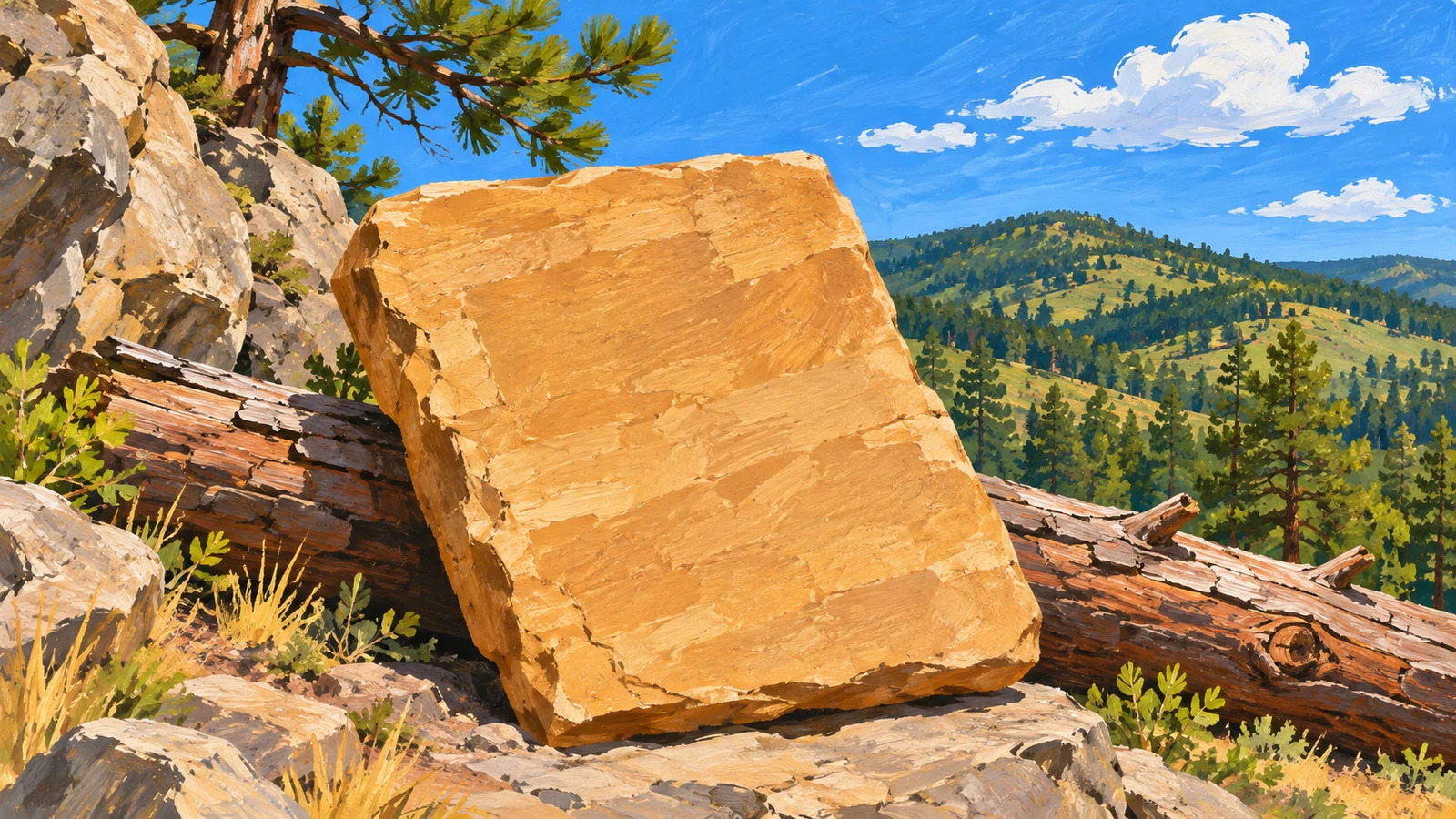
Another legend says he proved himself by moving the Naha Stone, a slab of about 5,000 pounds that now sits in front of the Hilo Public Library. Whoever could move it, the prophecy ran, would unite the islands. Whether a teenager really shifted two and a half tons of rock is a question best left to the legend. What he did next is history.
Through the 1780s and 1790s Kamehameha fought his way across the islands. In 1795 his forces took Oʻahu after the battle of Nuʻuanu, the most famous battle in Hawaiian history. Kauaʻi held out until 1810, when its ruler, Kaumualiʻi, agreed to join the kingdom peacefully and stayed on as a tributary king. For the first time, every major island answered to one ruler.
The sandalwood king: where the treasury came from
Here is the bit that makes a treasure story possible: Kamehameha was not just a warrior. He was a shrewd businessman, and the islands were sitting on something the outside world badly wanted.
That something was ʻiliahi, Hawaiian sandalwood. Merchants could sell its fragrant heartwood in China for serious money, priced by the picul (about 133 pounds). Around 1811, three Yankee captains, the brothers Jonathan and Nathan Winship and William Heath Davis, talked the king into giving them a ten-year monopoly on the trade. When they came back, they found him rather less friendly. He cancelled the deal and refused to renew it, and from then on the sandalwood was the king's to sell.
And sell it he did. One historian's estimate is that his monopoly could bring in $300,000 or more a year; another account puts a single year's take at $400,000. The figures are estimates and they don't agree, but either way it was a fortune for the time. Kamehameha also had the sense to see the forests would not last forever, and he placed a kapu (a ban) on cutting young trees.
In 1817 he decided to cut out the middlemen. He bought his own brig, named it Kaʻahumanu, and sent a cargo of sandalwood to China with Captain Alexander Adams. It was a bit of a disaster: port charges and brokers' fees ate the profit. So the king did what any sharp operator would do and started charging foreign ships instead. Every vessel anchoring in Honolulu's inner harbour now paid 80 Spanish dollars for the privilege. Brilliant.
The storehouses of Kailua, Lahaina and Honolulu
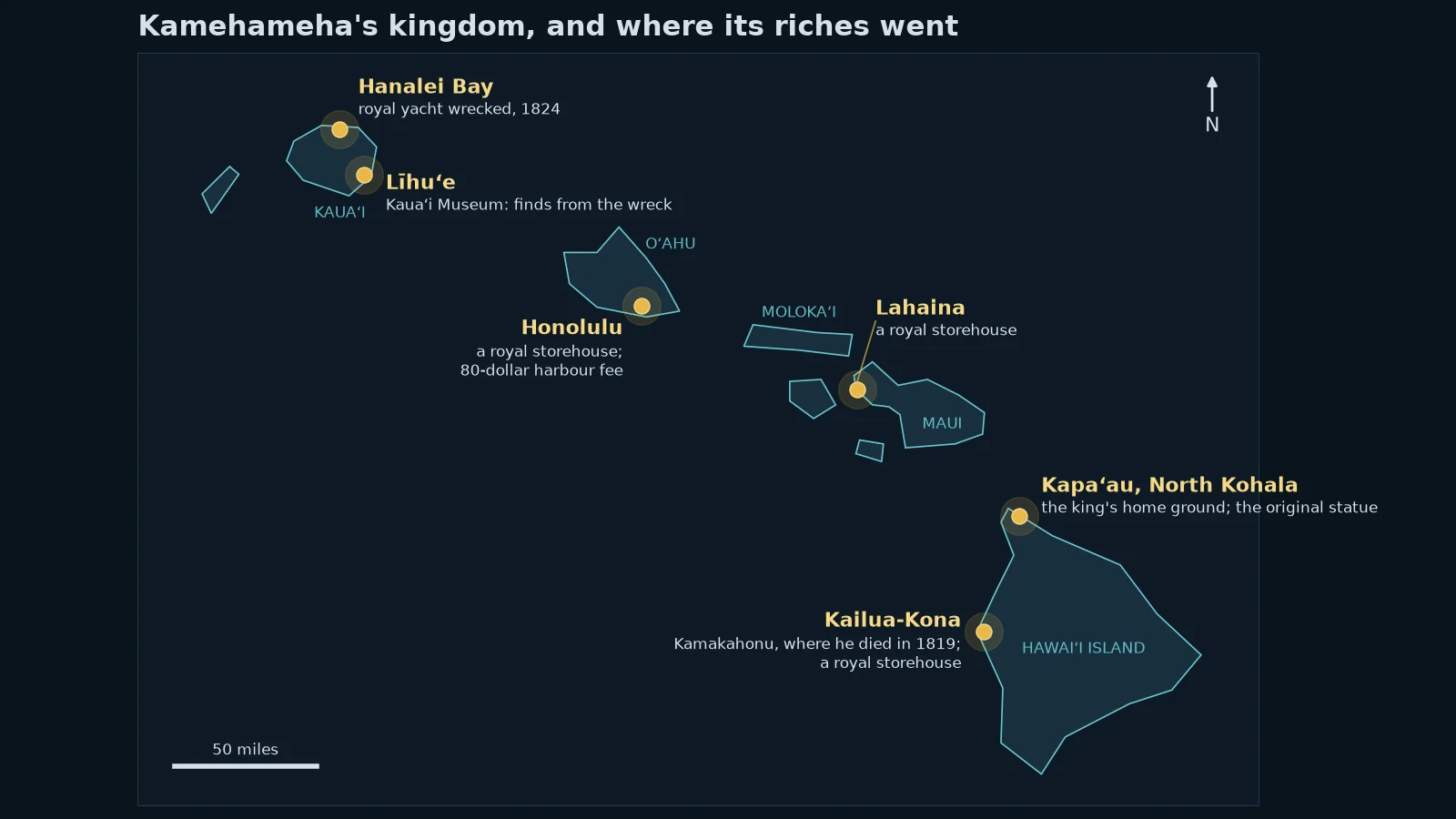
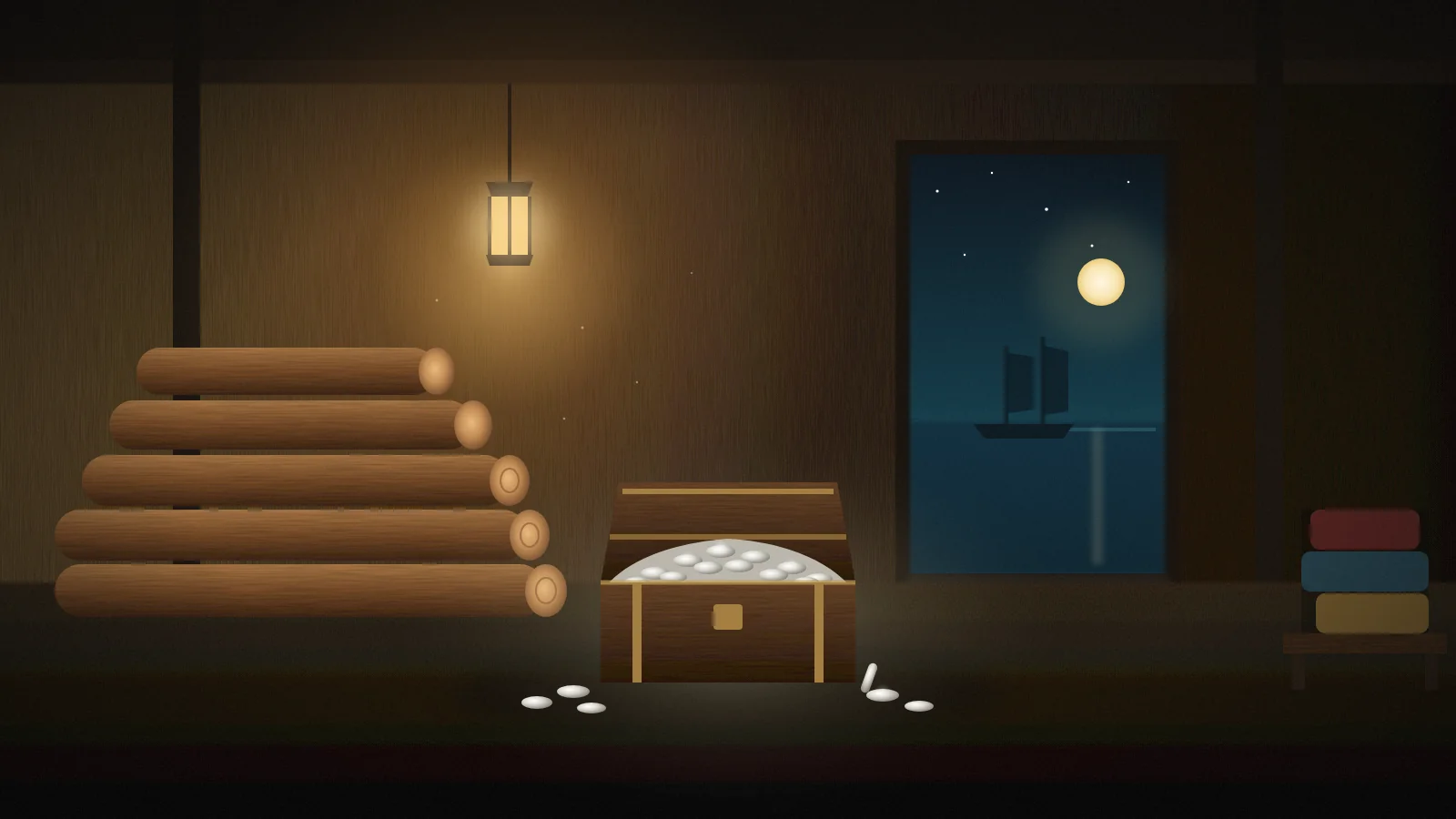
So where did all that wealth go? Into storehouses, for a start. Historical summaries describe the king piling up trade goods and large amounts of hard money, mostly through barter with foreign ships, and keeping them in storehouses at Kailua on Hawaiʻi Island, Lahaina on Maui and Honolulu on Oʻahu. He also built up a formidable fleet of double-hulled canoes and a number of small Western-style schooners, put together by European carpenters.
Picture it: silver dollars from the four corners of the Pacific trade, bolts of cloth, guns and powder, fine goods from China, all under royal guard. That is the "treasury" of the YouTube legend, and it was real enough. The mystery is what happened to it next.
The legend of the lost treasury
Popular treasure lists will tell you that Kamehameha hid a hoard during his reign: gold and silver coins, royal jewellery, ceremonial weapons, tucked away in secret caves somewhere on Hawaiʻi Island, often placed around Kohala or Waipiʻo Valley. Some retellings go further and claim he was buried with a fortune in gold and jewels.
Here's the catch, and it's a big one. None of this turns up in the historical record. The treasure-hoard version comes from modern travel and treasure-hunting pages that cite nothing at all, and serious accounts of the king's death and burial say nothing about gold going with him. The idea also misunderstands what mattered most. In old Hawaiʻi, the most precious royal possessions were things like feather cloaks and sacred objects, and the most precious thing of all, as you'll see in a moment, was the king himself.
The likelier answer to "where did the treasury go" is far less romantic, and it involves a shopping spree.
Where the money really went: a royal yacht on a reef
After Kamehameha died, his son Liholiho became Kamehameha II, and the sandalwood monopoly loosened as more chiefs got a share. The buying went into overdrive. Where the old king is said to have paid cash, the new court bought on credit, promising future sandalwood. By 1821 the debt owed to foreign merchants had reached about $300,000. In 1826 the kingdom brought in a sandalwood tax to pay it off, and the forests paid the price.
The most spectacular purchase of the lot was a ship. Cleopatra's Barge was a luxury yacht built in Salem, Massachusetts, in 1816, often called the first American ocean-going yacht built purely for pleasure. Kamehameha II bought it from the Boston firm Bryant and Sturgis for roughly $80,000 worth of sandalwood and renamed it Haʻaheo o Hawaiʻi, Pride of Hawaiʻi.
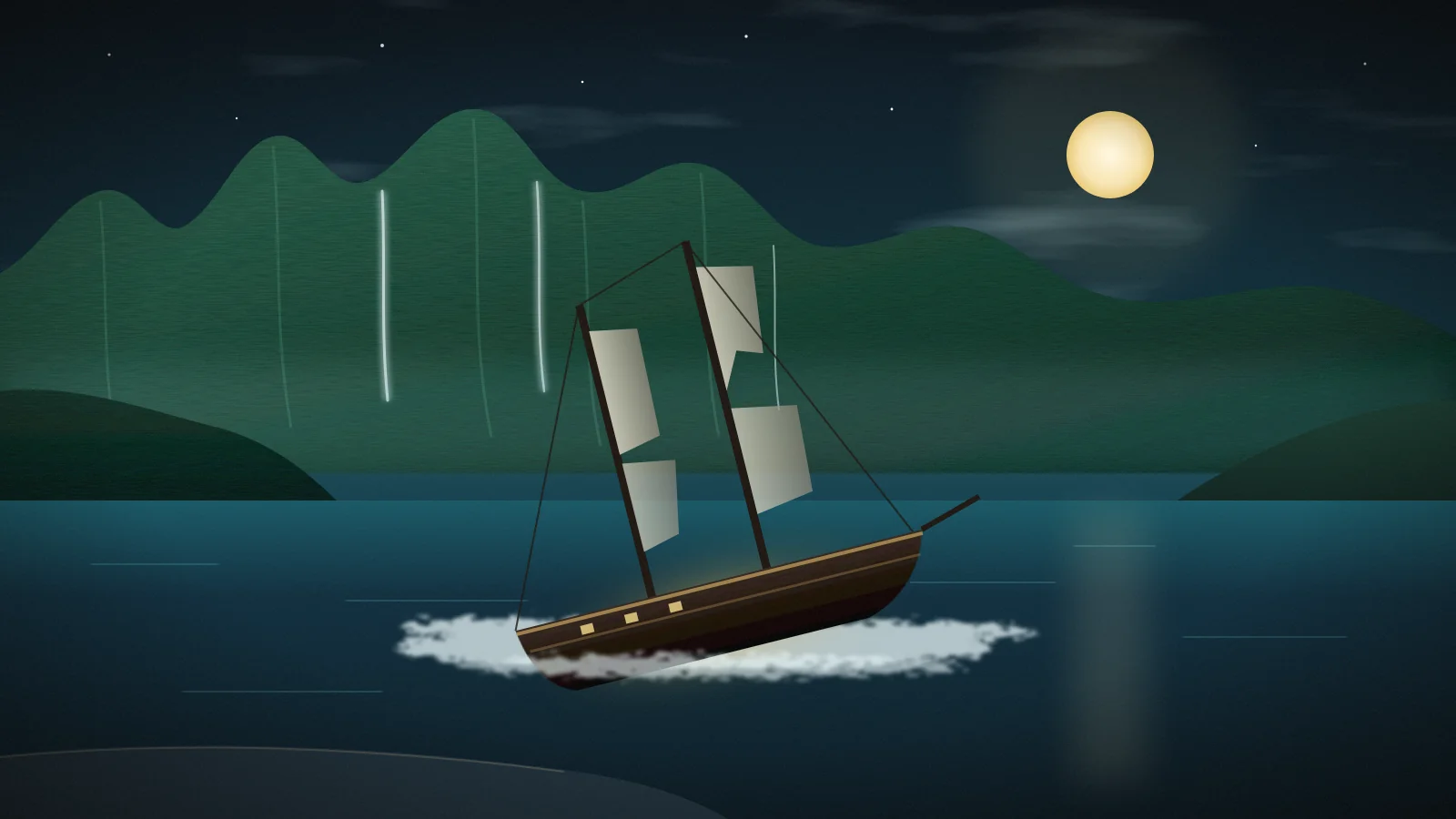
The pride lasted about three years. In April 1824 the yacht ran aground on the reef in Hanalei Bay on Kauaʻi and was lost, with royal belongings aboard. Salvage attempts failed and the sand swallowed the wreck.
Now for the part treasure fans will love. In 1994 Paul Johnston, a curator at the Smithsonian, was granted Hawaii's first underwater archaeology permit to look for the wreck. His team searched for a few weeks each year from 1995, and a couple of seasons in they found it under about ten feet of water and ten feet of sand. They brought up more than 1,000 artefacts: stone poi pounders, ballast bricks, ship fittings, and personal things of the king's, including a conch shell horn, ivory and coins. In 2015 the collection came home to Kauaʻi, to the Kauaʻi Museum in Līhuʻe.
So yes, a real royal treasure was lost in Hawaii, and part of it was found. It just wasn't buried in a cave by Kamehameha. It sank in a bay, paid for in his sandalwood.
The real mystery: the hidden resting place of Kamehameha
This is the part of the story that isn't a game, so it gets told straight.
Kamehameha died at Kamakahonu in Kailua-Kona in May 1819 (most accounts say May 8; a few give other dates). In Hawaiian belief, the bones, the iwi, carry a person's mana, their spiritual power, and the iwi of a great chief carried a great deal of it. Bones in the wrong hands could be dishonoured. So the iwi of high chiefs were hidden, and for Kamehameha the tradition followed was the strictest one, hūnākele: burial in total secrecy, the place never to be told.
Following the custom for a high chief, his bones were prepared and placed in a woven casket. The duty of hiding them went to two brothers and trusted advisers, Hoapili (born Ulumāheihei) and Hoʻolulu, sons of one of the chiefs who had helped Kamehameha to power. The historian Samuel Kamakau later wrote that the king had a reason to be careful: the hiding place of his own father's bones had once been pointed out to others.
The accounts agree on the essentials. The two men waited for a dark night and carried out their task in secret. Another 19th-century Hawaiian historian, David Malo, writing in 1839, credited their faithfulness to their sacred duty for keeping the place what he called "a profound secret". Beyond that, the stories differ, and nobody outside that small circle has ever known for sure. Hence the saying you will still hear across the islands: only the stars of the heavens know the resting place of Kamehameha.
The secret that was kept
The secret has held through some determined attempts to learn it, and the stories around those attempts say a lot about how seriously it was taken.
- A king is turned back. According to one account, years later Kamehameha III asked Hoapili to show him where his father lay. Hoapili set out, sensed they were being followed, and turned back. The place stayed hidden.
- A queen beside her king. One account says that when Kaʻahumanu, Kamehameha's favourite wife, died, her bones were quietly placed with his by the same trusted chiefs.
- King Kalākaua's search. In the 1880s King Kalākaua became keen to find his great predecessor. He is said to have had two sets of bones brought from a burial cave on Hawaiʻi Island to the Royal Mausoleum in Nuʻuanu on Oʻahu, believing one might be Kamehameha's. The details are sketchy, and most accounts still say the king's resting place is unknown.
- A modern claim. In 2022 a Hawaiʻi Island magazine published the account of a Native Hawaiian man who said that in 1983 he entered a burial cave in North Kona and believes he saw the king's remains. He said he had been raised to know such caves were forbidden. His belief has never been confirmed, and the land is now a protected site. Notably, his account mentions no gold or treasure of any kind.
Over the years, traditions and historians have named several places as possible resting places, on Hawaiʻi Island and on Maui, and most will probably never be confirmed. That is not a failure of history. It is exactly what Kamehameha asked for.
The theories, weighed
- A hidden royal hoard in a cave. The treasure-list favourite. The problem: no documents, no witnesses, no finds, and it first shows up in modern listicles.
- Buried with the king. Repeated online, backed by nothing. The accounts of his burial describe a woven casket and secrecy, not gold.
- Spent, traded and sunk. The dull but well-documented answer. The storehouses fed a new court that bought on credit, piled up $300,000 of debt, and lost a yacht worth some $80,000 in sandalwood on a reef in Hanalei Bay.
- The treasure was never the silver. In Hawaiian terms, the most precious thing Kamehameha left behind was his iwi and the mana they carry, and that treasure was hidden on purpose, to stay hidden.
Hawaiian burial sites and the law
Let's be absolutely plain about this. Kamehameha's resting place is not a treasure hunt, and no one should go looking for it or for any other burial site. To many Native Hawaiians, iwi kūpuna (the bones of ancestors) are sacred, and disturbing them is a deep wrong.
It is also against the law. Under Hawaii's historic preservation law, human remains that appear to be more than fifty years old, and the objects buried with them, may not be moved without the state's approval, and all burial sites are to be preserved in place. Island burial councils, which include Native Hawaiian members, decide what happens to known Native Hawaiian burial sites. Knowingly taking, digging up, damaging or altering a burial site or its contents is a crime, with fines of up to $25,000, and each day it goes on counts as a separate offence. If you ever come across what might be human remains in Hawaii, leave them exactly as they are and report them to the authorities.
Following Kamehameha's story in Hawaii today
Fancy a royal road trip instead? Splendid. There is plenty to see, all of it in plain sight.
- Kamakahonu, Kailua-Kona. The king's last home sits right on Kailua Bay, next to a restored temple, Ahuʻena Heiau, that you can see from the shore. Admire it from there; it is a sacred site, not a climbing frame.
- The original Kamehameha statue, Kapaʻau. Here is a lost-and-found tale with a happy ending. The first bronze statue of the king was cast in Europe and shipped in 1880, but the ship sank near the Falkland Islands and the statue was given up for lost. A second casting was ordered and now stands in front of Aliʻiōlani Hale in Honolulu. The original was later recovered (sources disagree on just when) and stands in Kapaʻau in North Kohala, near where the king was born.
- Kamehameha Day, June 11. The statues are draped in long flower lei in honour of the king.
- The Naha Stone sits in front of the Hilo Public Library. No moving it, please.
- The Kauaʻi Museum in Līhuʻe displays objects from the wreck of the Haʻaheo o Hawaiʻi, the closest thing to the royal treasury you can actually see.
The silver may be spent and the yacht may be firewood for the fish. But the king's last wish has been kept for more than two hundred years, and that may be the most remarkable treasure story in the islands.
...and if you find it, remember who encouraged your questionable life choices.
The short version of this story is on YouTube at @TenToeExpress.
Deep dive yourself
- Lost Tombs: Kamehameha I, King of Hawaii · Archaeology Magazine
- Only the Stars of the Heavens Know · Images of Old Hawaiʻi
- 3 Legends About Hawaiʻi's King Kamehameha · Hawaii Magazine
- The Story of ʻIliahi: Sandalwood, a Saga of Destruction and Rebirth · Ke Ola Magazine
- Sandalwood Era · Images of Old Hawaiʻi
- Kamehameha I · EBSCO Research Starters
- Hawaiian king's shipwrecked treasure returned to the Islands · Hawaii Magazine
- Lost Bones of Kamehameha · Ke Ola Magazine
- HRS §6E-43, Prehistoric and historic burial sites and §6E-72, Taking or damaging a burial site · Hawaii State Legislature
- Aloha Kamehameha Statue, Kapaʻau · Hawaii Tourism Authority (GoHawaii)