 Ten Toe Express

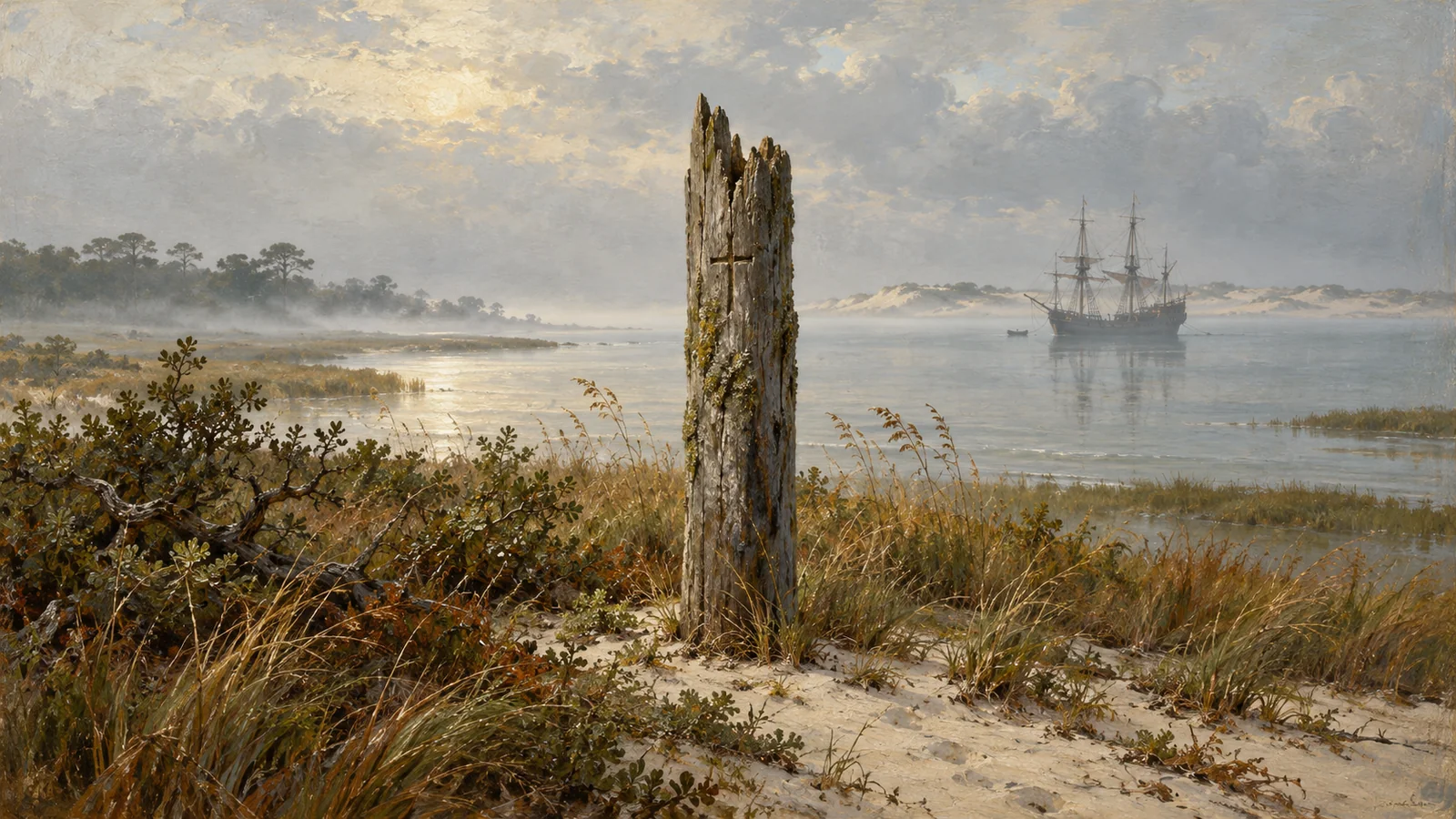
Picture a spring morning in the 1750s, somewhere in the hills of eastern Ohio. Ten French soldiers and a string of packhorses are picking their way along an old Native trail, and the saddlebags are heavy with the army's pay. Behind them, a British column is on the march. Ahead of them, a decision: bury the lot and run. That is the legend of the French payroll gold near Minerva, Ohio, and more than a century and a half of locals have been poking around fields, creeks and tree stumps trying to find it.
Right then. Here is what the legend says, what the records can actually back up, and why a quiet town in Stark County still throws a festival about a treasure nobody has ever found.
The Legend of the Lost French Gold in Minerva, Ohio
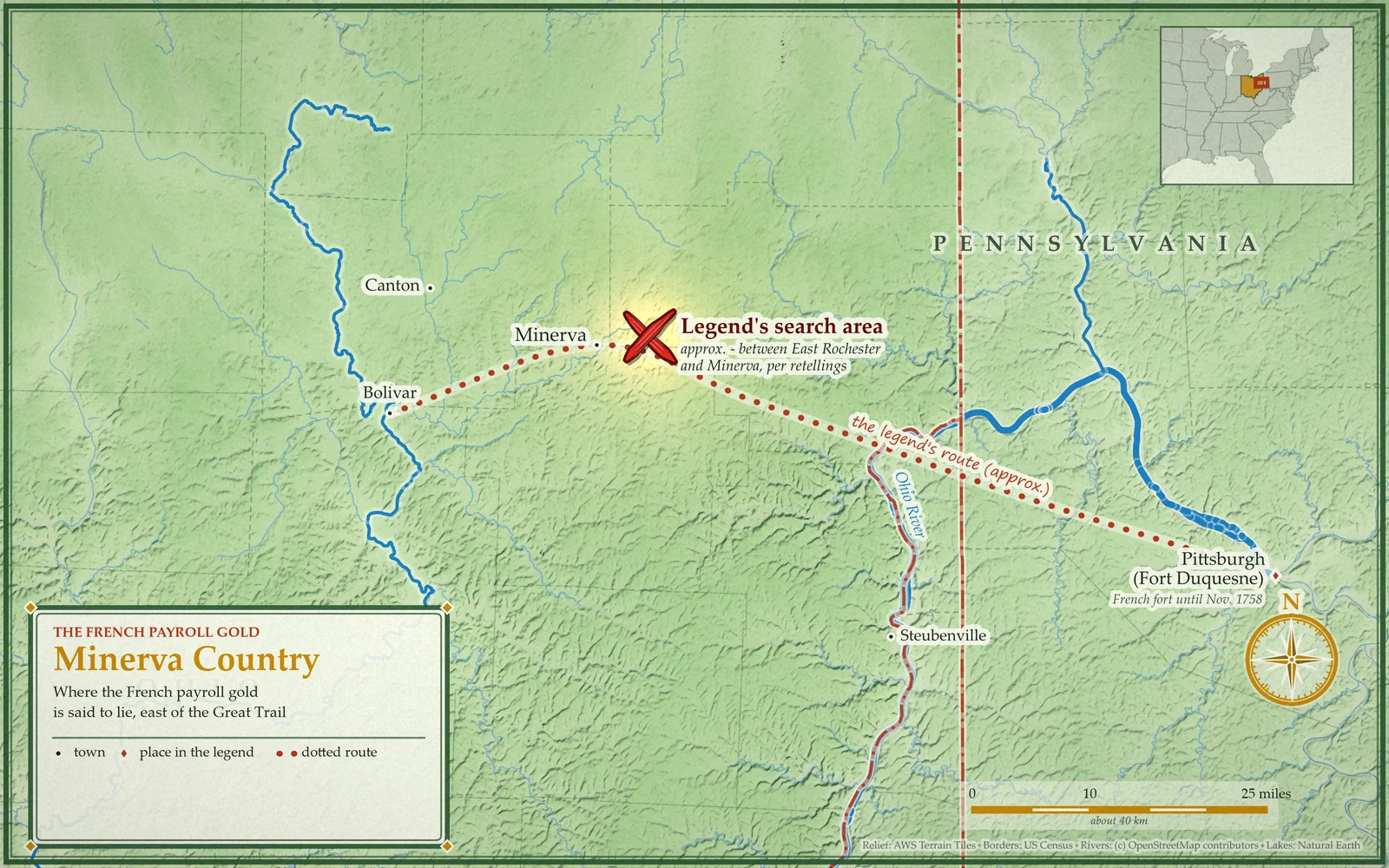
The story goes like this. The French held Fort Duquesne, where the Allegheny and Monongahela rivers meet to form the Ohio, in what is now downtown Pittsburgh. When British forces closed in, the French began shipping valuables west toward Fort Detroit. Retellings say the cargo was a military payroll in gold and silver, loaded onto packhorses (sixteen in some versions, ten in others) and escorted by ten men.
Their route, the tellers say, ran along the Great Trail, an old Native American path that crossed what is now Columbiana County toward Bolivar and on to Sandusky on Lake Erie. Their orders, if danger came, were simple: bury the treasure, mark the spot, and come back for it later.
Danger came. Within days of burying the hoard, the legend says, the escort was caught in a skirmish. Eight of the ten men were killed. Two got away, and neither ever came back with a shovel.
What the Records Say About Fort Duquesne
Here the legend runs into some awkward history, so it is worth separating the two.
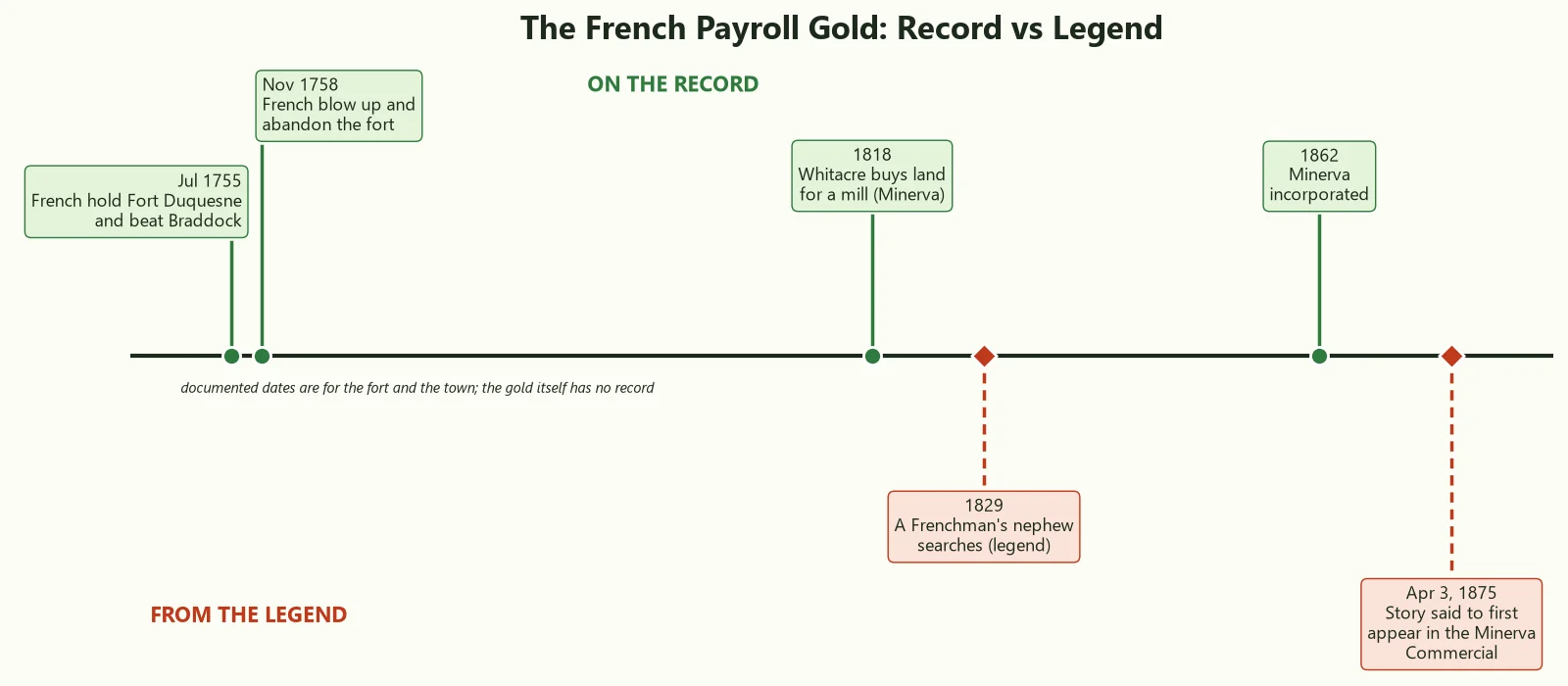
Fort Duquesne is real. The French held it, and in July 1755 they and their Native allies beat General Edward Braddock's British column at the Battle of the Monongahela, with a young George Washington serving as one of Braddock's aides. That is the "1755" some retellings use.
But there was no British assault that sent the French fleeing in 1755. The fort stayed French. The real end came in November 1758, when the much larger Forbes Expedition approached and the French blew up the fort and left on or about November 25. The British built Fort Pitt on the site between 1759 and 1761.
So the dates in the legend wobble. Some versions say the 1750s, some say the 1760s, one note says Braddock's 1755 campaign or Forbes's 1758 advance, and nobody can tell you which. No French or British record that these sources point to mentions a payroll buried near Minerva. That does not make the story false. It does mean the gold itself rests on local tradition, not on paperwork.
The Minerva Commercial and the Written Clues
If the gold has a paper trail, it starts late. Retellings say the legend was first printed in The Minerva Commercial on April 3, 1875. That is the date repeated in treasure-hunting circles, though a copy of the issue is not easy to find online, so treat the date as the story's own claim.
The village itself is much newer than the supposed burial. Minerva grew from a log mill that surveyor John Whitacre built after buying 125 acres in 1818. The town was established in 1833, named for his niece Minerva Ann Taylor, and incorporated in 1862. The canal and then the railroad fed it. Plenty of farmers were already working the land around it when the legend surfaced in print.
The Clues: A Carved Deer, a Rock in a Tree and Two Springs
The legend comes with a list of landmarks, which is generous of it. The details shift from teller to teller, but the core set runs like this:
- Two springs. One version names them as Beaver Hat Spring and Cranberry Spring. Another says the gold lies at the fork of three springs.
- A carved deer. A tree with a deer cut into its bark, about a mile east of the burial.
- A rock in a tree. A stone lodged in the fork of a tree, about half a mile west, near a spring.
- Buried shovels and a log. In some versions, shovels left as a marker, and a spot 600 steps north under a fallen log.
It is a lovely set of clues, and the way the tale handles them is its most charming feature. According to the retellings, a nephew of one of the escaped Frenchmen turned up in 1829 with his uncle's memorandum describing the cache. He searched, and found nothing. Neighbours kept digging for years. Then, the story says, the markers started turning up by accident between 1829 and 1875: a rock tumbled out of a tree fork when someone cut it for fence rails, a storm exposed a carved deer, someone found the buried shovels. Every landmark showed up. The gold did not.
An old tree that has lost its carving, a rock that conveniently surfaces and a nephew with a handy memorandum is exactly the kind of tale that grows in the telling. Local historians say as much with a shrug. Roger Bartley, a Minerva historian who has searched himself, told Ohio Cooperative Living that treasure hunters still come through a couple of times a year, and each arrives with a different theory.
Where Is the French Gold Said to Be?
Retellings narrow the search to a patch of Ohio countryside near the Stark, Carroll and Columbiana county lines, between East Rochester and Minerva. One version puts the spot near the southwest corner where Augusta and Ridge roads cross. Another says searchers now concentrate about four miles east of Minerva in West Township. The Great Trail's route toward Bolivar is the reason the story lives here at all, since a payroll heading west to Lake Erie and Detroit would have had to come this way.
The terrain does not help. The land is rolling, wooded in places, crossed by small streams, and mostly worked as farms or lived on as homes. Directions that rely on a particular tree standing 250 years after the fact are not exactly a GPS fix.
How Much Is It Worth?
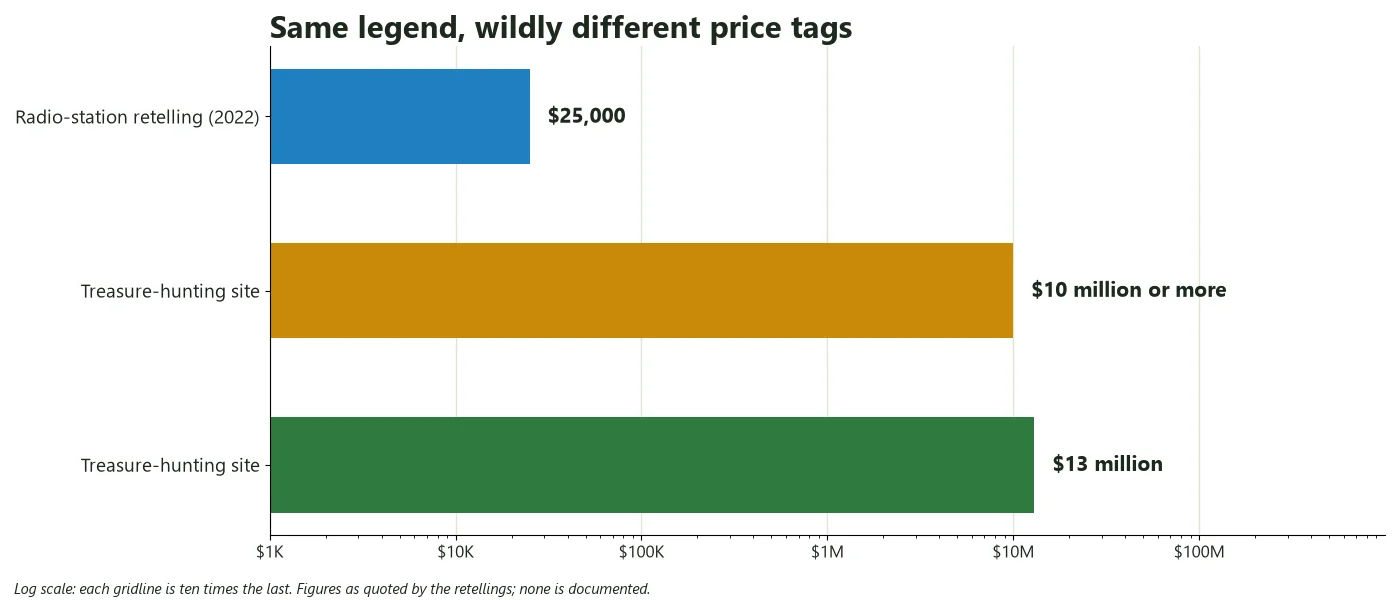
That depends entirely on which website you believe. A 2022 radio-station retelling says "more than $25,000". Treasure-hunting sites say $10 million or more, and one gives $13 million in today's money. The story has also been told with one ton of gold on ten horses, which is the sort of arithmetic that makes a packhorse file a formal complaint. None of these figures comes from an inventory or a record. They are guesses sitting on top of a legend.
Theories: Real Payroll, Tall Tale or Something in Between
You have roughly three options.
- It happened as told. A French escort buried a payroll on the Great Trail and the survivors never returned. The weakness is the lack of any independent record, and that the standard British-assault-on-the-fort timeline does not fit the history of Fort Duquesne.
- A kernel of truth. The French did move goods and soldiers along Ohio trails in these years, and the Great Trail was a real road. A scrap of memory about an escort, a skirmish or a cache could have grown into the full tale over a century of fireside retelling before reaching the newspaper in 1875.
- Folklore. A good story, passed around a small town, picks up springs, carved deer and nephews as it goes. That is how most buried-treasure legends work, and it does not make this one any less fun to chase.
The honest answer is that nobody knows. What can be said is that the landmarks in the story are the sort of thing a storyteller would add, and the gold in the story has never been seen.
Visiting Minerva Today
Minerva sits mostly in Stark and Carroll counties, with a sliver in Columbiana, and had 3,684 residents at the 2020 census. The legend is part of the town's identity, and the village holds a free Lost Gold Festival each year to celebrate it. That is the easy, friendly way to enjoy the story: go to the festival, talk to the locals and ask who has a theory.
The land where the gold is said to be buried is a different matter. Most of it is private farmland and homes, so no one should be digging there without the owner's say-so. Anyone chasing the story should stick to public roads and parks, and ask first.
...and if you find it, remember who encouraged your questionable life choices.
The short version of this story is on YouTube at @TenToeExpress.
Deep dive yourself
- Minerva, Ohio · Wikipedia
- Fort Duquesne · Wikipedia
- Great Trail · Wikipedia
- Legend of the Lost French Gold - OHIO · TreasureNet forum
- Treasure hunt · Ohio Cooperative Living
- Lost Treasures of Ohio · TreasureSeekr
- Lost Treasure of Gold in Central Ohio From The French & Indian War · 92.9 NiN