 Ten Toe Express

Right then. Picture Missouri in the 1870s: a farm boy turned guerrilla turned train robber, a few thousand dollars at a time, riding out of the hills with the law three counties behind him. Then picture the money. Jesse James's buried loot is the sort of legend that practically builds itself, because everybody knows he robbed a great deal and almost nobody can say where it went.
The story goes that the James gang buried a fortune somewhere in Missouri, in a cave in the Ozarks, or under an oak near the family farm in Clay County, and that it's still down there, waiting for someone with a shovel and bad judgment. The records tell a rather less glittering tale. Fancy a look at both?
Who was Jesse James, and why would he bury anything?
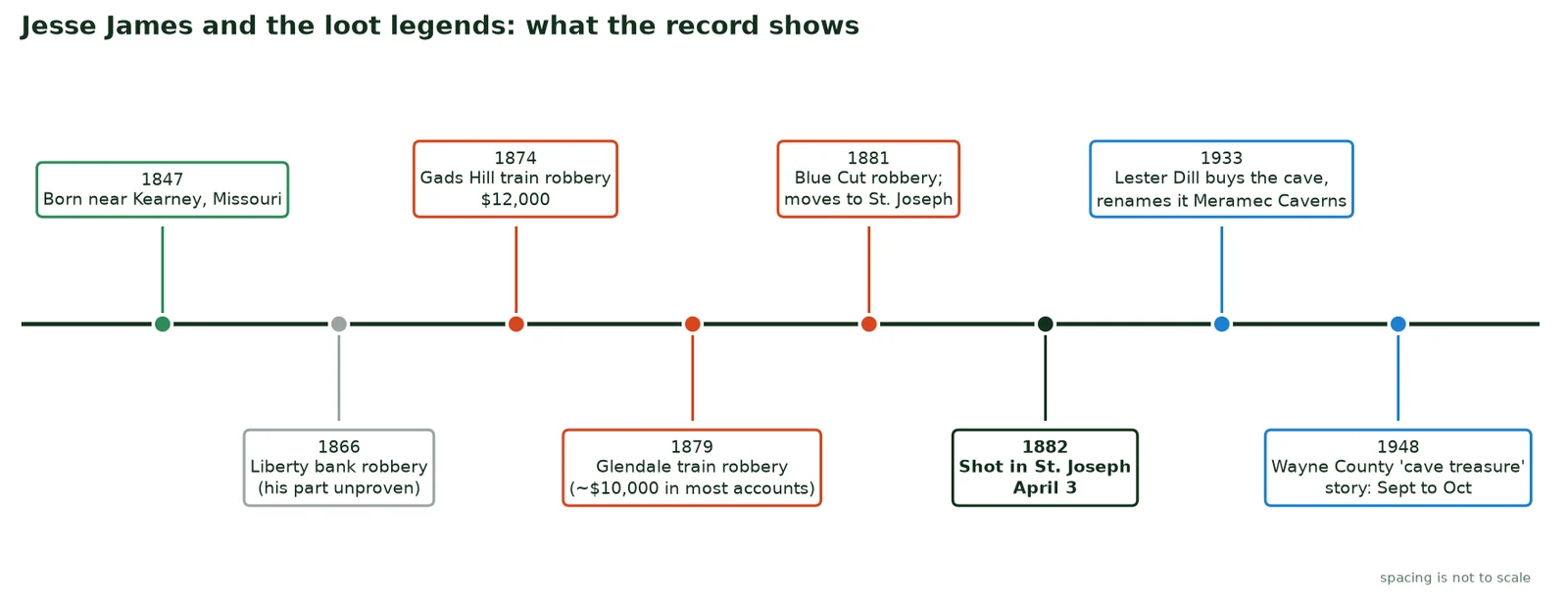
Jesse Woodson James was born on September 5, 1847, near Kearney in Clay County, Missouri. His family's farm there is still standing, and it's now a county-run museum. The Civil War found him as a teenager riding with pro-Confederate guerrillas, and in 1864 he was with William "Bloody Bill" Anderson, who was killed in an ambush that October.
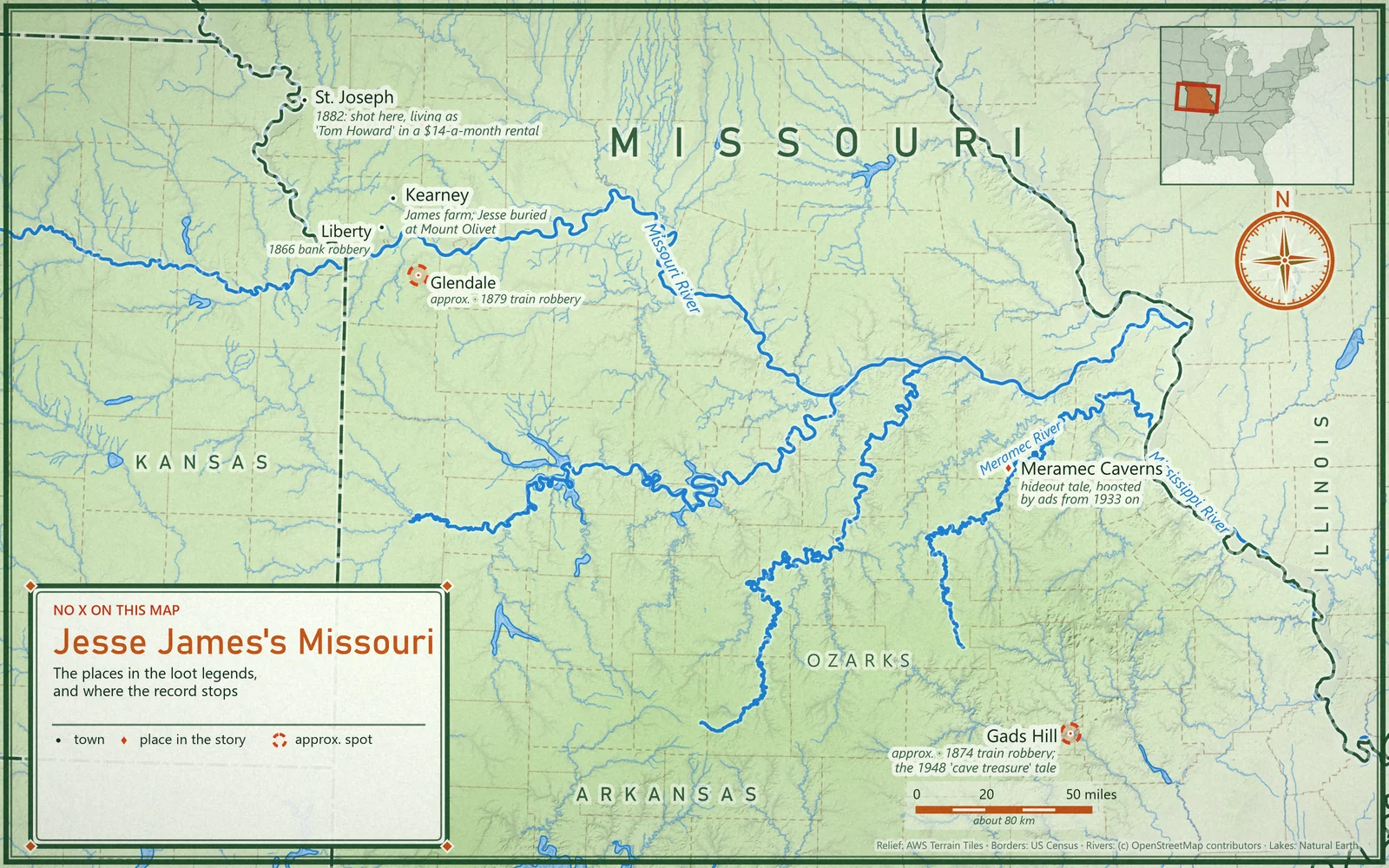
After the war came the robberies. On February 13, 1866, the Clay County Savings Association in Liberty was robbed in what's often called the first peacetime daylight armed bank robbery. Whether the James brothers actually took part is unclear: historians can neither prove nor rule it out. What matters for treasure hunters is that Clay County became the outlaw's home turf, and a hiding place near Kearney and Liberty is exactly where the legend likes to put the loot.
The robberies: what the gang actually took
Here's where the legend meets the ledger. The numbers matter, because a buried fortune has to come from somewhere.
Gads Hill, January 31, 1874
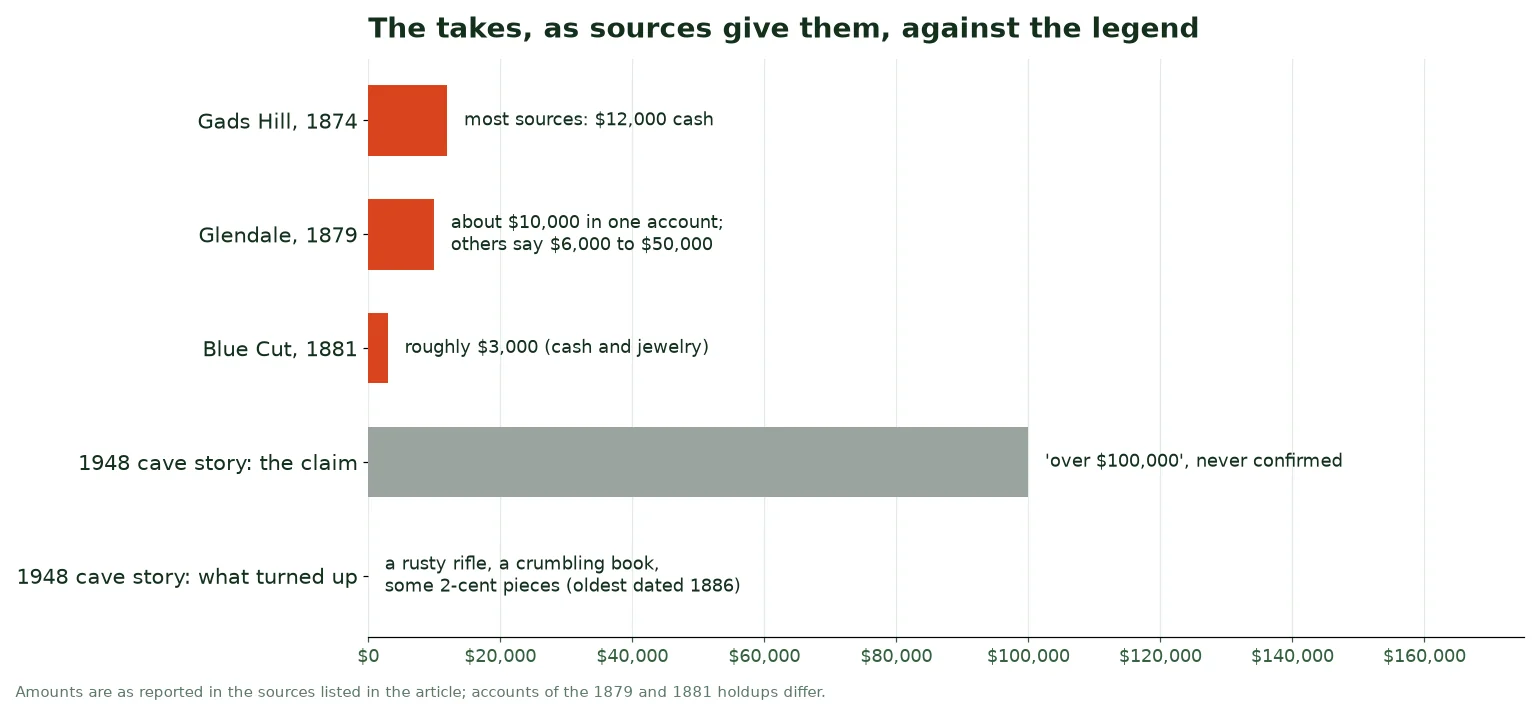
Five men, believed to be Jesse and Frank James and Cole, Jim and John Younger, rode into the tiny settlement of Gads Hill in Wayne County. They held the townspeople in the general store, piled up a bonfire on the tracks and waved a red flag to stop the evening train. They robbed the passengers and broke open the safe, and the standard figure for the take is $12,000 in cash. All five got away. The Pinkerton National Detective Agency set about chasing them, and in March 1874 John Younger was killed in a shootout in St. Clair County, Missouri.
Glendale, October 8, 1879
The gang stopped a Chicago and Alton train near Glendale, east of Kansas City. Sources can't agree on the haul: one account says about $10,000, another says as much as $40,000, and Dick Liddil's story, as told by HistoryNet, puts it at anywhere from $6,000 to $50,000. Liddil, a gang member, later said his own share came to just over $1,000. He got engaged the next evening and married three weeks later. On his wedding night he had $2,000, and the happy couple went through it in a couple of weeks. That is the sound of money being spent, not buried.
Blue Cut, September 7, 1881
Nearly two years later the gang hit another Chicago and Alton train at Blue Cut, near Glendale, for roughly $3,000 in cash and jewelry. Estimates vary, but nobody makes it a king's ransom.
The money trail runs the wrong way
Here's the awkward bit for anyone hoping for a hoard. In September 1879, according to Liddil, Jesse approached him for help because he needed money. In November 1881 Jesse moved his family to St. Joseph, Missouri, and lived there under the name Tom Howard, in a small home on a hill above the city, at 1318 Lafayette Street. The house was a rental: he paid a city councilman $14 a month. He'd also failed to buy a farm in Nebraska, was short of cash, and was lining up a robbery of the Platte City bank, which is hardly the behavior of a man sitting on a buried fortune.
On April 3, 1882, Bob Ford, a recent recruit tempted by a $10,000 reward on Jesse's head, shot him in the back of the head while he stood on a chair straightening a picture. After the killing the family was reportedly destitute and had to auction off most of what they owned. Whether Jesse stole from the rich and gave to the poor, or simply kept it all, is something St. Joseph's own city history admits was never settled. The director of the Jesse James House museum takes the blunter view: he stole from everybody and kept it. Kept it where, though? Nobody in the record says.
The legend: where Missouri's buried loot is "supposed" to be
The stories that followed fall into three camps.
- Clay County. A popular rumor places the cache near the James family farm, or near the towns of Liberty and Kearney. A treasure-hunting list repeats it, with a value of up to $10 million, but it doesn't name a source for any of that. Treat it as the kind of story that sounds right because the outlaw was from there.
- The Wayne County hills. The long-told local legend says the gang buried all or part of the 1874 Gads Hill loot in the Ozarks near the robbery site. There's no document behind it.
- Meramec Caverns. Not exactly a treasure legend, but a hideout one. More on that below.
Other states have their own Jesse James cache stories too, but this article sticks to Missouri, where the man was actually born and buried.
The 1948 cave: when the treasure hit the front pages
Early in September 1948, a woodcutter in Wayne County, Missouri, found the mouth of a cave while cutting timber. According to the HistoryNet account by Ronald H. Beights, he told a neighbor in mid-September. The neighbor remembered the local legend about the gang burying loot in those hills, and the story took off. The woodcutter went back in with a flashlight and entered a room in the cave.
What happened next is a masterclass in how a treasure story grows. The first reports had paper money, a hatful of old coins and a muzzleloading rifle. A "so-called reliable source" put the haul at more than $100,000 and said he'd seen $10,000 in old gold coins. Big-city reporters flocked to the village. Two U.S. Treasury Department agents reportedly came to look. An armored vehicle was said to be parked at the woodcutter's house.
Then it unraveled. What the cave actually held, per the same account, was a crumbling book, a rusty rifle with a rotten, worm-eaten stock and a few 2-cent pieces. The oldest coin was dated 1886, four years after Jesse was killed. The woodcutter himself said he'd only ever mentioned finding the gun and a few coins. On October 8, 1948, the St. Louis Globe-Democrat ran a final article mocking the whole business under the headline "Jesse Fizzles Again". The armored vehicle and the Treasury visit were never confirmed.
Meramec Caverns: the hideout that advertising built
Down in Franklin County, near Sullivan and Stanton, sits Meramec Caverns, and it wears the Jesse James name proudly. The cave runs more than four and a half miles, and the French mining director Philip François Renault explored it in the 1720s hunting for precious metals. He found trace amounts at best. What the cave really offered was saltpeter, an ingredient of gunpowder. In the Civil War the Union Army worked it until Confederate guerrillas destroyed the operation. Jesse James may have been among them, but sources can't confirm it.
Lester Dill bought the property in 1933, renamed it Meramec Caverns and opened it as a tourist attraction. He tied it to Jesse James in his advertising, claiming it as one of the gang's hideouts. In 1941 a drought dropped the water table and revealed new openings, and Dill announced artifacts he linked to the outlaw. James scholars dispute the link, and the sources say there's little documentary proof that Jesse ever used the place. Local tradition, an ad campaign on barn roofs in fourteen states, and one very good bumper sticker did the rest. No loot has ever been tied to the cave.
The theories, weighed
- Buried near Clay County. Possible in the sense that anything is possible, but the sources behind it are thin and the money trail points the other way. Jesse's last months look like those of a man who needed cash.
- Buried near Gads Hill. The local tale is old, but the one famous "discovery" turned out to be a rifle and some coins newer than the outlaw. Also, Gads Hill paid $12,000, split among five men.
- It was all spent. This is the dull answer, and it fits the documents best. Liddil's share of one big robbery was burned through in weeks. Spread a few thousand dollars across a gang, their families, the lawyers, the hiding and the horses, and there isn't much left to bury.
- Somebody found it and kept quiet. Always possible, never provable.
One last bit of Jesse folklore worth a raised eyebrow: a 2009 History Channel documentary, Jesse James' Hidden Treasure, which a historian dismissed as pseudo history, and which dabbled in the idea that he'd faked his death. In 1995 his remains were exhumed and tested with mitochondrial DNA, and the results were consistent with a female-line relative of James, so the man in the Kearney grave appears to be who the stone says he is.
Where it stands today
The Jesse James Farm and Museum is at 21216 James Farm Road in Kearney. The county operates it as a house museum, and the site is listed on the National Register of Historic Places. The farmhouse has a long history of its own: after Jesse died, his mother Zerelda buried him near the house and reportedly sold rocks from the grave for 25 cents each. He was later moved to Mount Olivet Cemetery in Kearney. Hours and admission change, so check before you go.
Meramec Caverns, at Sullivan, Missouri, is a working tourist cave you can tour in the normal way. The Ozark hills of Wayne County and the farmland of Clay County, meanwhile, are mostly private property, so the legend is best enjoyed from the road, the museum or a good chair.
That's the thing about the buried-loot legend: the search is the part that has survived. The man who supposedly hid a fortune died renting a $14 house under a fake name, and the best-documented treasure hunt in his name ended in a headline making fun of it. The mystery is not so much where the money is, as whether there ever was any to find.
...and if you find it, remember who encouraged your questionable life choices.
More lost treasure and legends on YouTube at @TenToeExpress.
Deep dive yourself
- Jesse James' Hidden Treasure · HistoryNet
- Jesse James · Wikipedia
- Gads Hill Train Robbery · Wikipedia
- The James Gang of Missouri · Legends of America
- James Andrew "Dick" Liddil: Riding With the James Gang · HistoryNet
- More About the Legend · City of St. Joseph, Missouri
- Meramec Caverns · The Clio
- Jesse James Farm · The Clio
- 15 Real Treasures Hidden In Missouri Waiting To Be Revealed · Rock Chasing