 Ten Toe Express
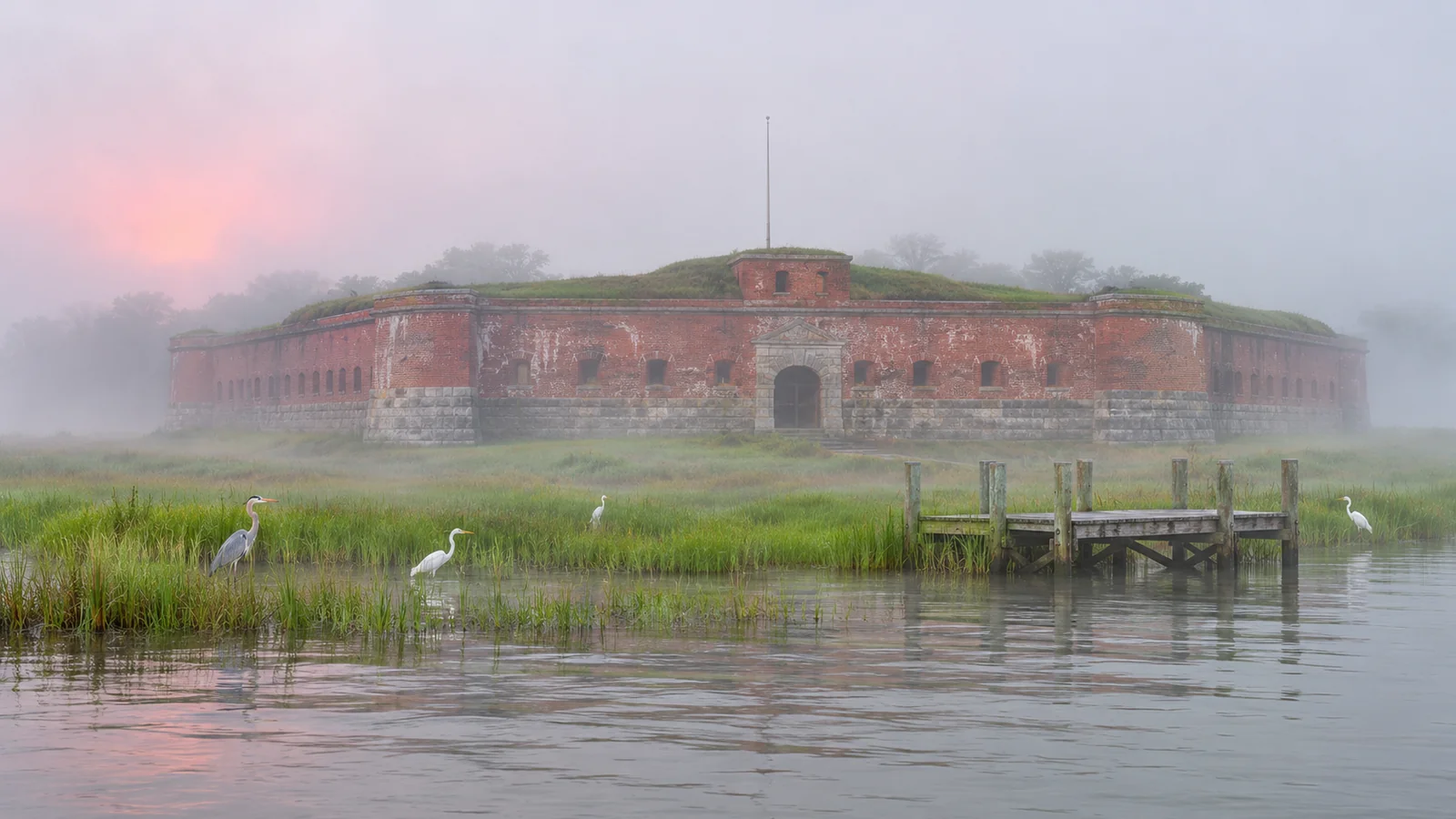
Right then, picture a brick fort sitting in the middle of the Delaware River, wrapped in fog, with nobody on the island and nobody at the controls of the generator. Now picture a barge captain passing at night and spotting lights on inside. That is one of the stories told about Fort Delaware, the Civil War prison on Pea Patch Island in Delaware, and it is only the opening act.
Fort Delaware is one of the most talked-about haunted places on the Atlantic coast. It held tens of thousands of Confederate prisoners, thousands of them died there, and the stories of what lingers have been told by staff, visitors, authors and television crews for decades. None of it can be proven, so here is the sorting job: what the records show, what the legend says, and what you can actually go and see for yourself.
Pea Patch Island: a fort on a sandbar nobody could agree on
The island itself comes with a legend. The story goes that a boat carrying peas ran aground in the shallows of the Delaware River, the wet peas sprouted, and their roots trapped sand and silt until a bar became an island. It is a charming tale and nobody should bet money on it, but it explains the name.
The real history is almost as odd. The engineer Pierre Charles L'Enfant, the man who laid out Washington, D.C., spotted the island as a strong defensive position in 1794. A New Jersey man, Dr. Henry Gale, used it for hunting and reportedly turned down a $30,000 offer from the Army. Delaware ceded the island to the federal government in 1813 and Gale was pushed out. Then the lawyers arrived. A descendant of Gale challenged the title in 1838, and about a decade of litigation followed until an arbitrator ruled in January 1848 that the island had belonged to Delaware all along.
Building on it was no picnic either. The soft island mud made foundations a nightmare, and an earlier star-shaped fort was badly damaged by a fire on February 8, 1831, and torn down in 1833. The fort you can visit today is a pentagon of brick and granite begun in 1848, built on a deep pile foundation with more than two million bricks. It was meant to guard the river approaches to Wilmington and Philadelphia. It never fired a shot in anger.
How a harbor fort became a prison
When the Civil War began, the fort took on a job nobody had designed it for. It became a Union prison for Confederate prisoners of war, plus convicted Union soldiers, political prisoners and privateers. Officers were generally held inside the fort, where conditions were better. Most other prisoners lived in wooden barracks outside the walls, on reduced rations. A barracks nicknamed the "bull pen" went up in 1863.
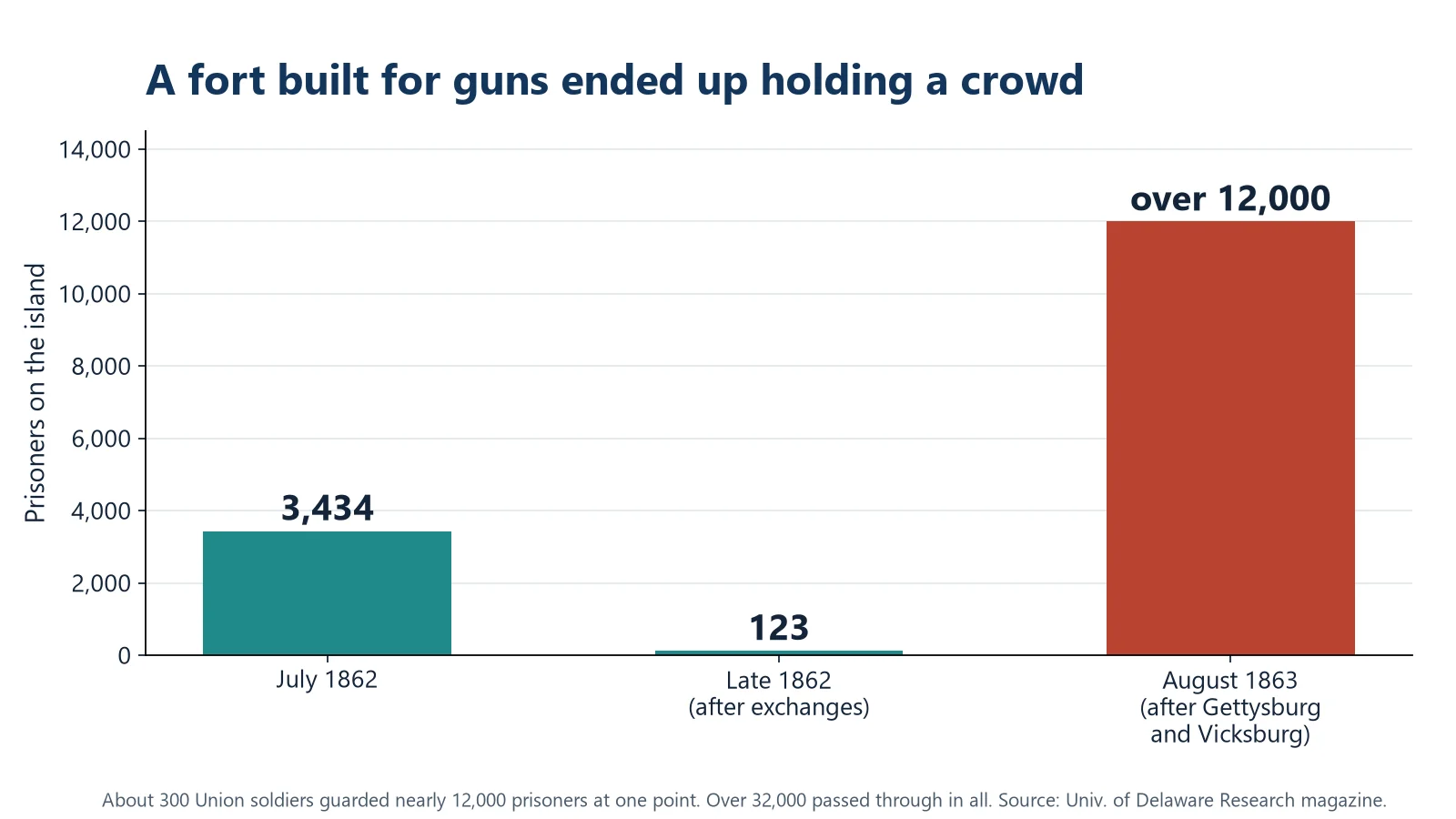
The numbers swung wildly. The fort held 3,434 prisoners in July 1862, then only 123 later that year after prisoner exchanges. After Vicksburg and Gettysburg in the summer of 1863, the island was packed with more than 12,000. At one point about 300 Union soldiers were guarding nearly 12,000 prisoners. Nearly all the Confederates captured at Gettysburg passed through here. Over the war, about 33,000 men were held on the island.
The dead of Fort Delaware
This is the plain, sad part. Crowding, heat and cold, lice, bad drainage and disease did their work, and smallpox, diarrhea and lung disease were the leading killers. Sources put the Confederate prisoner deaths at roughly 2,400 to 2,900, with about 2,500 the figure most often given; one source says half the deaths came during a smallpox epidemic in 1863. Around 109 Union soldiers and about 40 civilians also died on the island. Confederate prisoners compared the place to the Black Hole of Calcutta.
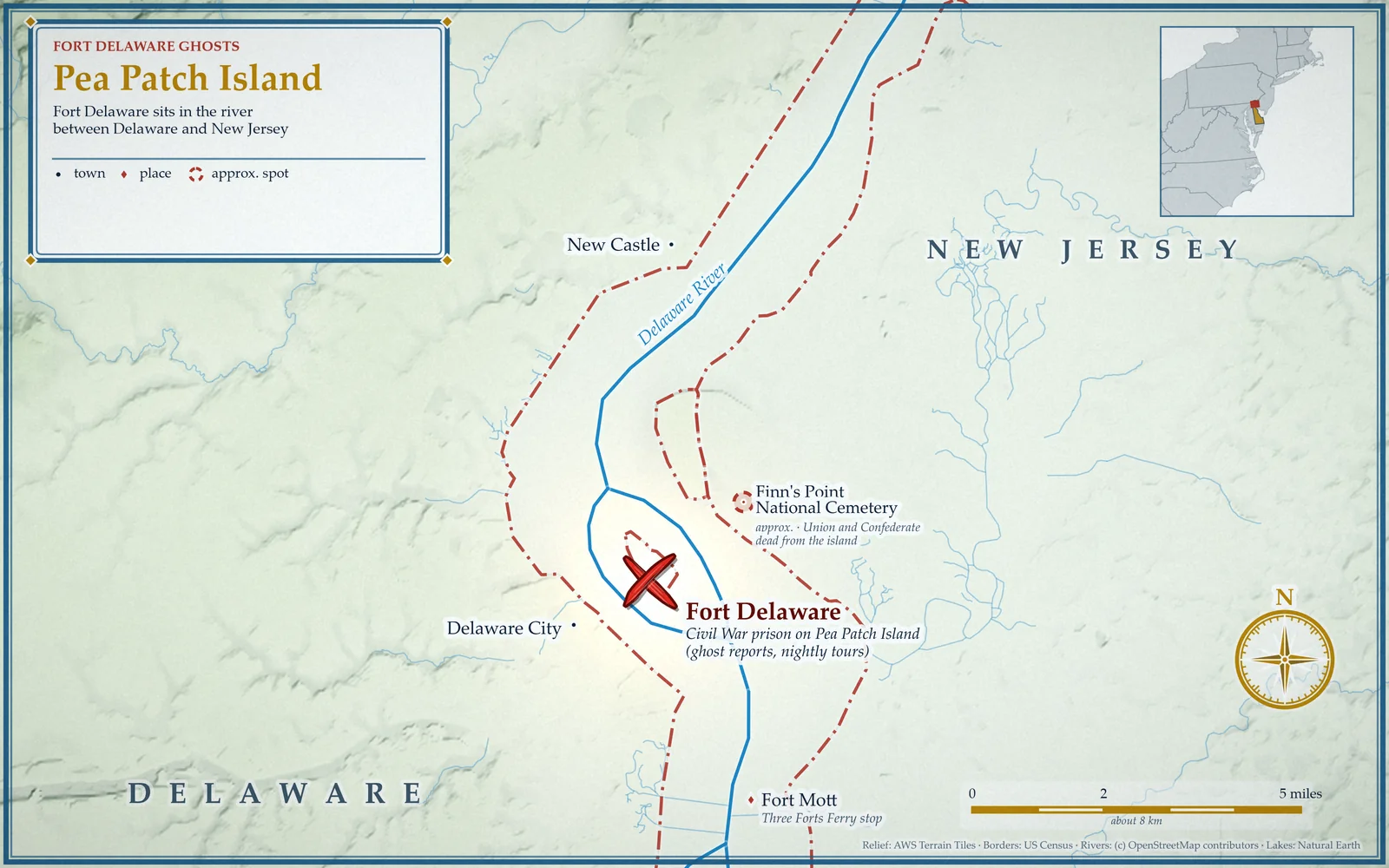
There was little room to bury anyone on the island. Many of the dead lie across the river at Finn's Point National Cemetery in Pennsville, New Jersey, after remains from the island were moved there in the 1870s.
One piece of history belongs here because it shows how bitter the war was. On August 20, 1864, 600 Confederate officers were moved from Fort Delaware to Morris Island, South Carolina, in retaliation for the treatment of Union prisoners. History remembers them as the "Immortal 600."
Escapes, real and legendary
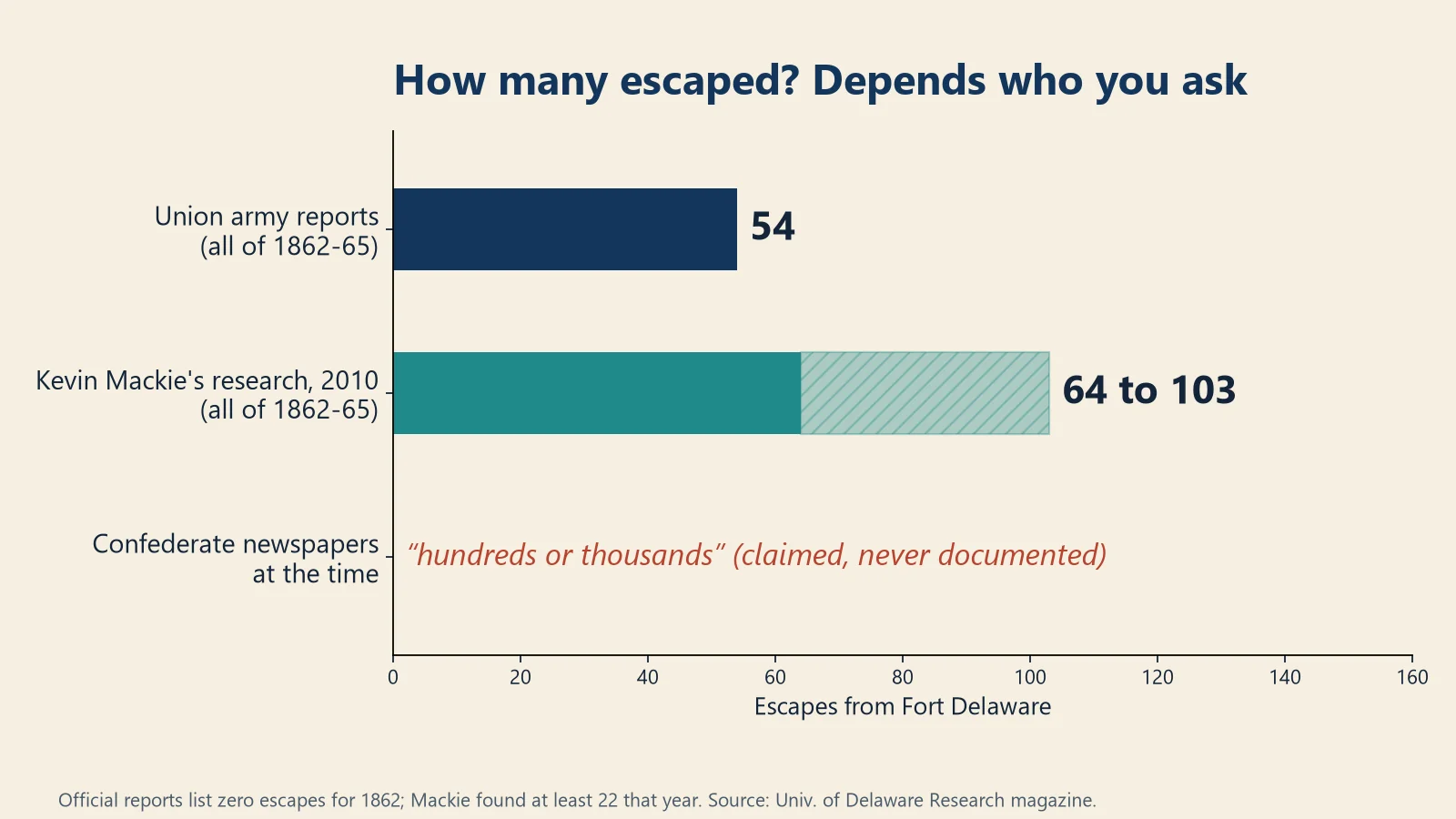
Escaping from an island in a wide, cold, tidal river is a proper bad idea, and plenty of men tried it anyway. Official Union reports count 54 escapes. A 2010 study by University of Delaware history graduate Kevin Mackie, written for the park, estimates somewhere between 64 and 103, and found at least 22 in 1862 alone, a year the official reports list as having none. Confederate newspapers claimed hundreds or even thousands, which historians put down to propaganda and sloppy wartime record keeping.
The documented methods are wonderfully inventive: men impersonating Union soldiers, using canteens as life preservers, hiding on a coal boat, bribing a guard, and crawling out through privies and sewers. One prisoner reportedly hid in a coffin from the prison hospital, escaped once it reached New Jersey, and rowed home. A Florida prisoner was said to have skated away over the frozen river in the winter of 1863 to 1864, though that comes from a family account, so treat it with a raised eyebrow.
Then there is the legend, which is darker: that 52 prisoners drowned trying to swim the roughly mile to shore. It is told at the fort, and it is legend rather than record. The tale lives on in a modern way, too, as an annual triathlon whose swim recreates the escape.
The ghost stories of Fort Delaware
The Fort Delaware ghosts are a mixed bag, and not all of them are soldiers. Here is what gets reported, always as reports and never as fact.
The Kitchen Ghost and the Lady in Black
The most famous resident is a woman said to haunt one of the officers' kitchens, especially the pantry. Stories collected from people who have worked there say she hides things (two cooks looking for cinnamon found it later on the shelf where it belonged), says the names of people entering the pantry and tells them to get out. In one tale, five or six women cooking a big meal saw an unfamiliar woman look over their food, grin, and walk through a wall. They left and would not come back that day. The University of Delaware Library, describing author Ed Okonowicz's book on the fort, mentions staff meeting a "Lady in Black" who stalks the kitchen.
The upstairs rooms
On the second floor of the officers' quarters there are reports of a child tugging at the clothing of people working in the rooms, and of children laughing when no children were on the island. Staff waiting in the parlor have reported taps on the shoulder from nobody. Books fall for no reason, and crystals hanging from candlesticks on the mantel have swayed with no breeze. In the old laundry area, a woman ghost reportedly threads needles for people lounging about and strings loose buttons together. Harmonica music has been heard outside the room with no source, and guessed to be an old soldier.
The powder magazine and the stairwell
Staff and visitors say they have heard swearing in an old-fashioned style in the powder magazine, said to be a soldier hunting for gunpowder and not finding any. Witnesses often cannot recall the exact words. In a stairwell in the later Endicott-era section, closed to the public, staff reportedly feel their clothes tugged as if someone wants them to tumble down the stairs.
Lights on the river
The tale that began this article: boats and barges on the river at night have reportedly seen lights on in the fort when nobody was there and the generator was off, and a figure standing on top of the fort as if on guard. These are unattributed stories, the sort that get better with each telling.
Television and photos
The fort has been featured on Ghost Hunters (including a Halloween 2008 broadcast), Ghost Hunters Academy and Most Haunted. The park's own ghost-tour guides say Ghost Hunters investigators reported hearing cannon fire, seeing a figure on a thermal camera and feeling a touch. A visitor photographed a blurry blue figure in a doorway, the so-called "blue man." Blurry photos and thermal blobs are the kind of thing that makes a skeptic's eyebrow climb, but they are part of the story, so there they are.
So, haunted or not?
The honest answer is that nobody knows, and nobody can. What can be said is that the setting is a perfect storm for ghost stories: a remote island, thousands of deaths in a few years, a fort with dark corridors and drafty rooms, and a long line of staff and visitors who have spent time there after dark. Skeptics would point to imagination, expectation and old-building noises. Believers would point to how many people have reported similar things in the same rooms. The documented history is solid. The ghosts are legend, and the legend is part of why people take the boat.
Visiting Fort Delaware today
Fort Delaware State Park covers all of Pea Patch Island and is run by Delaware's DNREC. You get there by seasonal ferry from Delaware City, or by the Three Forts Ferry from Fort Mott State Park in New Jersey, then ride a jitney from the dock to the fort. Costumed staff and volunteers portray Civil War-era people, and a Columbiad gun is fired daily. The north end of the island is a protected rookery for herons, egrets and ibises, which is a lovely and slightly absurd contrast with everything above.
The fort was added to the National Register of Historic Places in 1971. After it was declared surplus in the 1940s it passed to the State of Delaware, and it became a state park in 1951. Volunteer group Diamond State Ghost Investigators runs fall ghost tours with EMF meters, dowsing rods and audio recorders. The tours reportedly sell out months in advance, and the group encourages visitors to come back in daylight, too. It is a state park with set tours and visiting hours, so go the proper way, by boat and by ticket.
...and if you find it, remember who encouraged your questionable life choices.
The short version of this story is on YouTube at @TenToeExpress.
Deep dive yourself
- Fort Delaware · Wikipedia
- Unveiling Delaware's Dark Secrets: Exploring the Haunted Fort Delaware and Beyond · Delaware DNREC
- View from the Vault: Civil War Ghosts at Fort Delaware · University of Delaware Library
- Escape from Fort Delaware · University of Delaware Research
- Pea Patch Island · Delaware River Basin Commission
- Fort Delaware · The Clio
- Ghosts at an American Civil War Fort · Castle of Spirits