 Ten Toe Express
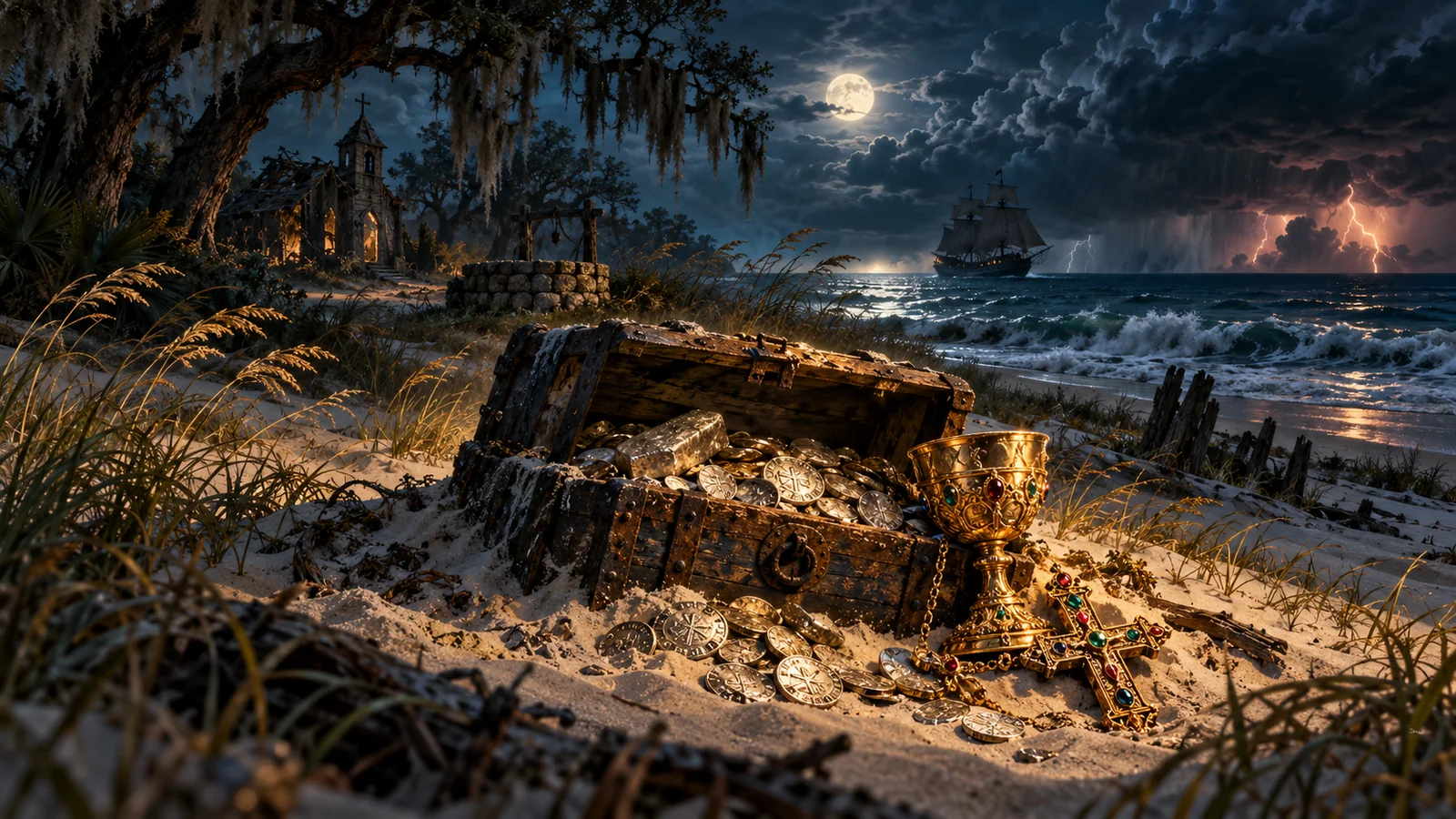
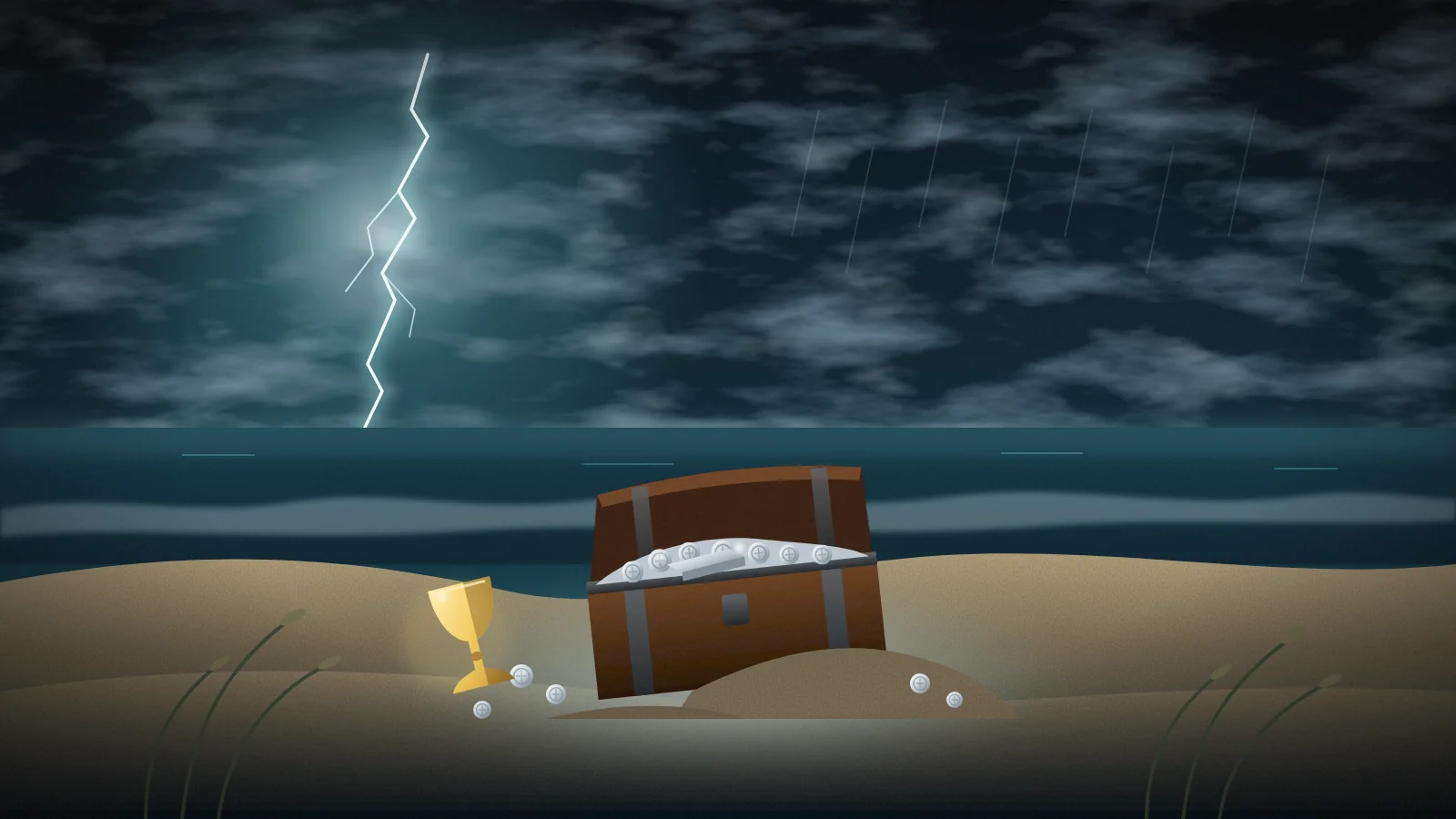
Picture a thin strip of sand at the mouth of Mobile Bay, a storm stacking up black over the Gulf, and a handful of Spanish sailors digging like their lives depend on it. Into the hole goes a chest of silver. On top, so the story goes, go the treasures of a church: a cross, perhaps a chalice, the kind of things nobody leaves behind unless they truly have to. Then the wind arrives, or the pirates do, or both, and the camp is gone.
That is the legend of the Spanish treasure of Dauphin Island, Alabama. Nobody has ever produced the chest. Nobody can point to the spot. And yet the island's real history is so crammed with raiders, hurricanes, shipwrecks and changing flags that the story fits it like a glove. A suspiciously well-tailored glove.
Right then. Time to sort the sand from the silver.
An island that was never quiet
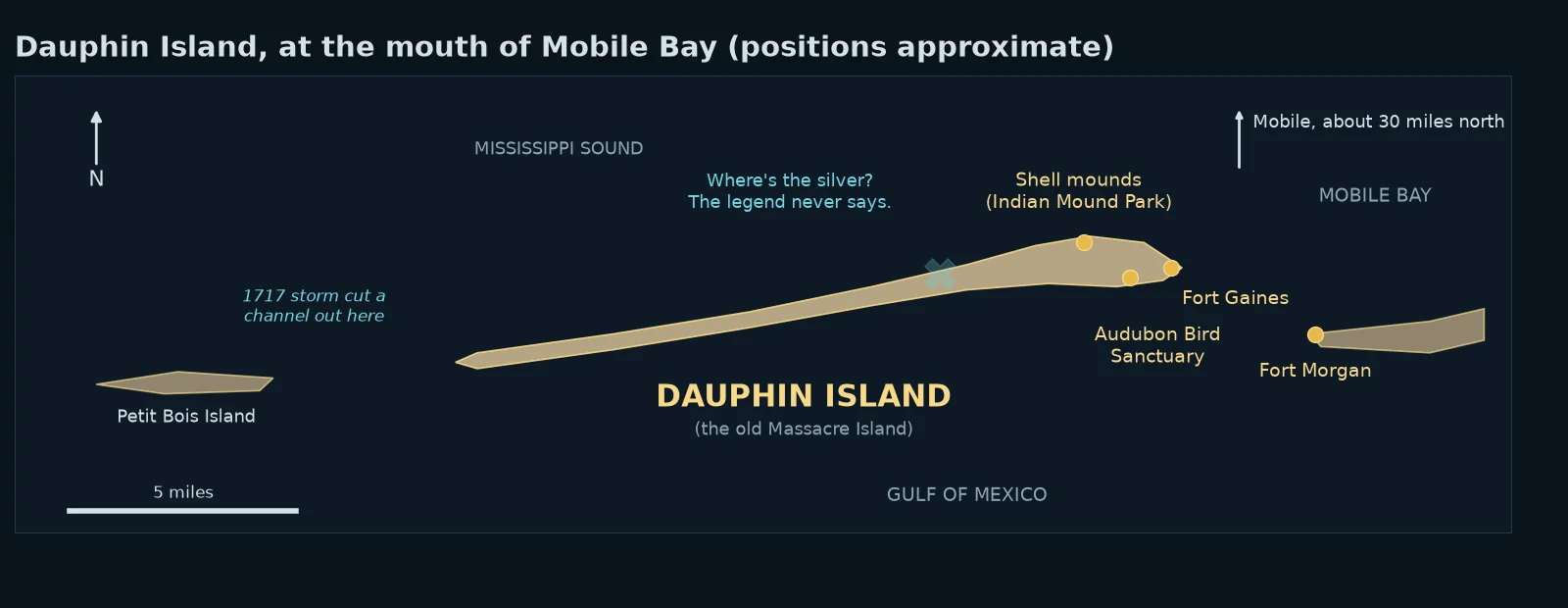
Long before any European turned up, people were living well here. On the island's north shore sit shell middens built up between roughly 1100 and 1550 by people who harvested oysters and fished the sound. The biggest is about 180 by 165 feet across. The site is now Indian Mound Park, listed on the National Register of Historic Places in 1973 and run by the state's Department of Conservation and Natural Resources.
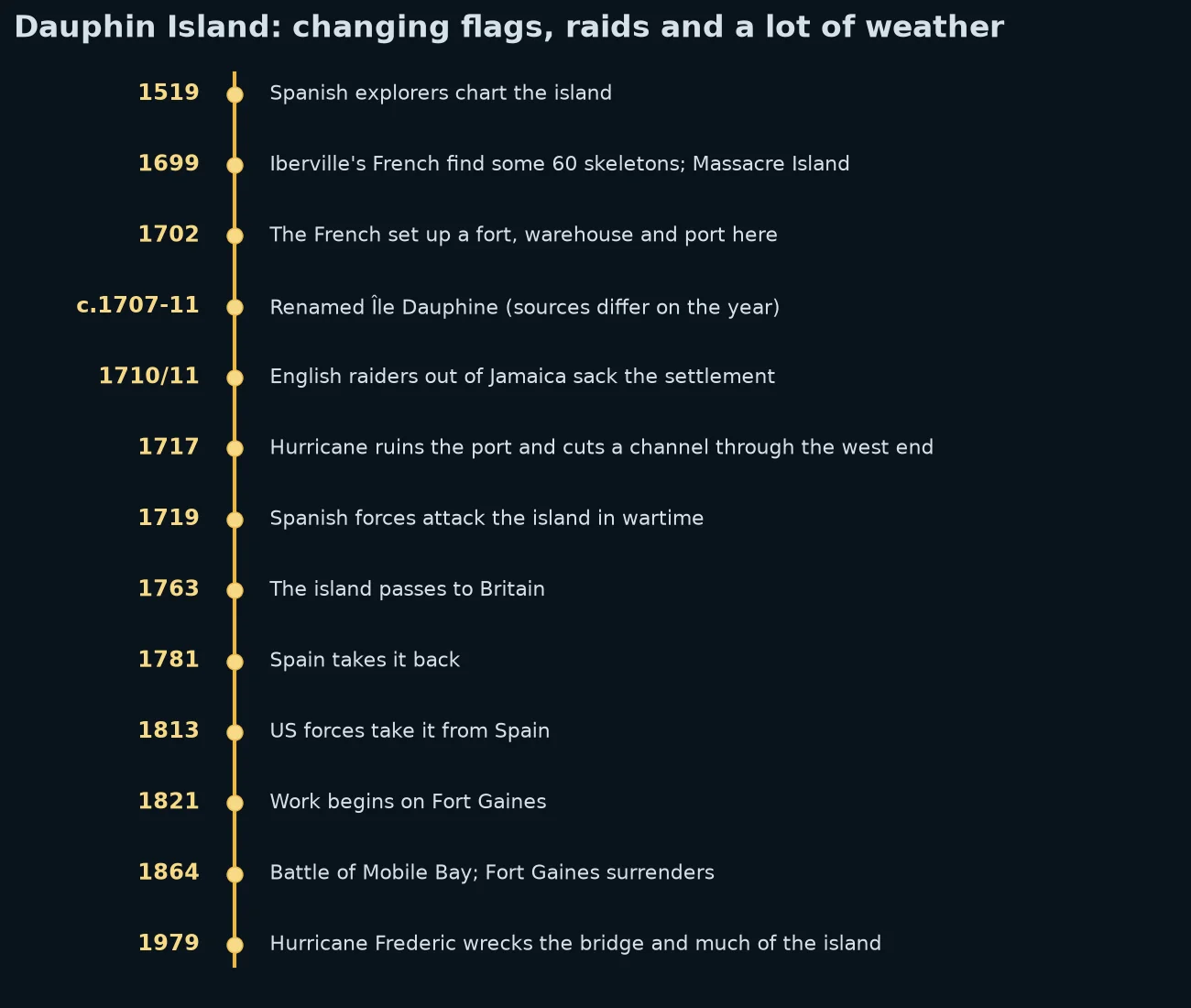
Spanish explorers charted the island in 1519. The expedition of Alonso Álvarez de Pineda is usually named as the first recorded European visit, and the island turns up on Spanish maps with impressive accuracy for the time. So yes, the Spanish knew this sandbar very early indeed. Hold that thought.
Massacre Island: a grim welcome in 1699
In 1699, the French brothers Pierre Le Moyne d'Iberville and Jean-Baptiste Le Moyne de Bienville came ashore and found human skeletons, some 60 of them according to the Encyclopedia of Alabama, gathered in mounds. They named the place Île du Massacre: Massacre Island. Cheery.
The usual modern explanation is less sinister than the name. A hurricane had most likely torn open a burial mound and laid the remains bare, so the "massacre" may never have happened at all. Those were people's ancestors, not props for a ghost story, and the island's first chapter is better remembered that way.
The French saw what Iberville saw: timber, fresh water and a deep natural harbor. From 1702 the island became the port for the young French colony, with a fort, a warehouse, homes and a chapel. Ships from France, Saint-Domingue, Cuba and Mexico unloaded here, and smaller boats ferried the goods across the shallow bay. In 1704 the ship Pelican landed 23 young women sent from France to marry colonists, remembered as the Pelican Girls. Somewhere around 1707 to 1711 (sources argue about the year, and even about which royal it flattered) the island got a more marketable name: Île Dauphine. Dauphin Island. Much better for the brochures.
The raid: English pirates out of Jamaica
Now for the pirates, and these ones are real. In 1710 or 1711 (sources disagree, and one puts it on September 9, 1710), English raiders from Jamaica fell on the French settlement on Dauphin Island and sacked it. Privateer or pirate depends rather on who's writing the report. The settlement was ransacked, but it survived and kept working as a port.
That raid matters to this story, because it's exactly the moment treasure legends love: valuables in a small settlement, armed men coming over the side, and no time to do anything clever. Which brings the story to the well.
The jeweled cross in the well
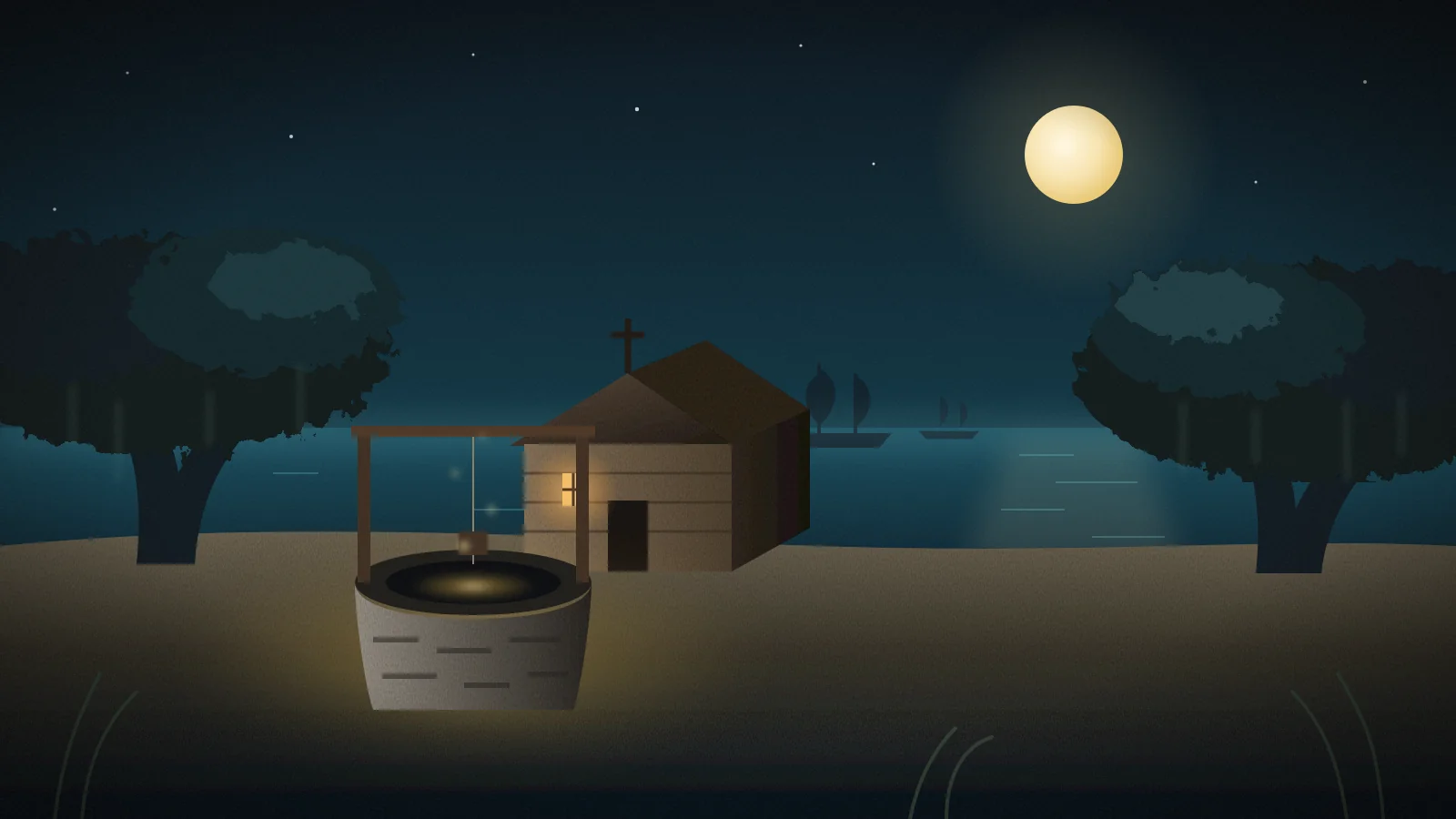
Islanders have long told the story of a jeweled cross from the island's church. During a raid, the story goes, somebody dropped it into a water well so the raiders couldn't take it. It was never fished out again, and the well has never been found. That's how it's told in modern write-ups of the island's legends, handed down by locals for generations.
What can be checked? The French settlement really did have a chapel, and it really was raided. What can't be checked is everything else: no record found names the cross, the well, or the person who dropped it, and no date is ever given. On treasure-hunting forums the tale wobbles even more, with pirates burying a gold cross instead of hiding it from them. Same cross, different villain. Legends do love a rewrite.
The Spanish treasure of Dauphin Island: the legend itself
Here is the version the island is best known for. Spanish sailors, the legend says, buried silver and church relics on Dauphin Island, and then storms and pirates destroyed their camps. Nobody came back for the hoard. It's still there, waiting under the dunes.
It's a cracking story, with a few rather inconvenient gaps:
- Whose camp? The island's documented colonial settlement was French, not Spanish. Spain charted it early, fought over it and later ruled it, but no record found describes a Spanish sailors' camp burying treasure here.
- When? The legend never says. That's handy for a legend and terrible for a treasure hunter.
- How much? No amount is given. Not a chest count, not a weight, nothing.
- Where? "On Dauphin Island." Which is miles and miles of shifting sand. Good luck.
Where might the tale come from? Spain had plenty of real business on this coast. In 1719, during the War of the Quadruple Alliance, France and Spain were at war, the French seized the Spanish town of Pensacola, and Spanish forces attacked Dauphin Island. Later, after a spell under the British from 1763, Spain took the island in 1781 and held it until American troops under General James Wilkinson took it in 1813. That's a lot of Spanish sails coming and going. Add a few real raids and a lot of real storms, and you can see how a story of buried Spanish silver would take root and refuse to leave.
Storms: the island's real treasure thief
If the legend says weather wrecked the camps, the weather certainly has the record for it.
In 1717 a severe hurricane ruined the colony's chief port on Dauphin Island. It closed at least part of the harbor and cut a channel straight through the western third of the island; the chunk that broke away is Petit Bois Island. Bienville moved the capital back to Ocean Springs, in today's Mississippi, and through the 1720s the harbor filled with sand until the French gradually gave up on the island.
The storms never stopped. Hurricane Frederic in 1979 destroyed the bridge to the mainland and devastated much of the island. Katrina in 2005 cut off the uninhabited western end, and Isaac in 2012 washed over the island and changed its shape again. Here's the awkward truth for anyone with a map: the Dauphin Island of the 1700s is not the Dauphin Island of today. Sand moves. Beaches walk. If something really was buried in a dune three centuries ago, it may now be under the Gulf, under the sound or under somebody's holiday house.
The shipwreck stories
Dauphin Island's treasure lore doesn't stop at the beach. Modern write-ups of Alabama legends add two shipwrecks, and both deserve a raised eyebrow:
- A Spanish galleon in 1801. The story says a Spanish ship carrying an estimated $1 million in gold and silver wrecked in a storm off the island's eastern end, with 11 survivors and no salvage ever reported. No ship's name is given, and no record of it was found for this article. Treat it as legend until somebody produces a name.
- La Bellone. A French ship said to have arrived off the island in 1724, wintered there, and sunk near the mouth of Mobile Bay in 1725, carrying furs, hides, tobacco, indigo and coins and bullion. It's described as the richest colonial wreck in the bay, but its story couldn't be confirmed against official records here either.
And no Gulf Coast treasure tale would be complete without Jean Lafitte, whose name gets stapled to buried loot all along this coast. There's no proof he buried anything on Dauphin Island. He's simply that sort of famous.
Fort Gaines and the Battle of Mobile Bay
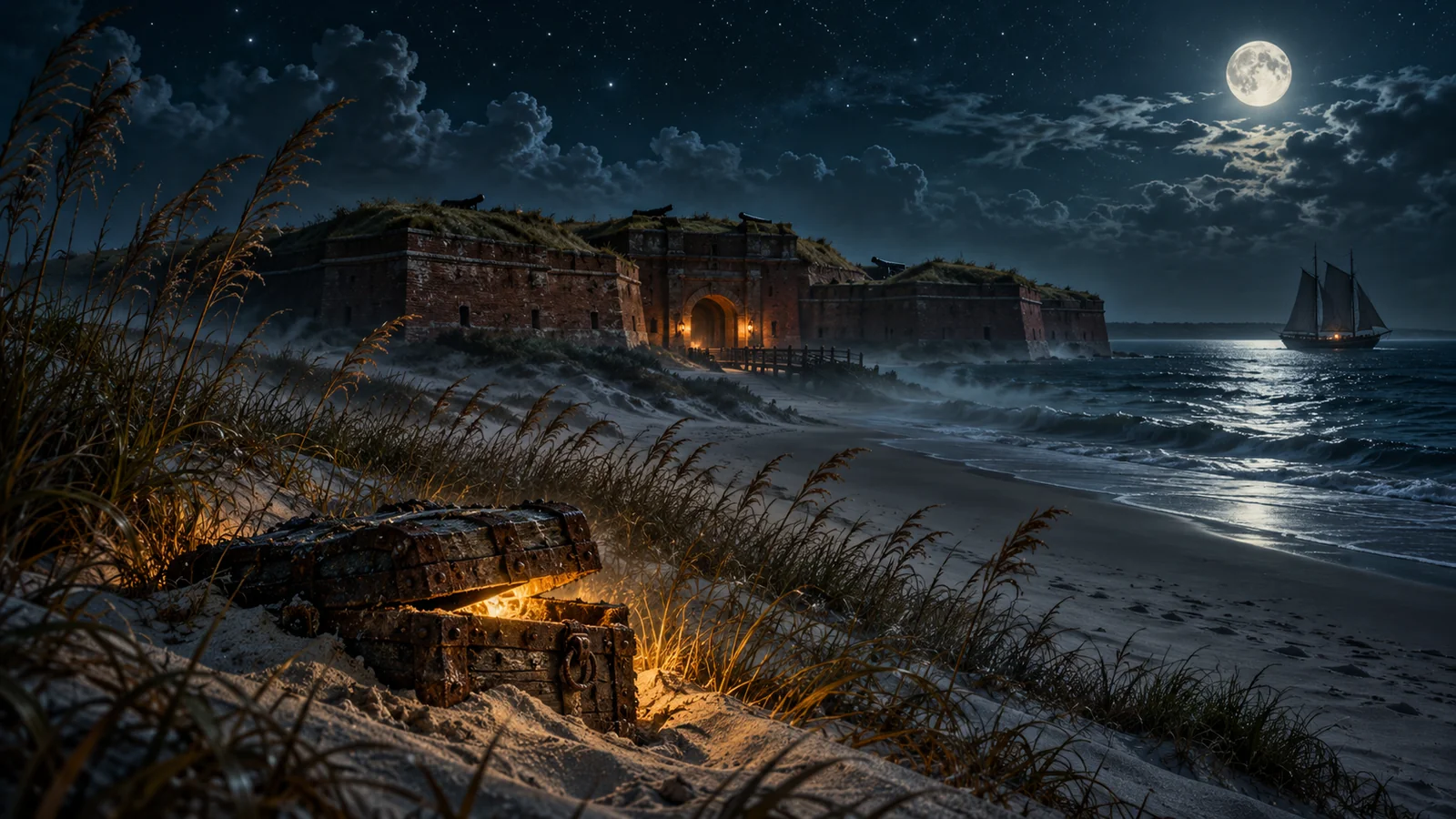
The island's most solid landmark is Fort Gaines, on the eastern tip. Work started in 1821, then stalled when the money ran short, and the fort was still unfinished when the Civil War arrived. In August 1864 it played its part in the Battle of Mobile Bay, and it surrendered to Admiral David Farragut's forces on August 7, 1864. The fort was listed on the National Register of Historic Places in 1976 and is run today by the Dauphin Island Park and Beach Board as a museum and living-history site.
It's also losing a fight with the sea. Erosion has eaten up to 10 feet of beach and dunes a year in front of it, and in 2011 it was named one of America's 11 Most Endangered Historic Places. On this island, even the fort is a bit worried about the weather.
The theories, weighed
- A real Spanish cache. Spain was on this coast from 1519 and ruled the island for decades. Not impossible. But there's no name, no date, no amount and no document, which is a lot of nothing for a real hoard.
- A French story wearing a Spanish hat. The documented raid hit a French settlement with a French chapel. Over the centuries, "the church treasure hidden from raiders" may have drifted into "Spanish silver," because Spanish silver simply sounds richer.
- Shipwreck gold, washed ashore in the retelling. Real wrecks and wreck rumors off the island could easily become "something buried on the beach" after a few generations.
- Mostly a story. A dramatic island with a grim name, real pirates and endless storms practically writes its own treasure legend. That doesn't make it true; it makes it inevitable.
The honest verdict? The raids, storms and wrecks are real. The silver is a rumor with excellent scenery.
Visiting Dauphin Island today
Fancy a look? Brilliant. Dauphin Island is a small town now, with about 1,800 people at the 2020 census and a bridge from the mainland.
- Historic Fort Gaines on the east end: museum, tours and reenactments, with Fort Morgan across the water.
- Indian Mound Park on the north shore: the ancient shell middens. It's a protected archaeological site, so look, don't dig.
- Audubon Bird Sanctuary, 164 acres where migrating birds rest after crossing the Gulf, often the first land they reach.
- The beaches and the long western end, the best place to see just how restless this island's sand really is.
A word on treasure hunting, in plain English. Historic sites like Fort Gaines and Indian Mound Park are protected, and digging there is off the table. Abandoned shipwrecks and old artifacts in Alabama's waters fall under the Alabama Underwater Cultural Resources Act, and exploring or recovering them needs a permit through the Alabama Historical Commission and the state's conservation department. If you fancy a wave of a metal detector on the beach, check the town's rules first. Most of the treasure on Dauphin Island these days comes in the form of sunsets and fried shrimp, and nobody needs a permit for those.
The silver may never surface. The story, like the sand, just keeps shifting.
...and if you find it, remember who encouraged your questionable life choices.
The short version of this story is on YouTube at @TenToeExpress.
Deep dive yourself
- Dauphin Island · Encyclopedia of Alabama
- Le Moyne Brothers · Encyclopedia of Alabama
- French in Alabama: 1699-1763 · Encyclopedia of Alabama
- Maritime Heritage Program · Alabama Historical Commission
- French attack on Spanish Florida at Mobile Bay · Unearthing Florida, WUWF
- Legend Says This Treasure Is Still Hidden Somewhere in Alabama · Only In Your State (via Yahoo Travel)
- Dauphin Island, Alabama · Wikipedia
- Indian Mound Park (Dauphin Island, Alabama) · Wikipedia
- Fort Gaines (Alabama) · Wikipedia