 Ten Toe Express
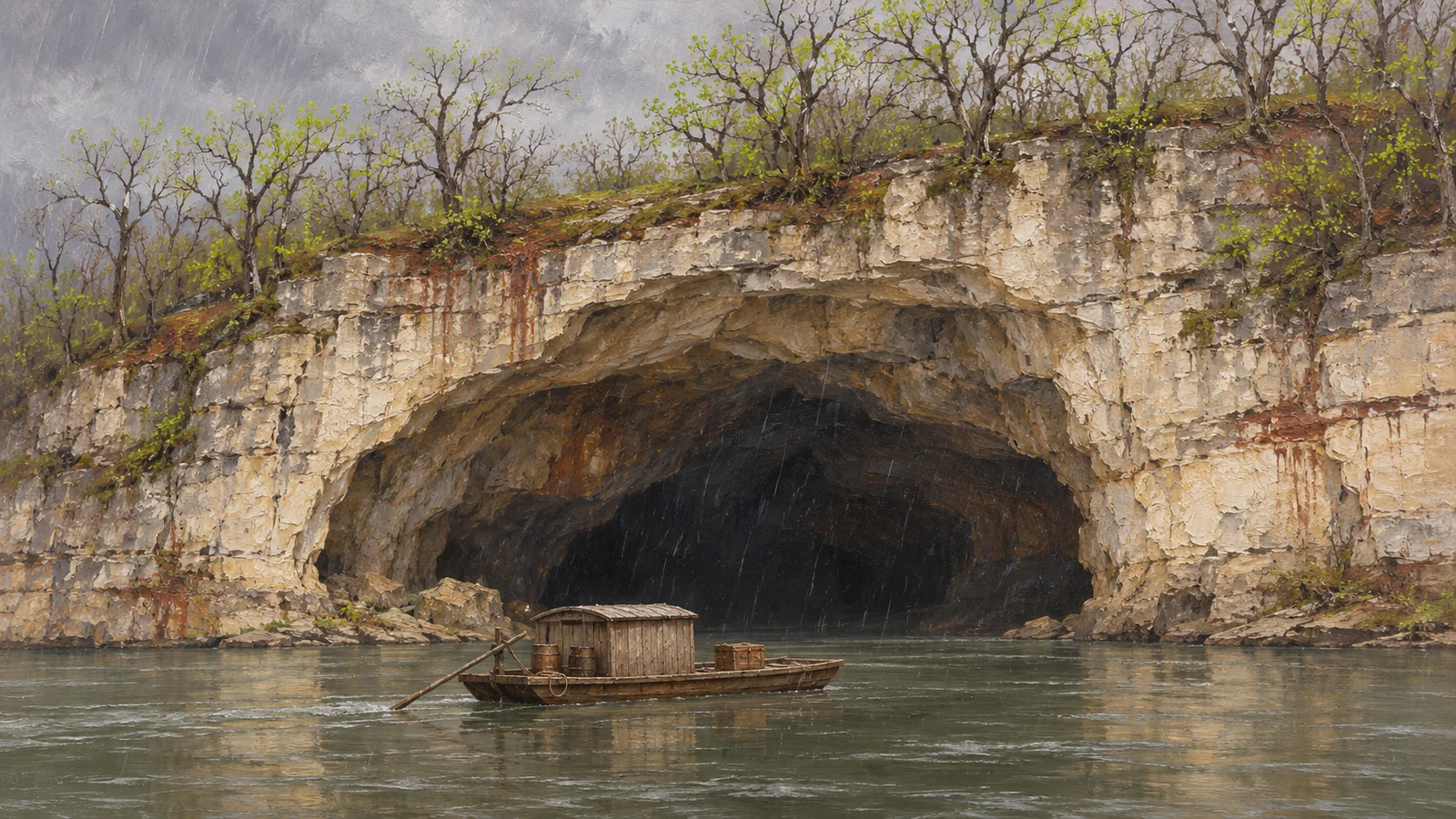
Picture an Illinois riverbank in the 1790s: a pale limestone bluff, a great dark arch in its face, and a flatboat full of Kentucky farm goods drifting past on the Ohio River, bound for New Orleans. The crew, naturally, are delighted to spot a friendly stopping place. Right then. That is exactly the problem. This is the story of Cave-In-Rock, Illinois, the river pirates who made it their base, and the loot that, according to legend, never left.
The pirates are real history. The buried treasure is a different matter, and it gets the raised eyebrow it deserves, because while the crimes are documented, the hiding places are pure legend. Fancy a proper mystery? Read on.
Cave-In-Rock, Illinois: a cave with a reputation
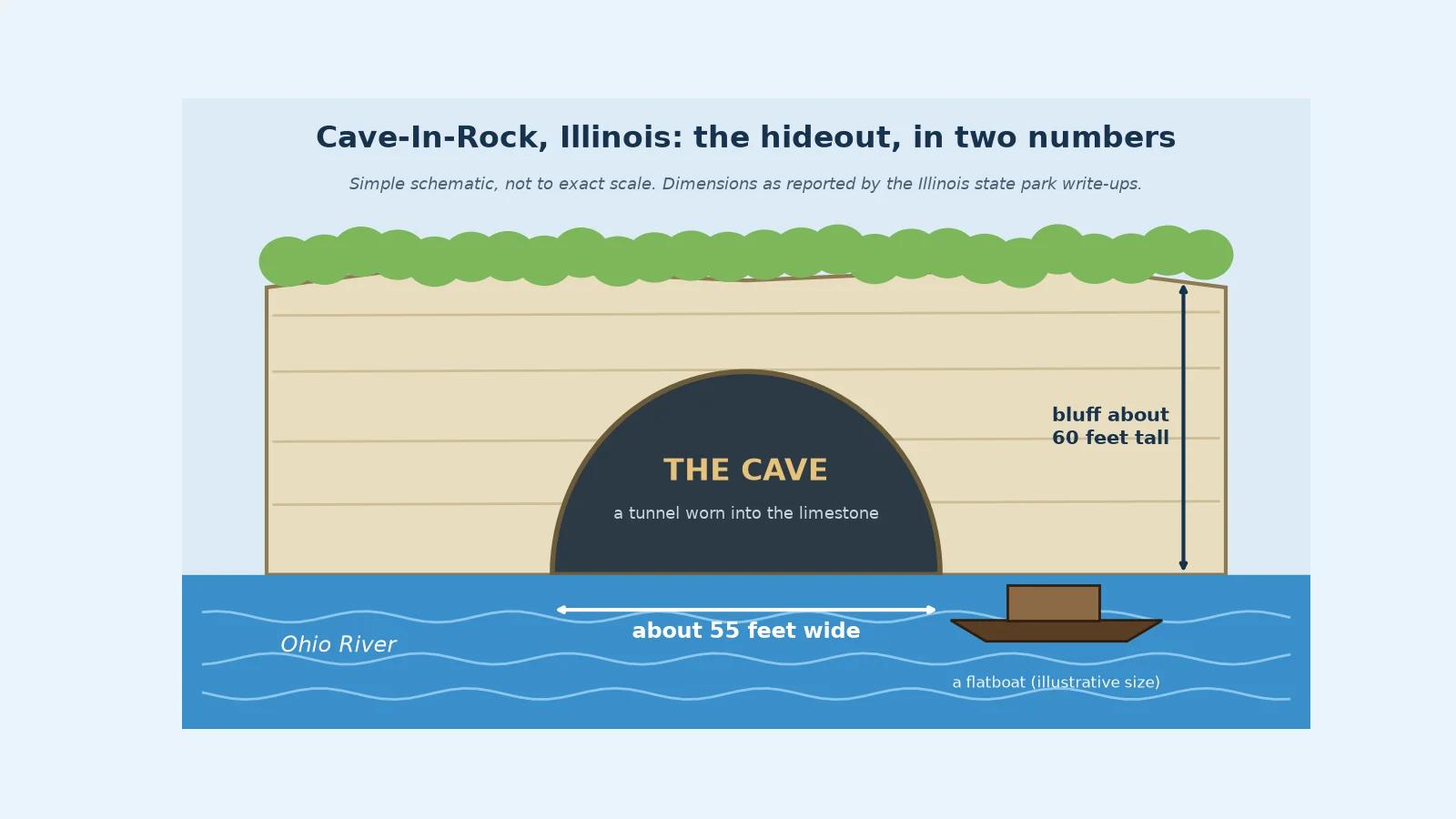
The cave is not a classic underground cave at all. According to the state park's own history, it is a tunnel worn into the limestone bluff of the Ohio River by floods, especially the glacial meltwater floods after the last ice age, rather than by the usual slow dissolving of rock. The 55-foot-wide opening faces the river, which made it impossible to miss from a boat.
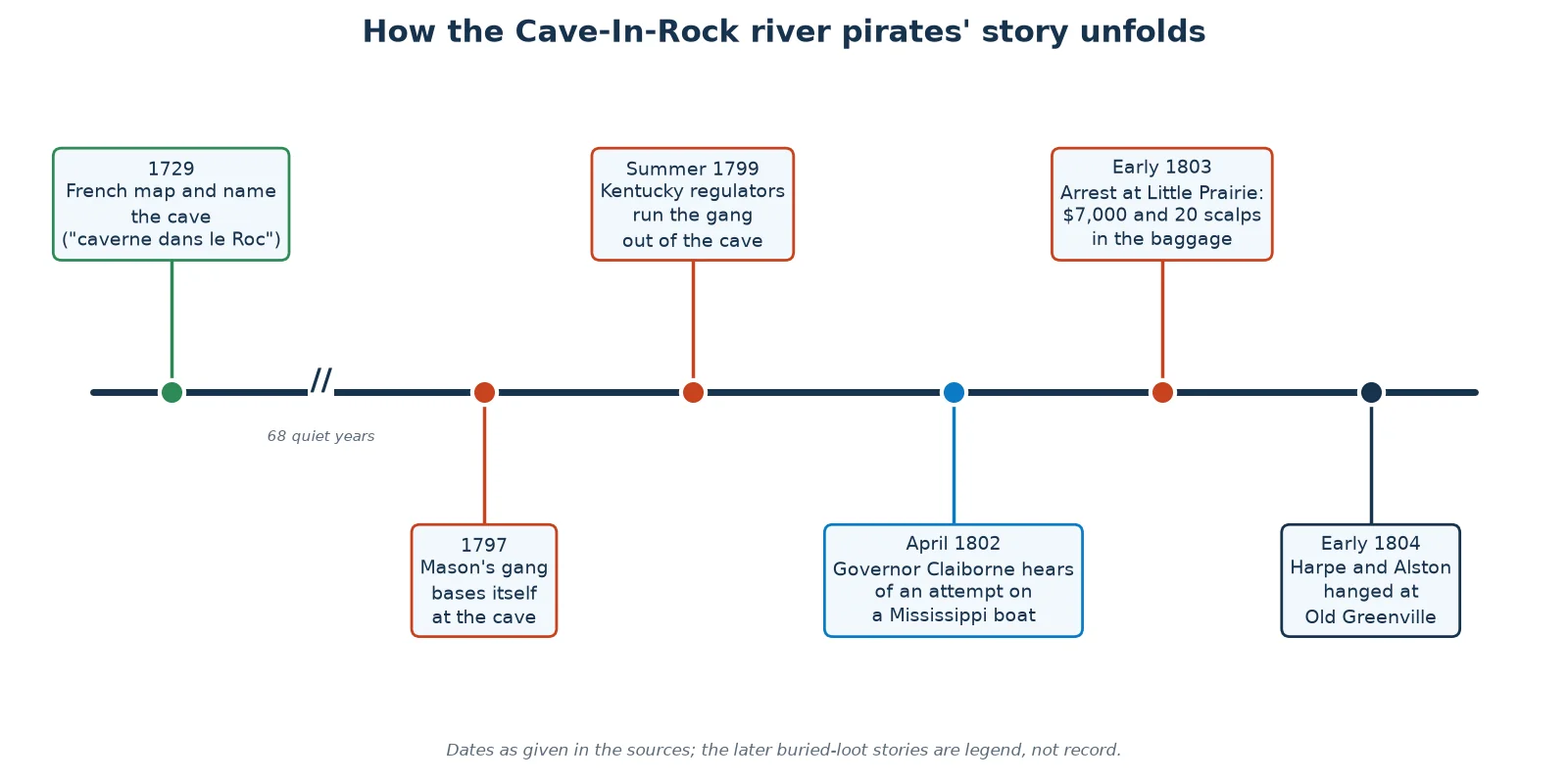
People have used it for thousands of years. A French explorer, M. de Lery, mapped it and named it "caverne dans Le Roc" in 1729, and that name, translated, is the one it still carries. It also collected a pile of other names over the years, including House of Nature, Rock-In-Cave and, rather tellingly, Murrell's Cave.
Then the flatboats arrived. From the 1790s, farmers in Kentucky, Ohio and southern Indiana floated produce down the Ohio towards New Orleans, and the cave was a famous landmark on that dangerous trip. A famous landmark with a roof, shelter and a view of every boat coming round the bend. Outlaws noticed.
Samuel Mason and the Mason gang
The name that sticks to the cave is Samuel Mason, and his story is genuinely odd. Born in Virginia in 1739, he served as a militia captain on the Revolutionary War frontier, survived an ambush near Fort Henry in 1777 that killed most of his company, and later served as a justice of the peace in Pennsylvania. He was, in other words, the sort of man you would trust to hold your coat.
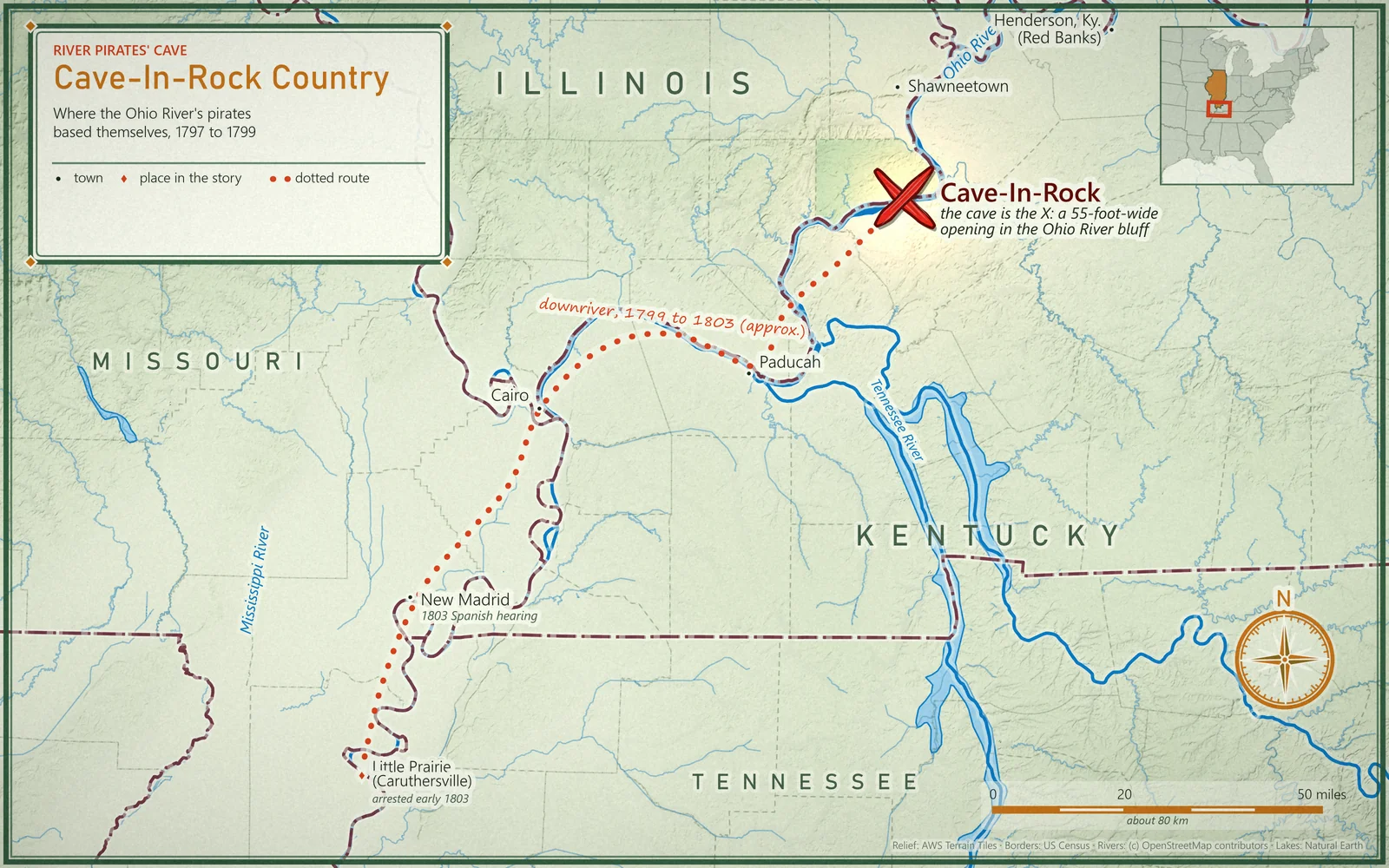
Something changed. By the early 1790s he had moved his family to the Red Banks, near present-day Henderson, Kentucky, and begun full-time crime. He later settled on Diamond Island, and by 1797 he had moved his base further downriver to Cave-In-Rock, which was then in the Northwest Territory. The gang openly based itself at the cave until the summer of 1799.
One popular account of the method, which is retold in several places and should be read as colourful tradition rather than court record, goes like this: the pirates played friendly hosts, fed and sheltered travelling boatmen, quietly noted what they carried, and then robbed them around the next river bend. It is a clever business model, if you can ignore the felony.
The gang's stay ended when a group of Kentucky regulators called the "Exterminators," led by a Captain Young of Mercer County, drove them out in the summer of 1799. Mason moved down the Mississippi, settled his family in Spanish Louisiana, and turned to robbing travellers on the Natchez Trace in Mississippi, where he was said to leave notes signed "Done by Mason of the Woods."
The Harpes: the lodgers even pirates did not want
Mason briefly kept company with Micajah and Wiley Harpe, brothers on the run, often called America's first serial killers. By tradition, they were too cruel even for the Mason gang, and were asked to leave. A caution, though: the Illinois Department of Natural Resources says popular lore ties the Harpes and other river outlaws to the cave, but that no historical documentation actually links the Harpe brothers to this particular landmark. So the best-known villains of the story may be a bit of a retelling.
The end of Samuel Mason
The documented ending is stranger than the legend. In early 1803, Spanish officials arrested Mason and several others at the Little Prairie settlement, now Caruthersville, Missouri. At a hearing at New Madrid, Mason claimed to be a farmer his enemies had maligned. Then the Spanish looked in his baggage and found $7,000 in cash and twenty human scalps, and, remarkably, that ended the farmer defence.
Mason and the others were sent towards New Orleans, to be handed over to American authorities. On the way upriver, Mason and two men going by the aliases John Sutton and James May overpowered their guards and escaped. Mason was shot during the escape: in the head, says one account; in the leg, says another. Whether he died of the wound or was killed is, in the words of one source, never established.
What is recorded is that the Mississippi governor, William C. C. Claiborne, put up a large reward, and that the two men turned up to claim it carrying Mason's head. Instead of money they got recognition. "Sutton" and "May" were identified as Wiley Harpe and Peter Alston, tried for piracy, and hanged at Old Greenville in the Mississippi Territory in early 1804. Reward figures differ by source, from $2,000 to $2,500.
The legend of the missing loot
Here is where the treasure comes in, and where the facts thin out. According to one widely repeated version, the thousands of dollars in cash and valuables the gang stole over the years were never recovered, and some of it is said to be hidden at Cave-In-Rock. One retelling says the gang was rumoured to have hidden a large stash of gold there around 1800 and that Mason was killed before he could fetch it. Another claims more than $1 million in stolen loot, gold, cash and counterfeit bills changed hands in the cave between 1790 and 1830, and that more gold and silver caches may sit along the cliff face.
That is the full legend, and it is worth saying plainly what is missing: no named hiding place, no map, no letter, no recovered cache, and no document from the time saying where anything was buried. The $7,000 found in Mason's baggage is real; the million dollars is a good story.
There is a second legend further south. At Rocky Springs, Mississippi, a posse is said to have found a hastily abandoned camp used by Mason and Wiley Harpe near the Natchez Trace in 1802, and some of its members stayed behind to search for hidden loot rather than chase the outlaws. A cache in that area is a legend of its own. So even the lost treasure of Mason's gang is lost in two states.
Theories, weighed
- Buried in the cave. A famous landmark seen by thousands of boatmen is a rotten hiding place. A cave hideout is good for ambushing boats, not for hiding things from the locals.
- Buried along the cliff face or the bluff. Possible, and also unprovable. Nobody has produced a name, a measurement or a find.
- Spent, seized or lost. The simplest explanation. The Spanish already confiscated $7,000 in 1803, and outlaws on the run tend to spend money.
- The whole thing is embellished. It is worth knowing that Wikipedia notes no contemporary accounts attest to river pirates occupying the cave in the first decade of the 1800s, so the cave's fame rests partly on later retellings, including Otto Rothert's 1924 book The Outlaws of Cave-in-Rock.
Hollywood did help. Disney's 1956 Davy Crockett and the River Pirates used the cave, and John Ford's 1962 epic How the West Was Won featured it. Local lore adds that Frank and Jesse James hid out there too, leaving their marks in the cave, which is the sort of thing every old outlaw cave eventually claims.
Where it stands today
Cave-In-Rock is now the centrepiece of Cave-In-Rock State Park, run by the Illinois Department of Natural Resources. The state acquired the cave and 64.5 acres in 1929, and the park has grown since. Visitors can walk to the cave, camp, and take the little ferry that crosses the Ohio to Kentucky. It is empty, scenic, and a good deal more peaceful than in 1798.
It is protected state park land, so digging is simply off the table; the only things you will be taking home are photographs and the odd dry remark about pirates. The real treasure, if there is one, is the cave itself and a river view that has barely changed since the boats came through.
...and if you find it, remember who encouraged your questionable life choices.
The short version of this story is on YouTube at @TenToeExpress.
Deep dive yourself
- Cave-in-Rock State Park · Wikipedia
- Samuel Mason · Wikipedia
- Cave-In-Rock, Illinois · Wikipedia
- Samuel "Wolfman" Mason Takes on the Natchez Trace · Legends of America
- The Outlaws of Cave-in-Rock · Otto A. Rothert, Project Gutenberg
- Cave-In-Rock feature, Outdoor Illinois · Illinois Department of Natural Resources
- River pirates of southern Illinois, 1795 to 1830 · Historia, Eastern Illinois University