 Ten Toe Express
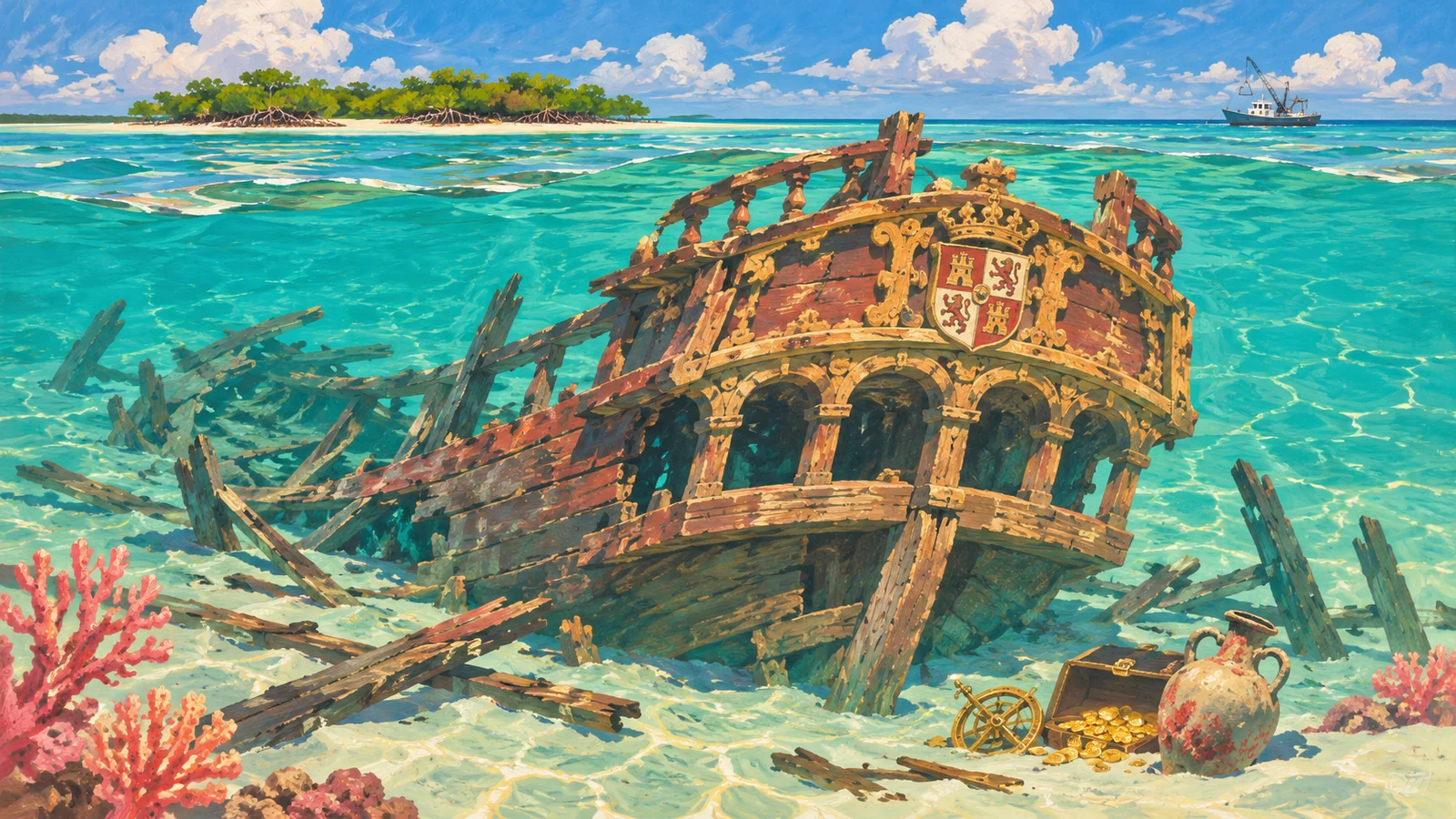
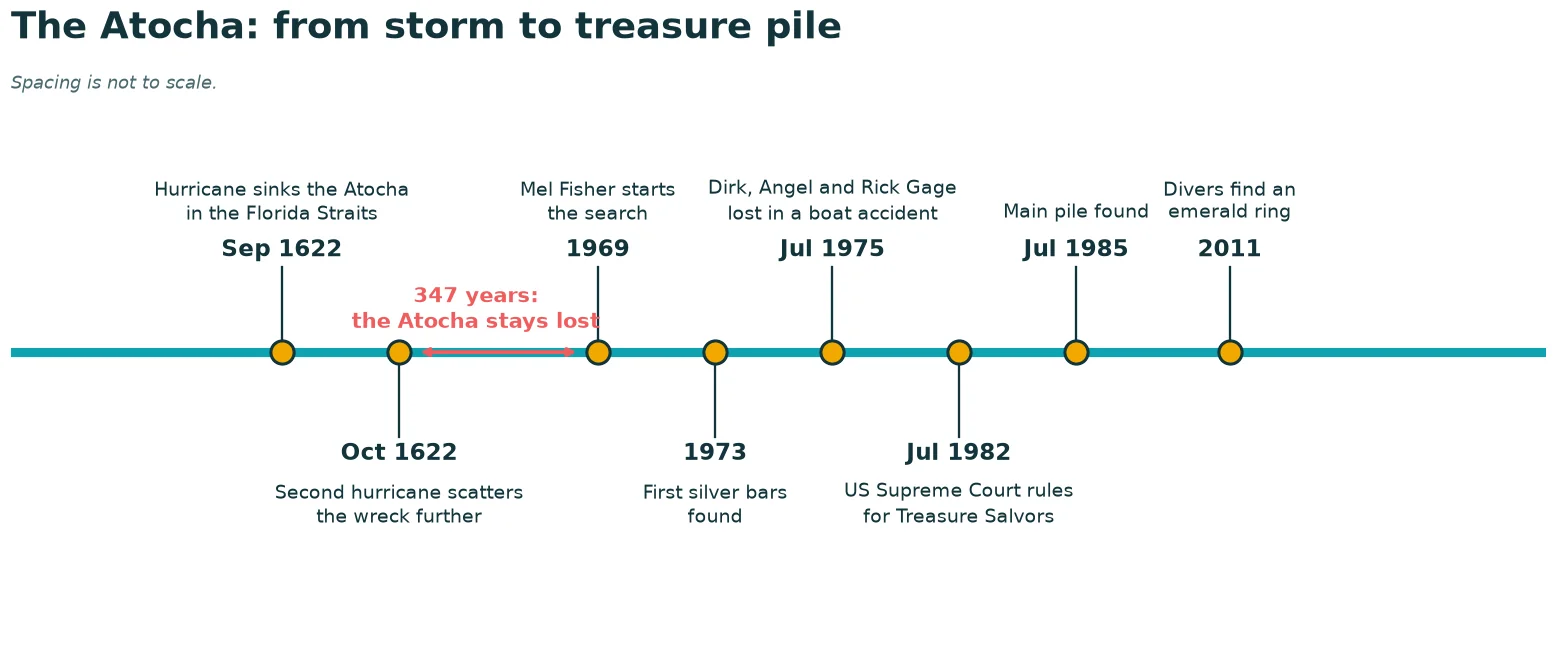
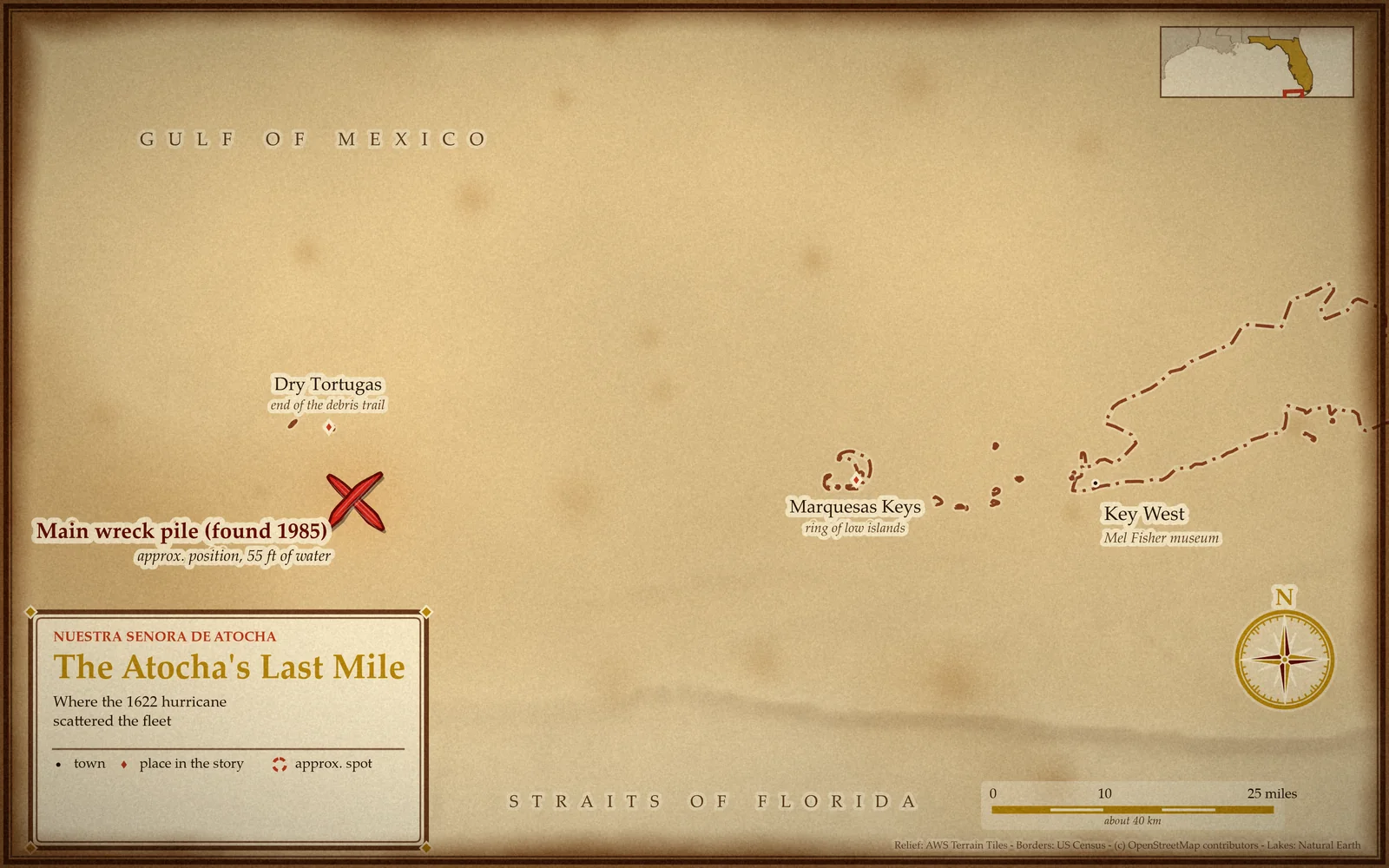
Picture the Florida Keys on a good day: flat turquoise water, a few lazy clouds, a boat bobbing about. Now picture the same water on 6 September 1622, when a hurricane had just finished dismantling a Spanish treasure fleet. Eight ships were gone between the Marquesas Keys and the Dry Tortugas, and the most valuable of them, the galleon Nuestra Señora de Atocha, had vanished with a cargo of silver, gold and emeralds that sources put at hundreds of millions of dollars in today's money.
Here is the twist that makes the Atocha's story so annoying for the people who love it. The wreck was found. Treasure hunter Mel Fisher pulled a fortune off the seabed in 1985, a fortune that would make most people retire to a beach and never look at a boat again. And yet the bit that was supposed to hold the very best of it, the ship's rear castle, has apparently never turned up. Right then: the mother lode was found, and the mother lode's mother is still missing.
The Atocha and the fleet that sailed late
The Atocha was built in Havana in 1620 and served as the rear guard of the Spanish treasure fleet, a heavily armed galleon of roughly 550 tons. Her hull was made of mahogany rather than the usual oak, which is a very fancy way to build something that was about to be dropped on a reef. Her job was to carry the wealth of the Spanish colonies home: silver from the mines of Bolivia, Peru and Mexico, gold and emeralds from Colombia, pearls from Venezuela, plus tobacco, indigo, copper and bronze cannons.
The cargo had been gathered slowly. It crossed Panama by mule and took about two months to record and load. When the fleet finally left Havana on 4 September 1622, it was about six weeks behind schedule. That matters, because those weeks pushed it straight into the heart of hurricane season.
The storm of September 1622
The hurricane struck within a day or two of departure, in the Florida Straits. By the morning of 6 September, eight ships had sunk, their wreckage strewn between the Marquesas Keys and the Dry Tortugas. The Atocha went down in roughly 55 feet of water. Of about 265 people aboard, five survived: three sailors and two enslaved men, who clung to the mizzenmast, the rear mast, which stuck up out of the water.
That mast is the reason the Spanish knew where to look. They also knew they would not have long. A second hurricane on 5 October 1622 scattered the wreck even further, burying and spreading what the first storm had left.
Sixty years of Spanish searching
Spain sent salvage ships out to the wrecks straight away. They recovered most of the cargo of the Santa Margarita, a sister ship that had run aground nearby, over about a decade. The Atocha was another matter. By the accounts used here, the Spanish never found her despite searching for some sixty years.
The work relied on enslaved divers working from a brass diving bell, and many of them died doing it. The records of the time noted those deaths as a business expense. It is a grim detail, and it is a reminder that the treasure came out of the seabed and out of a great deal of suffering.
Mel Fisher and the longest search in the Keys
Enter Mel Fisher, born in 1922 in Hobart, Indiana, and a man with the sort of stubbornness that either wins treasure or ruins marriages. Fisher and his company, Treasure Salvors, Inc., began hunting for the Atocha in 1969, and the search lasted sixteen and a half years.
The first real scraps arrived in 1973, when divers found silver bars that matched the Atocha's manifest. In 1975 Fisher's son Dirk found five bronze cannons bearing the ship's markings, the first solid proof they were on the right track. Days later, on 20 July 1975, Dirk, his wife Angel and diver Rick Gage died when their salvage boat capsized. Fisher kept searching.
The legal fight, and the pile
There was also a courtroom to cross. Florida claimed the wreck and demanded a quarter of anything found. After years of litigation the US Supreme Court ruled on 1 July 1982 in favour of Treasure Salvors, awarding the company the rights to the treasure.
The breakthrough followed in 1985. On 27 May, divers found 13 gold bars and 16 emeralds about two miles from where they had been digging. Then, in July, a side-scan sonar reading led divers to a long mound of stones, copper ingots and dark silver bars about 70 to 80 feet long. One account has the news radioed in as the end of the charts: the main pile had been found. Shipper's marks on the silver matched the Atocha's manifest.
Different sources give slightly different dates for that July find (the 19th or the 20th) and slightly different counts of what came up, which is normal for a discovery this chaotic. The broad picture is consistent: about 40 tons of gold and silver, silver ingots by the thousand, well over 100,000 silver coins and Colombian emeralds, valued at around $450 million.
So what is still missing?
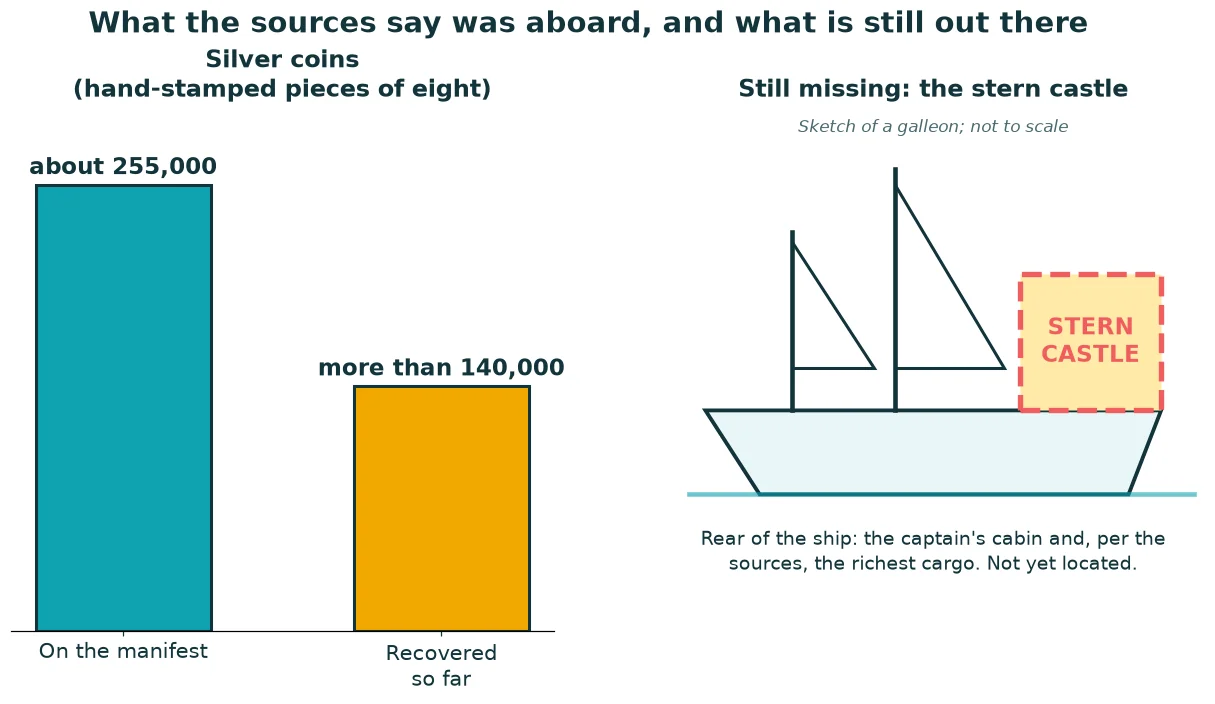
This is the part that keeps Atocha fans awake. The main pile was a haul of silver, coins and ballast, the kind of thing a ship leaves behind when she sinks in one lump. But the Atocha did not sink in one lump. She broke apart in the hurricane, and the stern castle, the tall rear section that held the captain's quarters, separated from the rest.
That is where the richest cargo would have been stowed: the gold and the finest Muzo emeralds. A lower section of hull has been recovered and was stored for researchers, but the stern castle itself has not been located, according to the sources used for this article.
What the manifest says, and what it leaves out
The manifest listed around 1,038 silver bars, about 255,000 hand-stamped silver coins and over 7,000 ounces of gold. Gold and emeralds are slippery, though. Many recovered gold bars were crudely cast and had no royal tax stamp, and gold coins, nuggets, chains and emeralds were found in quantity that barely appears in the paperwork. In other words, Spanish smugglers had stuffed the ship with unregistered treasure, which means nobody can say with confidence what the missing section holds.
Where could it be?
Nobody knows, and anyone who claims otherwise is selling something. The theories are modest and sensible:
- It broke away and drifted. The storm separated the castle from the hull, and currents and a second hurricane could have carried it a long way from the main pile.
- It is buried. Shifting sand and sediment on the Keys seabed can swallow a wreck whole, and a surveyor can pass directly over the spot without seeing a thing.
- It is already in the scatter. Odd finds keep turning up far from the main pile. In 2011 divers recovered an emerald ring valued at around $500,000, along with two silver spoons, about 35 miles from Key West.
Where it stands today
Fisher died in Key West on 19 December 1998 at age 76, and the company that carries his name still works the wreck. Sources report occasional finds, including a silver bar in June 2026 estimated at $50,000 to $100,000. The wreck is no longer a lost ship in the strict sense. It is an active salvage operation with court-awarded rights behind it, and the missing stern castle is the final chapter that has not yet been written.
If you want to see the Atocha without going near open water, the Mel Fisher Maritime Heritage Museum in Key West displays many of the recovered treasures. The coins, the bars, the cannon and the emeralds are all there, behind glass and under a roof, which is a much safer place to meet a hurricane survivor.
...and if you find it, remember who encouraged your questionable life choices.
The short version of this story is on YouTube at @TenToeExpress.
Deep dive yourself
- Nuestra Señora de Atocha · Wikipedia
- Mel Fisher · Wikipedia
- Nuestra Senora de Atocha, a treasure under the sea · Ancient Origins
- Coins of the Nuestra Señora de Atocha · American Numismatic Association
- The Treasure of the Atocha Shipwreck · Primal Nebula