 Ten Toe Express
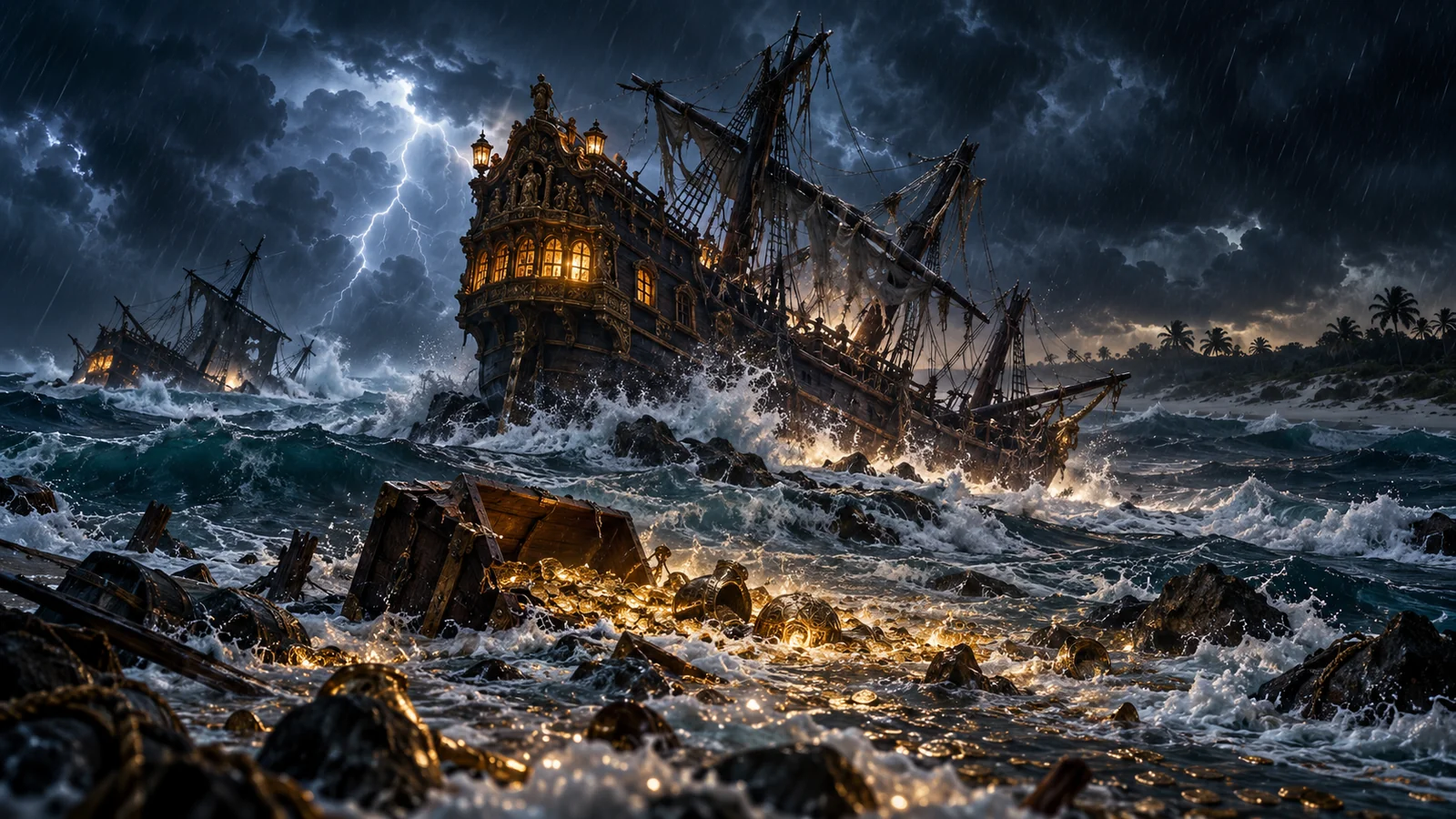
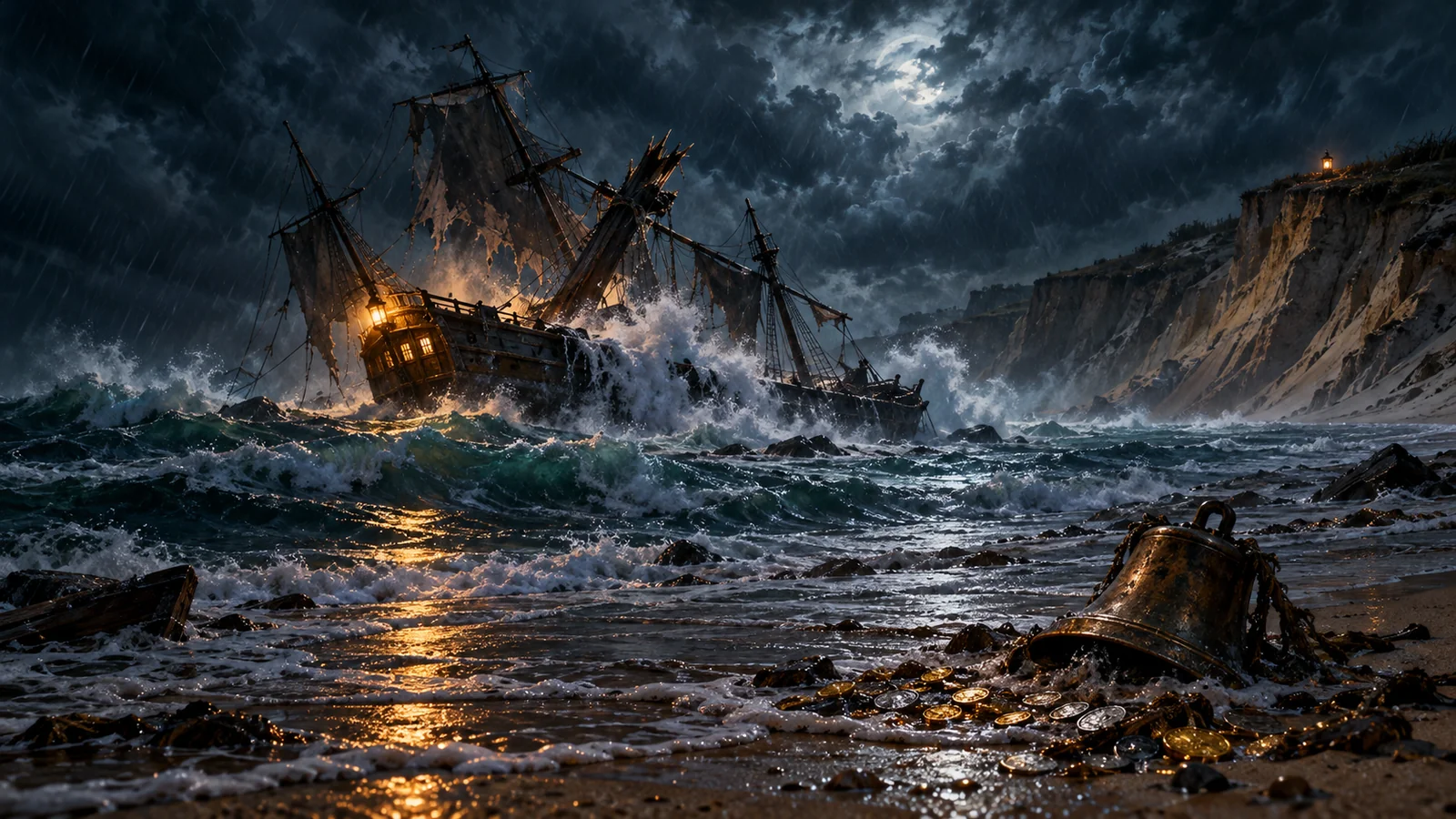
Picture it. The small hours of July 31, 1715, somewhere off the east coast of Florida. Eleven Spanish ships, low in the water with silver, gold and a queen's worth of jewels, are being shoved toward a reef by a hurricane nobody saw coming. The wind is screaming, the sea is a wall, and the only lights are lanterns swinging wildly on deck. By dawn, the most famous treasure fleet in American waters is gone.
That was the end of the 1715 Spanish Plate Fleet, and the beginning of a treasure hunt that is now more than 300 years old. Spanish salvors, Caribbean pirates, a Florida building contractor with a cheap army-surplus detector and a modern company with a federal court on speed dial have all had a go at it. The wrecks gave this stretch of Florida its name: the Treasure Coast. And every so often, after a big storm chews up the beach, a few silver coins still roll in with the surf.
Right then. Here is what happened, what was found, what is still out there, and, because this is Florida and the state takes it very seriously, exactly who gets to keep it.
Why Spain sent a treasure fleet in hurricane season
For two centuries, Spain moved the wealth of its American empire home in armed convoys: silver and gold from the mines of Mexico and South America, plus goods brought across the Pacific from Manila. Each year the fleets gathered at Havana, then rode the Gulf Stream up the Florida coast before turning east for Spain.
By 1715 the Spanish crown was badly short of cash. The long and ruinous War of the Spanish Succession had only ended in 1714, and King Philip V needed his treasure, quickly. So two fleets were combined in Havana. The New Spain fleet sailed under Captain-General Juan Esteban de Ubilla, and the Tierra Firme fleet, from the South American mainland, under General Antonio de Echeverz. Riding along with them, for safety in numbers, was a French ship called the Grifón.
The problem was the calendar. After months of delays, the fleet didn't leave Havana until late July, deep into hurricane season. Most accounts say it sailed on July 24; NOAA's hurricane researchers give July 27. Either way, it was a gamble with very poor odds, and nobody in 1715 had a weather forecast to tell them so.
The night of July 30, 1715
The first days were fair. Then, as the ships worked north through the Bahama Channel, the wind turned against them and they slowed to a crawl, tacking back and forth with the Florida reefs on one side and the Bahama Bank on the other. A heavy swell rolled in. The sky went strange. By the night of July 30, the wind was rising hard, and the fleet had nowhere to run.
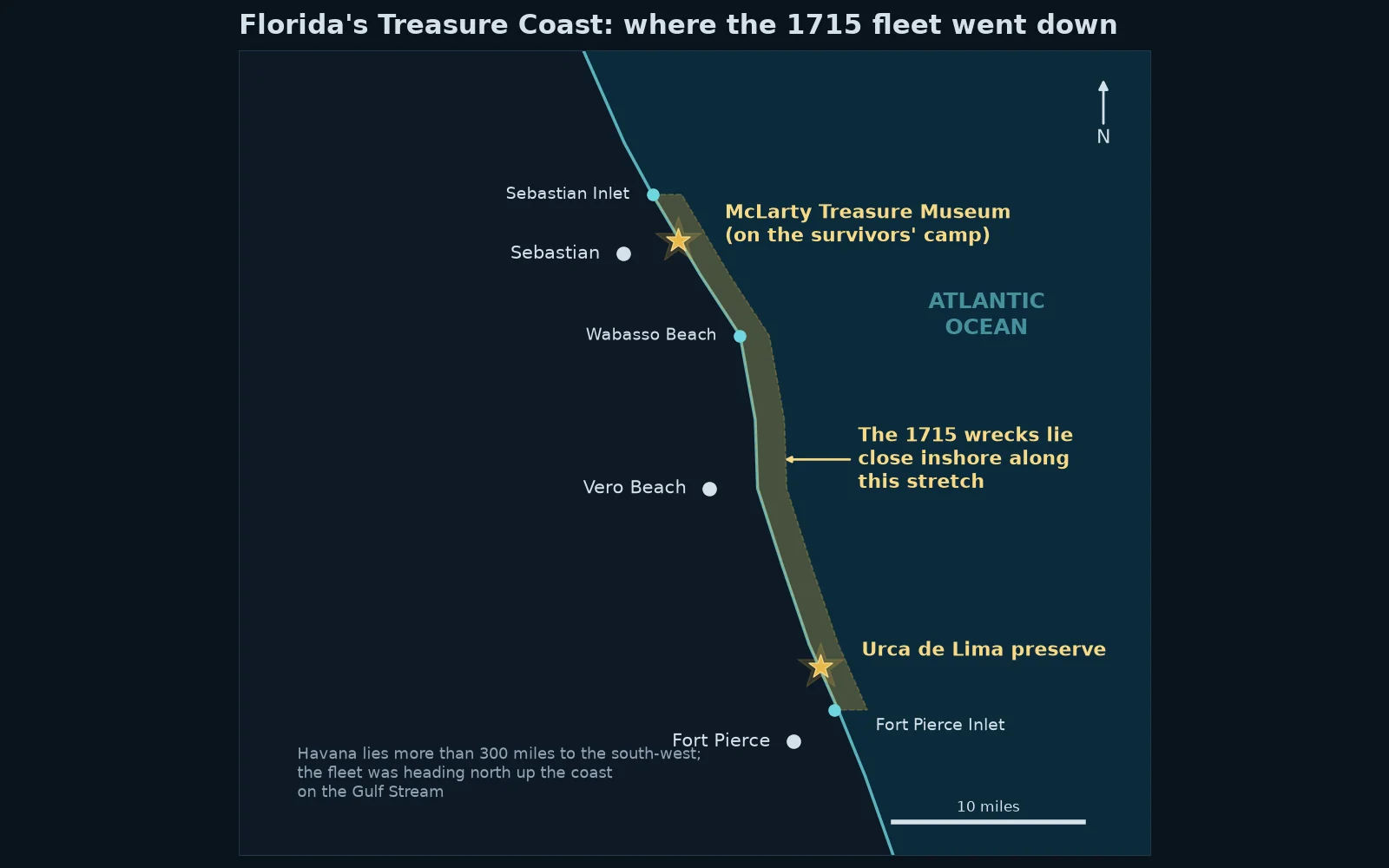
The hurricane struck in full in the early hours of July 31. Three ships went down in deeper water. Eight were driven onto the shallow reefs and sandbars along the coast, from present-day Fort Pierce up to Wabasso, north of Vero Beach, and were smashed apart. Of roughly 2,500 sailors and passengers, around 1,000 died, according to NOAA's account, including Ubilla himself. Echeverz drowned too. Some counts are lower and some higher, and nobody kept a tidy tally that night.
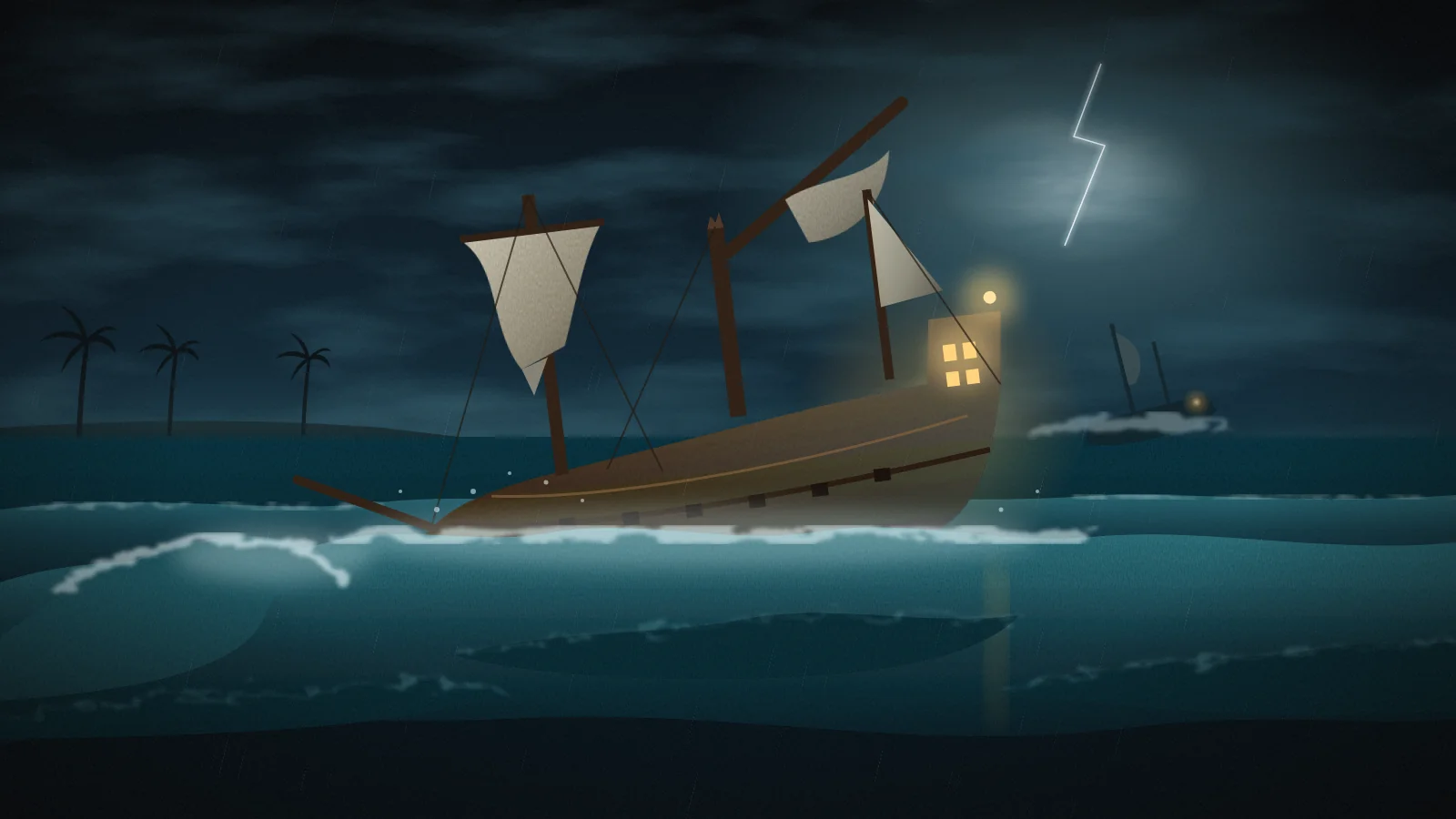
Only one ship came through. The French Grifón had sailed further offshore and slipped clear. She reached Brest, in France, by early September, with no idea that the rest of the fleet was gone.
The survivors' camp and the Spanish salvage
On the beach, the survivors were in a desperate state: injured, soaked and stranded on a wild coast with very little food or fresh water. Two boats were patched up and sent for help, one north to St. Augustine and one south to Havana. Meanwhile a rough camp grew up behind the dunes near what is now Sebastian Inlet. The McLarty Treasure Museum stands on part of that camp today.
Spain moved fast. Relief ships arrived from Havana by the end of August, a salvage camp was set up, and divers went down on the wrecks over and over again. The Spanish kept at it for about four years before giving up in 1719. How much they got back is a proper argument. Some accounts say much of the treasure was recovered. Others, drawing on Spanish records, suggest something like 30 percent of the registered value, and point out that officials had every reason to fudge the books in both directions. What everyone agrees on is that a great deal stayed on the seabed.
One ship, the Urca de Lima, had managed to steer toward an inlet near Fort Pierce and grounded with her hull largely in one piece. After the Spanish emptied her, they burned her to the waterline so that nobody else could find her easily. It worked rather too well on some people and not at all on others.
Enter the pirates
News of a beach covered in Spanish silver travels fast in the Caribbean. In late 1715, the English privateer Henry Jennings captured a Spanish vessel and learned where the main salvage camp was. Early in 1716, his ships turned up at the camp with a force the Spanish guards couldn't hope to fight, and the commander handed over the recovered treasure.
Just how much Jennings took depends on who is telling it. Figures range from about 120,000 pesos to 350,000 pesos, and one estimate puts it at around £87,500 in gold and silver. Some accounts put a young Charles Vane, later a notorious pirate in his own right, in the crew. What is clear is that the 1715 wrecks became a magnet for every chancer with a boat, and Jennings and some of the men who came to fish for silver later turned up in the pirate haven at Nassau. A hurricane, it turns out, can be very good for piracy.
The queen's jewels: the part that is still missing
Now for the bit that keeps treasure hunters awake at night. Philip V had married Elisabeth Farnese, also called Elizabeth of Parma, by proxy in 1714, and the fleet was carrying a dowry of jewelry for his new queen. Accounts describe more than 1,200 pieces, including a heart made of 130 pearls, pearl earrings and a 74-carat emerald ring. The jewels are said to have been kept in the senior commander's cabin.
The queen never got them. And despite three centuries of searching, most of that dowry has never been found. Whether it is buried under shifting sand, scattered across a mile of reef or quietly went missing in 1715 is anyone's guess. That uncertainty is exactly why the current salvage company is called Queens Jewels.
Kip Wagner and the birth of the Treasure Coast
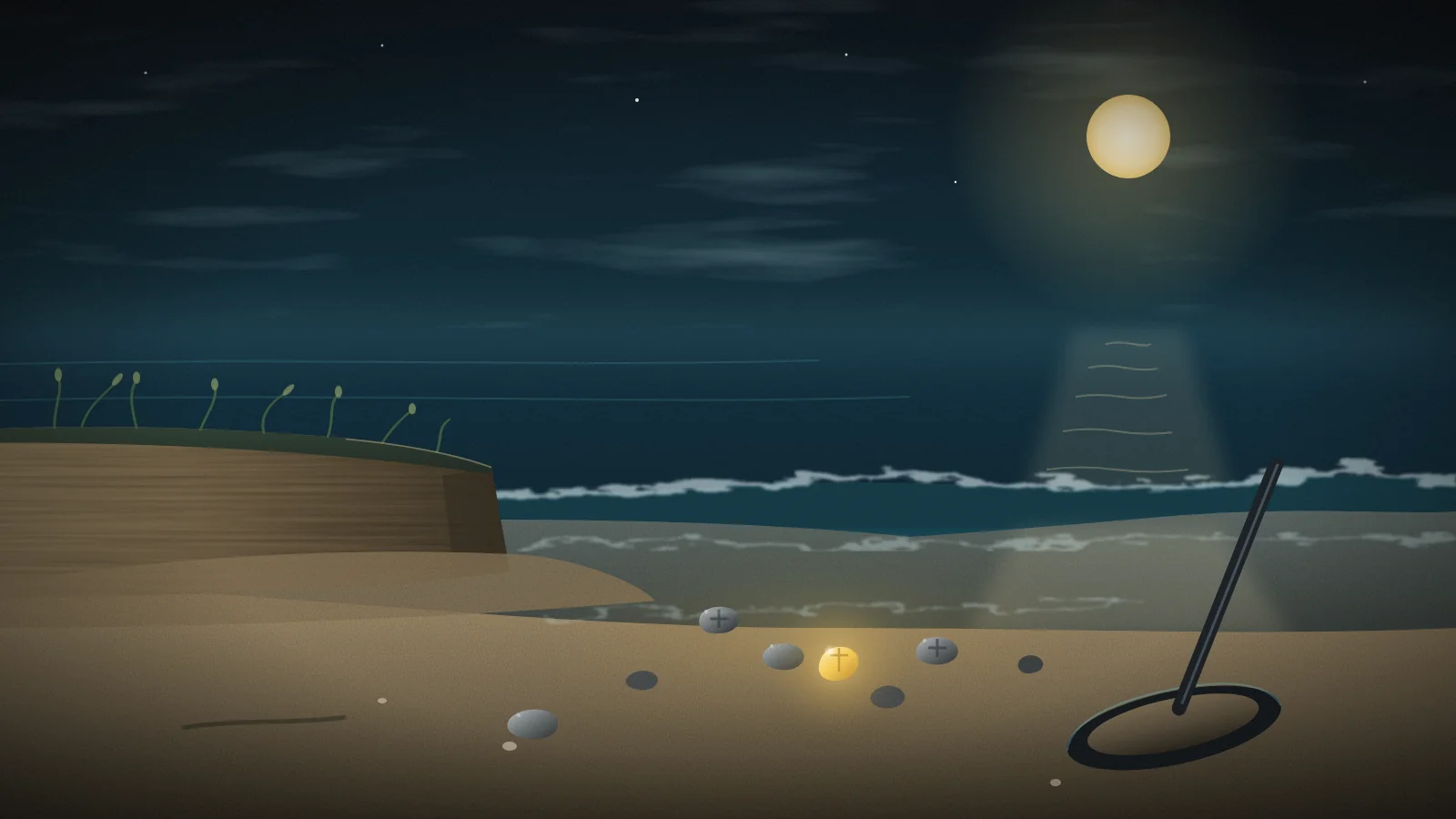
For more than two centuries, the fleet was mostly forgotten. Then the beach started giving up its secrets. In the early 1940s, an amateur archaeologist named Charles Higgs found traces of colonial-era camps in the dunes near Sebastian Inlet. A hurricane in 1955 tore away more dunes there and exposed artifacts and silver coins.
Enter Kip Wagner, a local building contractor who had been picking up old silver coins on the beach. The curious thing was that none of them was dated later than 1715. He teamed up with a local doctor, Kip Kelso, who in 1959 dug up an 18th-century map marking the spot where the Spanish admiral had been lost, opposite the Sebastian River. Wagner bought a $15 army-surplus mine detector and started sweeping the old camp. Brilliant.
In 1960 he joined forces with experienced divers, and on January 8, 1961 the group brought up more than 2,000 silver pieces of eight in a single day. They formed a company with eight members and called it the Real Eight Company, after the Spanish ocho reales, the famous piece of eight. Some of the coins came up fused together in great black lumps of a thousand or more, which is the sort of problem most people would quite like to have.
In 1963, Real Eight brought in a Californian diver with his own crew and boats: Mel Fisher, who would later become famous for the Atocha in the Florida Keys. In July 1964, Fisher's team found what became known as the "Carpet of Gold," a stretch of seabed covered in gold coins. National Geographic ran the story in January 1965, Wagner published his book Pieces of Eight in 1966, and the coast between Sebastian and Fort Pierce had a new name. Local newspapers started calling it the Treasure Coast, and it stuck.
Three centuries of salvage, in brief
Since the 1960s, the 1715 wrecks have been worked almost every summer by one crew or another. The wrecks have nicknames rather than ship names, because nobody can always be sure which ship is which: the Cabin Wreck near Sebastian, Corrigan's off Vero Beach, the Douglass Beach wreck near Fort Pierce and others. Mel Fisher's team came back in 1983. In 2010, Fisher's heirs sold the salvage rights to 1715 Fleet–Queens Jewels LLC, led by Brent Brisben, which now works the wrecks with teams of subcontracted divers.
The finds that still turn up
This is the part where the story refuses to stay in the past.
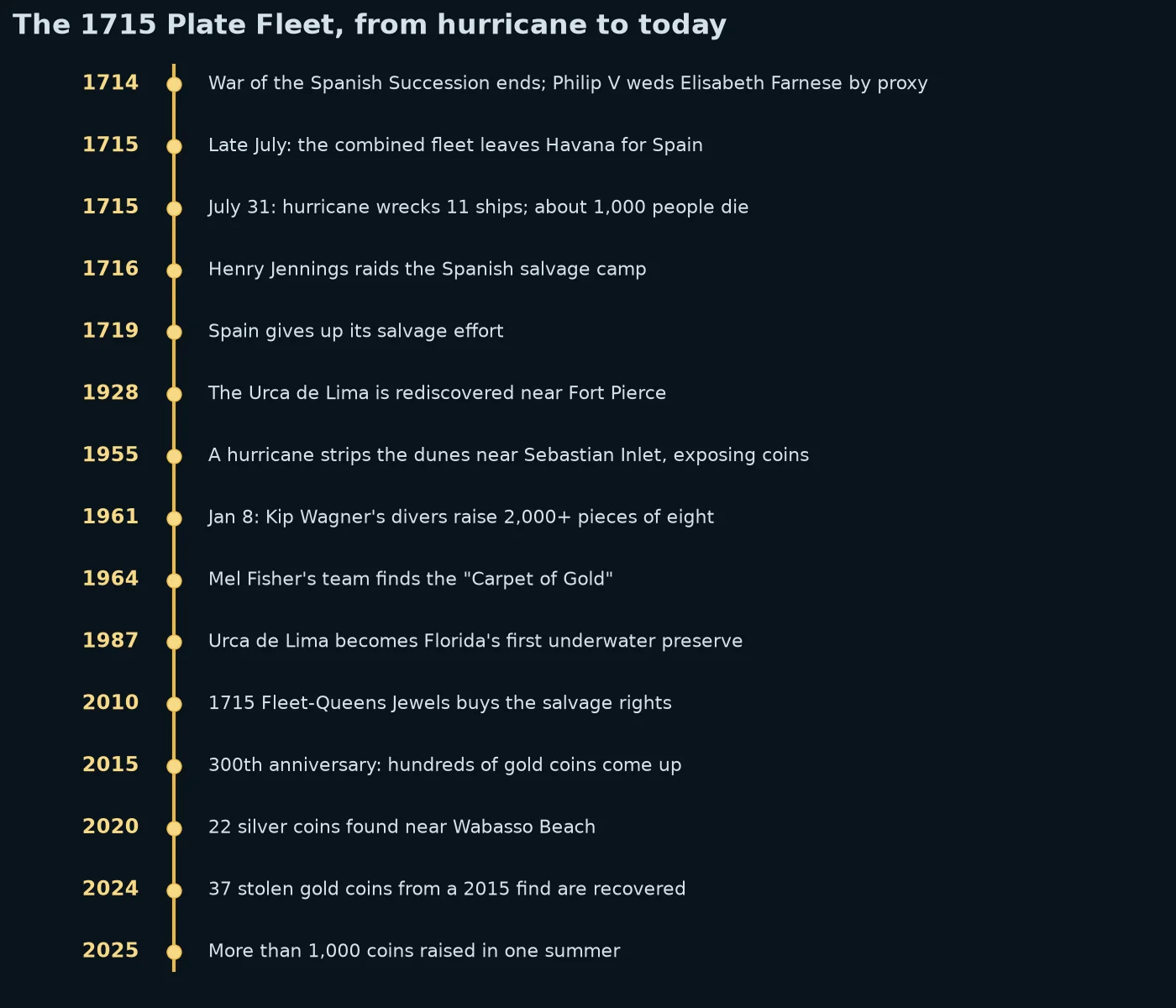
- June 2015. A family of subcontracted divers, the Schmitts, working about 1,000 feet off a beach in Fort Pierce in roughly 15 feet of water, brought up 52 gold coins and about 40 feet of gold chain, worth over a million dollars. Among them was a rare "Tricentennial Royal," a specially struck presentation coin of the kind made for the king, valued at more than $500,000. They kept quiet until the 300th anniversary of the wreck.
- July 2015. Right on the anniversary, the company announced roughly 350 gold coins, worth an estimated $4.5 million, recovered off Vero Beach.
- February 2020. Jonah Martinez and friends, beach treasure hunters with metal detectors, found 22 silver coins linked to the fleet near Wabasso Beach after rough weather, worth a few thousand dollars. Martinez said the best hunting comes after hurricanes and cold fronts strip sand off the beach.
- Summer 2025. Divers working for Queens Jewels recovered more than 1,000 silver coins and five gold escudos, minted in Spain's colonies in what are now Mexico, Peru and Bolivia, with an estimated value of about $1 million.
And then there is the cautionary tale. In November 2024, the Florida Fish and Wildlife Conservation Commission, working with the FBI, announced it had recovered 37 gold coins worth more than $1 million. Investigators said they came from a 2015 find of 101 coins, only half of which had been properly reported, and that the rest had later been sold off. Thirteen coins were still missing, and a member of the diving family was charged with dealing in stolen property. A charge is not a conviction, and the case is told here only as it was announced. The lesson for everyone else is simple: in Florida, 1715 gold comes with paperwork, and the state notices when it doesn't.
Who owns 1715 Fleet treasure? Florida law, plainly
Fancy a go yourself? Here is where the swagger stops and the precise bit begins, because Florida has some of the clearest treasure laws in the country.
- The state owns it. Under Section 267.061 of the Florida Statutes, treasure trove, artifacts and other objects of historical or archaeological value that have been abandoned on state-owned lands or state-owned sovereignty submerged lands belong to the State of Florida, with title held by the Division of Historical Resources.
- The sea floor is state land. Land below the mean high water line counts as state sovereignty submerged land. On the Atlantic side, Florida's waters run out three nautical miles, and the 1715 wrecks lie well inside that. A 1987 federal law, the Abandoned Shipwreck Act, also hands states the title to abandoned historic wrecks embedded in their submerged lands.
- Salvage needs a state permit. Searching for and recovering historic shipwrecks is governed by Chapter 1A-31 of the Florida Administrative Code. An exploration permit allows survey work, and no digging or moving of artifacts is allowed without the Division's written approval. A recovery permit comes only after the site has been documented. A qualified project archaeologist is part of the deal.
- The state takes its share. Under Rule 1A-31.090, the Division keeps approximately 20 percent of the recovered archaeological material, chosen for its historical value and what the state's collection already holds. The permit holder gets roughly 80 percent and title to it in writing.
- A federal court keeps watch. Queens Jewels holds exclusive salvage rights to the 1715 Fleet wrecks through the federal court in South Florida. Each year state representatives look over the finds and pick items for public collections, and the court approves the division. What's left is split between the company and its subcontractors.
- Breaking the rules is a crime. Under Section 267.13, removing or disturbing archaeological material on state land without a permit is a first-degree misdemeanor, and doing it by excavation is a third-degree felony. So is knowingly buying or selling items taken that way. Unpermitted treasure hunting on state land can also bring fines of up to $500 a day, and the finds, and even the boat and gear, can be forfeited.
And the coins on the beach?
This is where people get muddled. The Division of Historical Resources says many public beaches allow metal detecting between the high tide line and the toe of the dune, but beaches inside state or federal parks, preserves and other protected areas set their own rules. Some coastal state parks ban detecting entirely. Others allow it only between the dunes and the mean high water line, and only for modern objects. Counties and cities have their own ordinances too. And the wet sand below mean high water is state land, where removing historic objects is prohibited.
In plain English: what you can do with a sandy old coin depends on exactly where you were standing and who owns that strip of beach, so check with the park or local government before you go. If you come across something historic, the state's advice is to leave it in place, note the location and report it to the Division of Historical Resources or the Florida Public Archaeology Network. Stay off the dunes, and never dig or fan away sand on a wreck site without a permit.
The theories, weighed
- The jewels are still on the seabed. The romantic favourite. The wrecks broke up over miles of shallow, shifting sand, and storms keep moving things about. Plenty of coins were missed for 250 years, so a box of jewels could have been too.
- The Spanish got more than they admitted. Salvage records could be fiddled to dodge the crown's cut or to put rivals off, and sources disagree on how much was recovered. Some of the "missing" treasure may have been quietly taken home in 1716.
- The pirates got it. Jennings and the swarm of wreck-fishers who followed him took an unknown amount. Some of the fleet's silver almost certainly went to Jamaica and Nassau.
- It's scattered too thinly to ever be "found." The likely answer for most of it: a coin here, a chain there, spread along 30-odd miles of coast and only shaken loose when a storm moves the sand.
The honest answer? Nobody knows how much is left. Which is exactly why the boats still go out every summer.
Visiting the Treasure Coast today
- McLarty Treasure Museum, inside Sebastian Inlet State Park, stands on part of the 1715 survivors' and salvagers' camp, with fleet artifacts and an observation deck over the very water where the ships went down. It is run with volunteers, so check the opening days before you go.
- Mel Fisher's Treasure Museum in Sebastian shows finds from the 1715 Fleet.
- Urca de Lima Underwater Archaeological Preserve, near Fort Pierce, was the first of Florida's underwater preserves when it opened in 1987, and it is on the National Register of Historic Places. It lies about 200 yards offshore, roughly 1,000 yards north of Pepper Beach Park, in 10 to 15 feet of water: a ballast mound about 100 by 50 feet over the old hull timbers, with five concrete replica cannons and an anchor placed for divers. Entry is free and it is open year-round. Tie up to the mooring buoy rather than anchoring, and take nothing but photographs.
- The beaches from Sebastian Inlet to Fort Pierce, for a walk after a storm with a raised eyebrow and an eye on the tide line. Read the local rules first.
The fleet sank in a single night. The search has been going for more than three hundred years, and every hurricane season the Atlantic shuffles the deck again. Somewhere out there, under a few feet of Florida sand, the queen's jewels are still waiting, or they're long gone. Rather the point, isn't it?
...and if you find it, remember who encouraged your questionable life choices.
The short version of this story is on YouTube at @TenToeExpress.
Deep dive yourself
- 300th Anniversary of Spanish Silver Fleet's Fatal Encounter with a Hurricane · NOAA Atlantic Oceanographic and Meteorological Laboratory
- Urca de Lima · National Park Service
- Underwater Archaeology: frequently asked questions · Florida Division of Historical Resources
- Section 267.061 and Section 267.13 · The Florida Statutes, Florida Legislature
- Rule 1A-31.090: disposition of recovered materials · Florida Administrative Code, via Cornell Legal Information Institute
- 1715 Fleet History · Mel Fisher's Treasures
- Numismatic History: The Loss of the 1715 Spanish Treasure Fleet · CoinWeek
- Family finds a fortune in gold from a 1715 Spanish shipwreck (2015) · National Geographic
- $1 million worth of gold coins stolen from 18th-century shipwrecks found (2024) · CNN, via KVIA
- 1715 Treasure Fleet · Wikipedia (a good starting point, with further references)