 Ten Toe Express
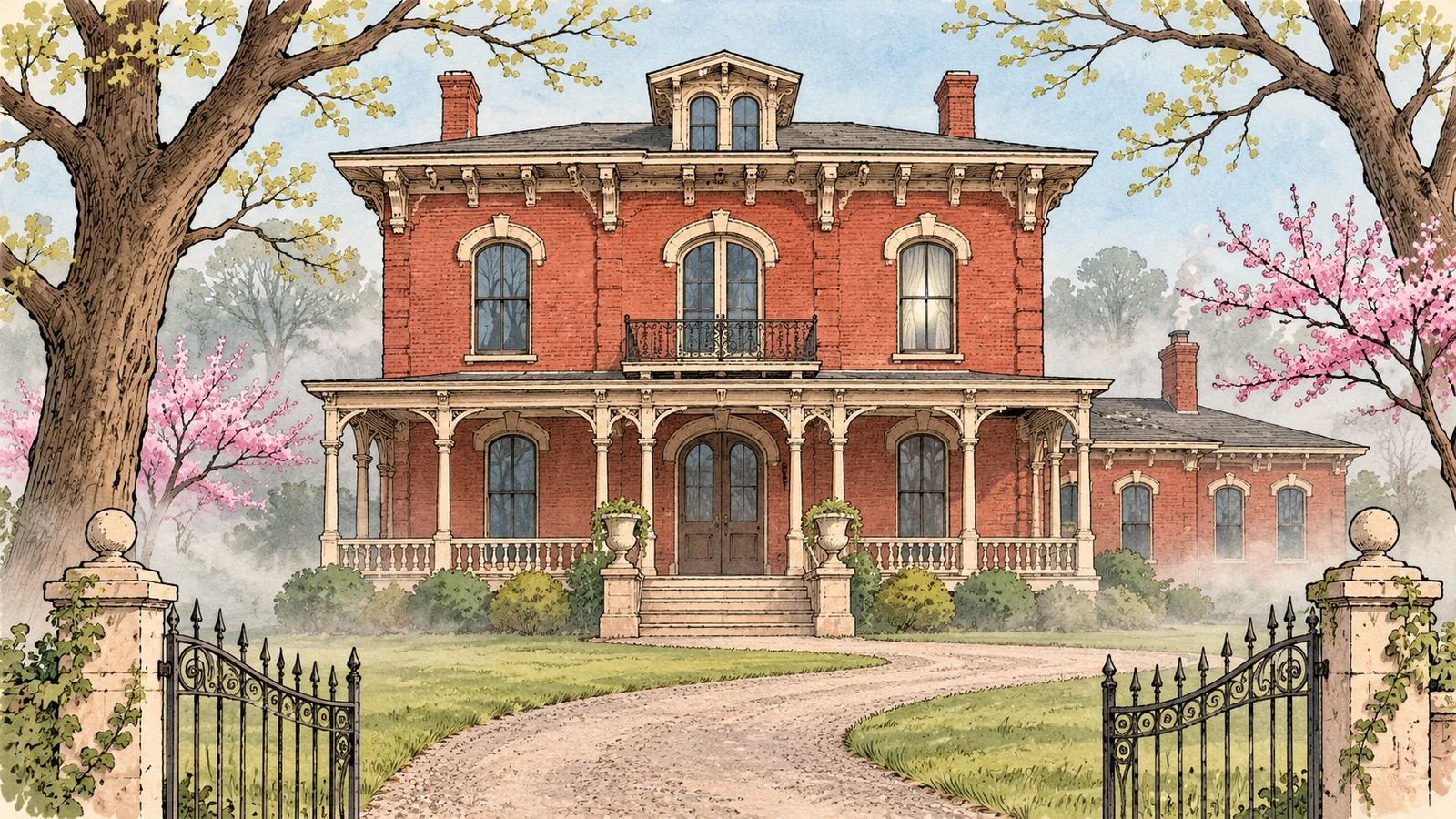
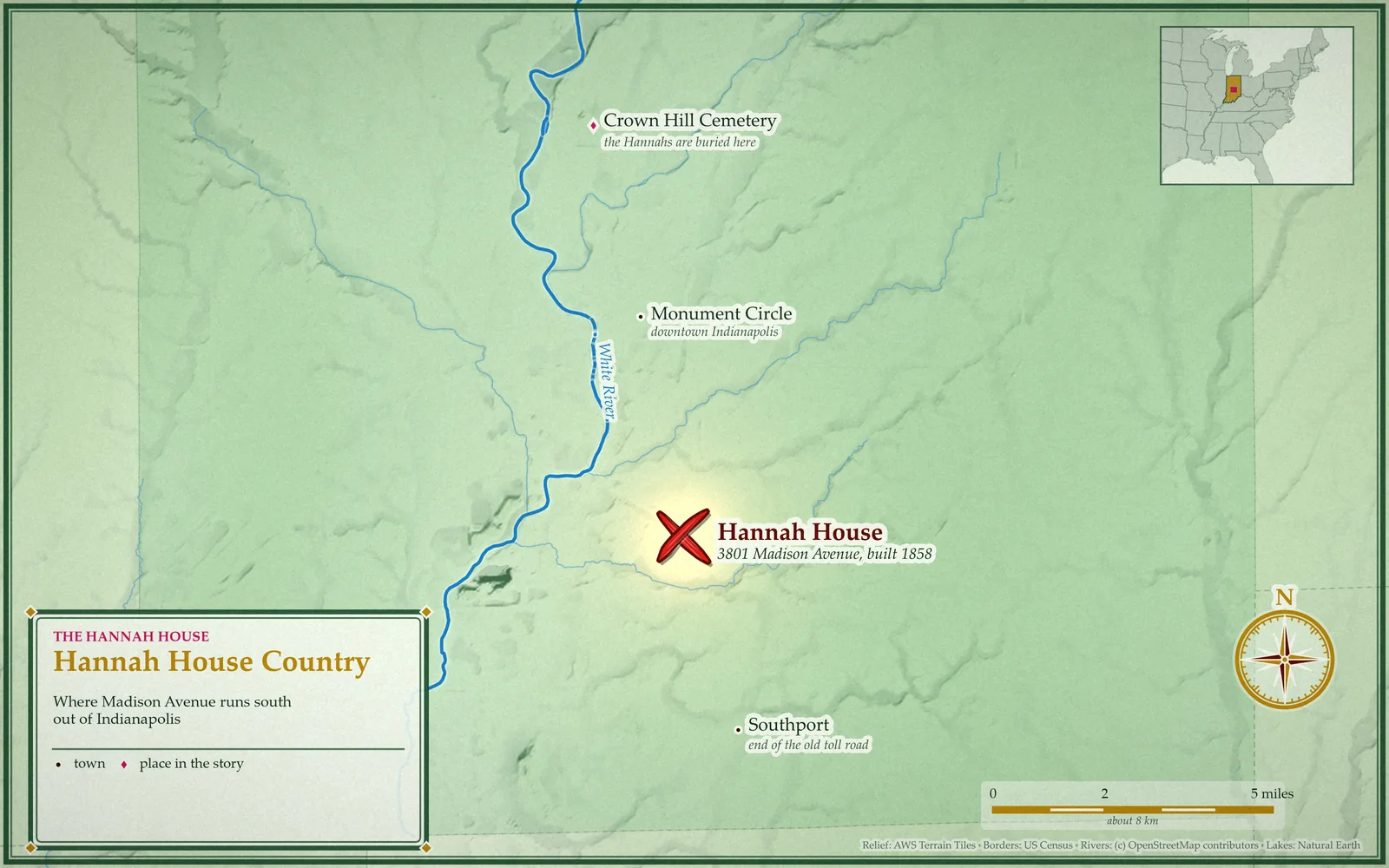
Right then, picture a brick mansion on the south side of Indianapolis, three acres of lawn, twenty-odd rooms and a reputation. The Hannah House at 3801 Madison Avenue is one of the best-known haunted houses in Indiana's capital, and the story that goes with it is a proper gut-punch: people seeking freedom, a fire in a cellar, and a smell that visitors say they would rather not describe at dinner.
Here's the awkward bit. The house is real, the family is real and the paperwork is lovely. The famous fire is a different matter, and the people paid to study the house's history say there is no evidence for it. So what's actually known about the Hannah House ghosts, and what's just a very good campfire tale?
The Hannah House of Indianapolis: the documented bits
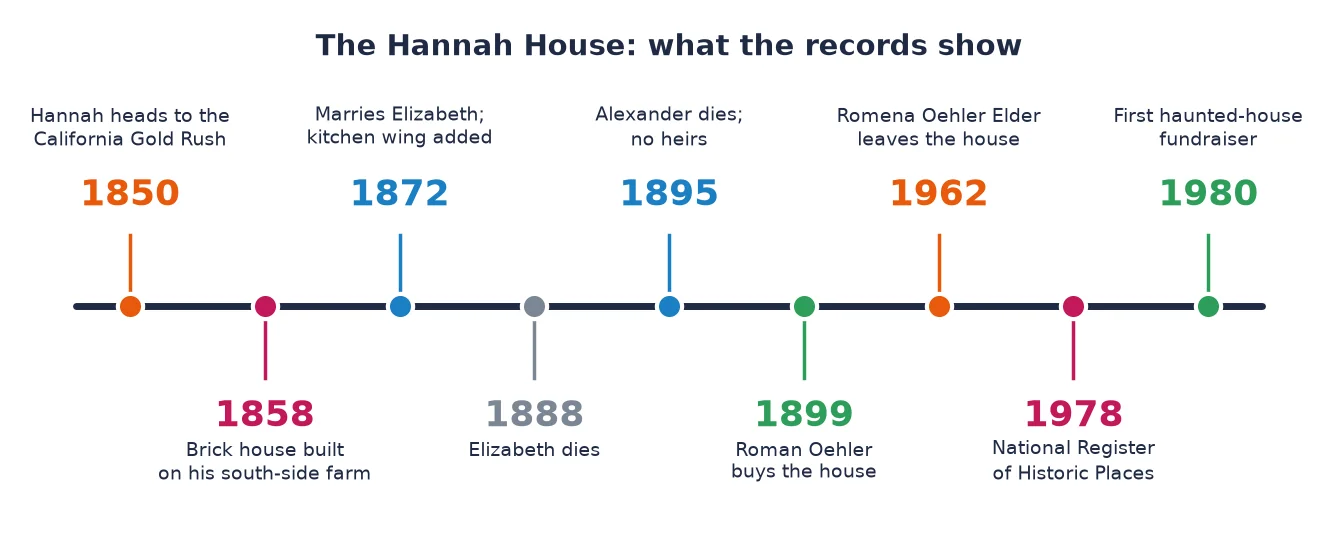
Start with the man himself. Alexander Moore Hannah was born in 1821 and began as a harness maker. He worked alongside his father, Samuel, on the Indiana Central Railroad, and around 1850 he joined the California Gold Rush. He came back about five years later.
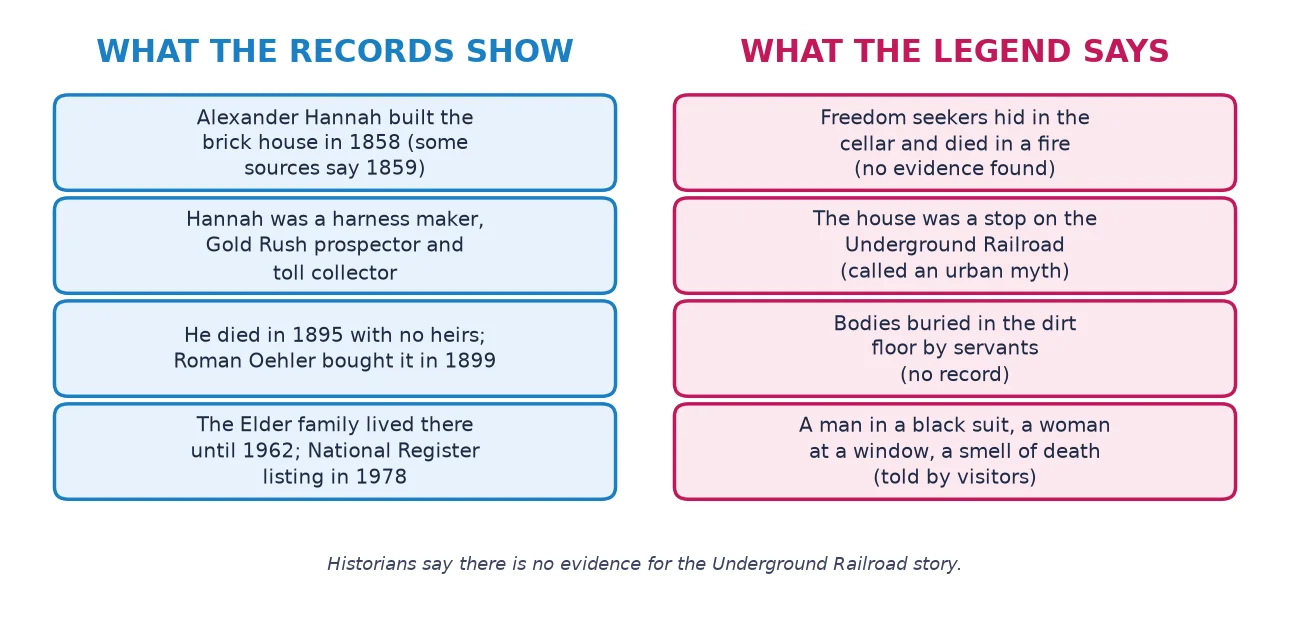
He bought a 240-acre farm south of Indianapolis, and in 1858 he built a two-and-a-half-story Italianate brick house there. (Wikipedia gives 1859, and notes that he bought $585 worth of brick in November 1858. Close enough that nobody's coming to blows.) He also collected tolls on the Indianapolis-Southport Toll Road from 1860 until 1895, which is the sort of job that makes you very well informed about who is going where.
In 1872 Hannah married Elizabeth Jackson, who was born in 1835, and a kitchen wing with a smokehouse, a milk-cooling room, staff quarters and a washhouse went on the back. Elizabeth died in 1888 and Alexander in 1895. Neither left an heir, and both are buried at Crown Hill Cemetery.
After the Hannahs: Oehler, the Elders and an antique shop
The house stood empty for about four years. In 1899 a German-born jeweler and Civil War veteran named Roman Oehler bought it along with 21 acres. When he died in 1920 it passed to his daughter Romena, who lived there with her husband, Marion Elder, and raised four children. Romena stayed until 1962.
Then came the quiet decades. John and Gladys O'Brien rented the place and ran an antique store in it, and the Elder family worked toward the house's listing on the National Register of Historic Places, which came through on December 1, 1978. (The register's database spells it "Hanna-Ochler-Elder", so it's worth searching both ways.) Upkeep and property taxes on a house this size are no joke, so through the 1980s the family held fundraisers: parties, murder mystery dinners, weddings, flea markets and, from 1980, a haunted-house event.
Note the timing. The ghost stories gather around exactly the years when the house was rented out, half-empty and surrounded by antiques.
The legend: freedom seekers, a cellar and a fire
Here's the story as it's usually told. Alexander Hannah was a Quaker and an abolitionist, and his house, set well back from prying eyes, hid people fleeing slavery on their way north. One rainy night a group sheltering in the cellar (or, in some versions, an outbuilding's basement) was caught by a fire. An oil lamp was knocked over, or a lantern tipped into straw, and nobody got out. The bodies, says the legend, were buried in the dirt floor by Hannah's servants.
It's a dreadful story, and the details shift depending on who's telling it: the lamp, the straw, the number of victims, whether it was the house or an outbuilding. A story that keeps changing its own facts is usually a story with no record underneath it.
That's exactly what the experts say. The Encyclopedia of Indianapolis calls the Underground Railroad claim "an urban myth" that "has not been proven true," and its author, Jessica Fischer, says that no evidence shows Hannah's house was part of it. Hannah may well have been a Quaker and an abolitionist, and the property was away from the city, but that's context, not proof. Historic Indianapolis adds that neighbors have reported partly collapsed tunnels nearby, which it calls "not categorically proven." Even the ghost hunters are careful here: one 2017 investigation reported the curator saying there was "no written account for this urban legend."
The Hannah House ghost reports
The hauntings, as reported, come in a familiar assortment. Unexplained noises, lights and electronics switching on and off, and objects moving were first reported in the O'Brien years. People describe cold spots, doors and wall hangings that move, and voices. David Elder, a descendant of Oehler, once called it "supposedly the only true haunted house in town," and reported glass breaking in an empty basement, swaying chandeliers and pictures flying off walls.
The apparitions are fairly consistent: a man in a black suit in the upstairs hall, a woman at a second-floor window and, in some tellings, a stillborn baby presumed to be Elizabeth Hannah's. Gladys O'Brien told investigators she heard glass crash at least five times, and saw a man in a black suit during renovation work in the 1970s. She followed him, she said, and he vanished. In 1992 a workman described a woman's face in an upstairs window that disappeared.
Then there's the smell. A bedroom at the top of the stairs, known as "Grandma's Room," is said to give off an odor of rotting flesh. It reached print by July 1981, in a chapter called "The House that Reeks of Death" in More Haunted Houses by Richard Winer and Nancy Osborn Ishmael, and it's the detail visitors mention most. Ghost Research Society investigator Dale Kaczmarek wrote that it has never been thoroughly explained.
And a word on the baby. The Encyclopedia of Indianapolis and Wikipedia say the Hannahs' only child was stillborn on March 16, 1875. Historic Indianapolis calls that "local lore" and says there are no records of a child's death tied to the house. The sources don't agree, so treat it as an open question.
Investigations: whispers, boxes and a gardenia
Modern ghost hunters have been through the place in numbers. A 2010 student newspaper piece at the University of Indianapolis quoted house manager Mary Cox saying escaping slaves "were trapped in the basement during a fire," and described basement recordings of whispers that sound like "find me" and "help me."
The Ghost Research Society ran an overnight investigation on September 23, 2017. Its devices produced responses like "Help fire" and a "Yeah" when asked whether there'd been a fire in the basement. The team itself says it can't be 100 percent sure any of it is paranormal, and that some responses "seem to contradict some of the urban legends." Most of the night was quiet. The one reported sensory event was a whiff of gardenia in a hallway.
Which is rather the pattern. Audio from random-noise boxes tends to say what the room is already thinking, and the legend has been in the air for decades before any microphone arrived.
Weighing the theories
- A genuine haunting. Possible if you're so inclined, but there's no documented death at the house to anchor it. The fire and the buried bodies have no record behind them.
- A legend that grew. The most paper-friendly answer. The Underground Railroad tale, an empty house, a haunted-house fundraiser and a few books arrived in the same decades, and each fed the next.
- An old house. Twenty-odd rooms of 160-year-old brick, plumbing, drafts and settling floors make plenty of noise on their own, and a big cellar can smell like a big cellar.
One honest caution: there's still a gap. Hannah's real sympathies and anything the family did on the quiet wouldn't necessarily have left a paper trail. Absence of proof isn't proof of absence, but it isn't a fire in a cellar either.
Visiting the Hannah House today
The house is privately owned: its own site says Oehler's descendants still own it, and the whole operation is run to fund restoration and taxes. It hosts weddings and private events, overnight paranormal investigations and monthly open houses. According to the house's own website, historical tours run on the first Sunday of each month from 1 to 4 p.m., with private tours by appointment. Check the site for current dates and prices before you go, and treat the grounds as private property outside those times.
If you do go, the best haunted thing in the building might just be the story of a very ordinary harness maker who struck it lucky in California and built himself a 24-room brick house.
...and if you find it, remember who encouraged your questionable life choices.
The short version of this story is on YouTube at @TenToeExpress.
Deep dive yourself
- Hannah House · Encyclopedia of Indianapolis
- Hannah-Oehler-Elder House · Wikipedia
- Hanna-Ochler-Elder House, National Register record · National Park Service
- Friday Favorites: Haunted Hannah House · Historic Indianapolis
- Hannah House investigation · Ghost Research Society
- UIndy Community Weighs in on Paranormal Activities · The Reflector, University of Indianapolis
- Historic Hannah House · The house's own website