 Ten Toe Express
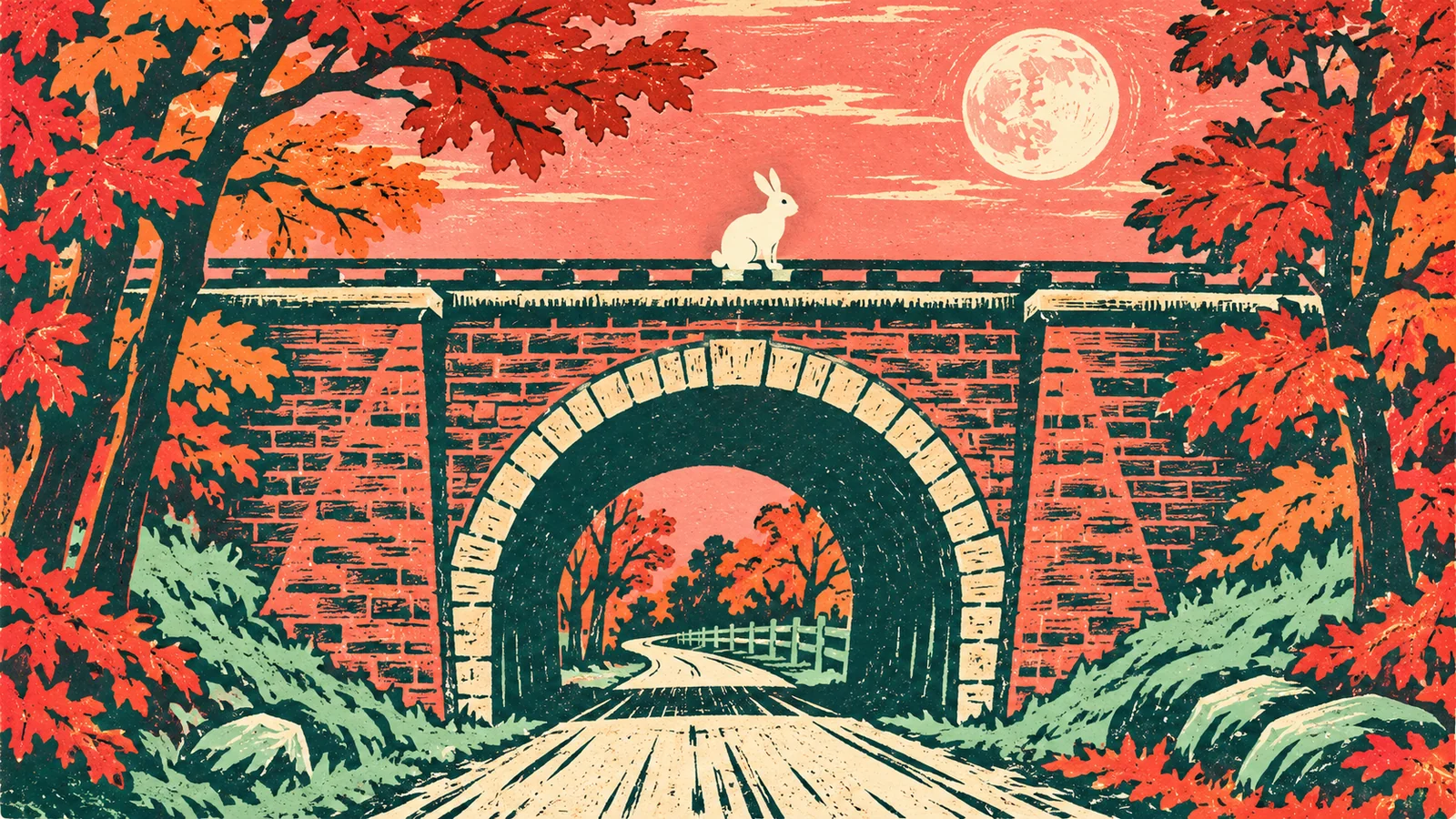
Right then, picture a quiet October night in Northern Virginia, 1970. A young couple is parked on a country road, the way couples did, when a figure in white bursts out of the bushes, shouts that they are trespassing and flings a hatchet through the car window. The detail that made the story: according to the cadet involved, the man was dressed as a rabbit.
That is the real seed of the Bunny Man, Fairfax County's most durable legend. It later grew a bridge, an escaped asylum patient, a pile of invented bodies and a Halloween traffic jam. Here is what the records show, what grew on top of them and why the famous Bunny Man Bridge near Clifton, Virginia was never actually part of the original case.
The Bunny Man of Fairfax County: what happened in 1970
The documented story comes down to two nights, roughly ten days apart, in the Burke area of Fairfax County. Brian Conley, historian-archivist at the Fairfax County Public Library, dug through police files and old newspapers for years and published the findings as "The Bunny Man Unmasked". His conclusion is that the October 1970 events are the genesis of the legend.
Night one: the hatchet
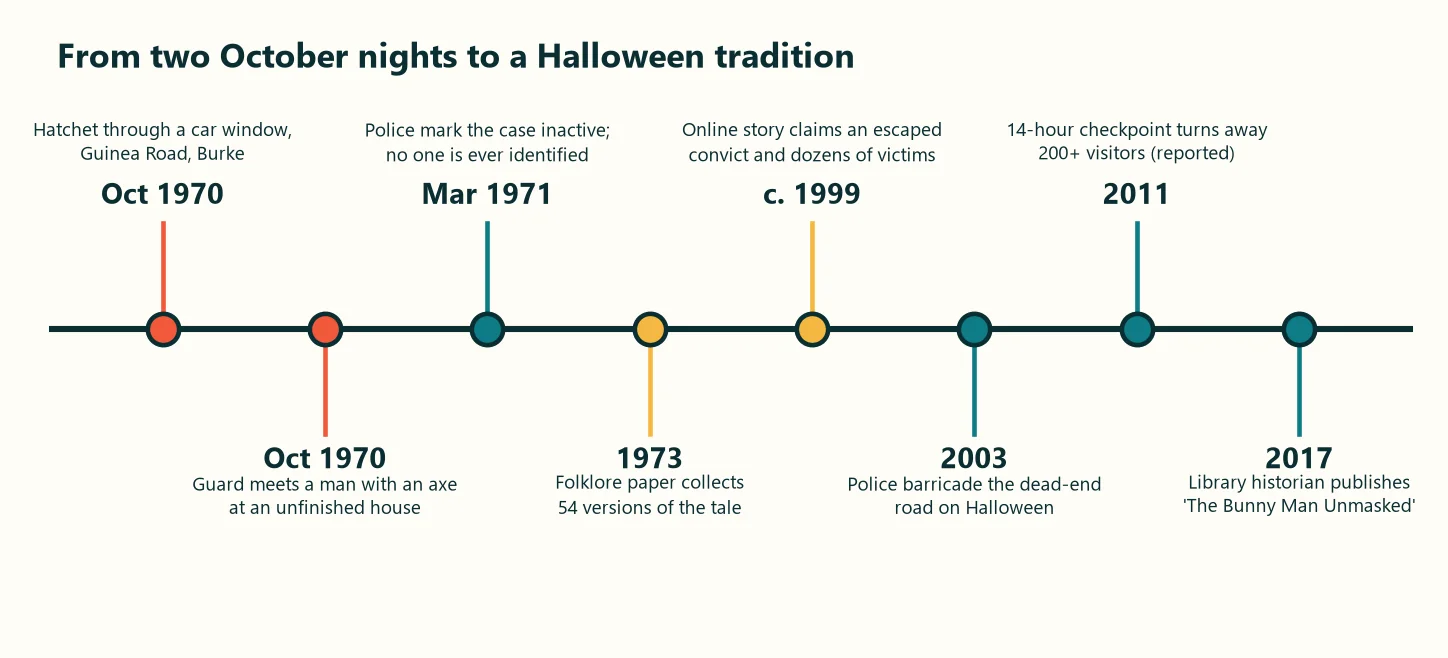
On October 18, 1970, just after midnight by one account, an Air Force Academy cadet and his fiancée were parked in the 5400 block of Guinea Road. The cadet was visiting relatives nearby. A man in white came out of the dark, accused them of trespassing and threw a hatchet through the car's window. Nobody was hurt. The Washington Post reported it on October 22 under the headline "Man in Bunny Suit Sought in Fairfax".
Even here the details wobble. The cadet described a white suit with long bunny ears. His fiancée remembered a white hood instead, and a later newspaper piece suggested a pillowcase. So the very first witnesses did not entirely agree on whether there was a rabbit at all.
Night two: the axe
On October 29, a private security guard watching a construction site in the Kings Park West development, about a block or so away on Guinea Road, spotted a figure on the porch of an unfinished house. The figure was chopping at a porch post with a long-handled axe. The guard later told police the man warned him, in so many words, to get out or get hit. Six officers turned up. The figure had already vanished into the woods. The Post followed up on October 31 with "The 'Rabbit' Reappears".
The guard described a man of about 20, around 5'8", in a gray, black and white costume. That is more or less all anyone ever knew about him.
Then the rabbit went viral (1970 style)
Once the papers ran it, the Bunny Man multiplied. By early November police said they were fielding more than 50 reports, and the Post ran "Bunny Reports Are Multiplying" on November 6. Sightings came in from Washington, D.C. and Prince George's County, Maryland, none of which police could confirm. One paper reported, with a perfectly straight face, that the rabbit had eaten a man's runaway cat.
A caller who called himself the "Axe Man" rang a representative at the Kings Park West construction offices about dumped debris and invited a worker to a meeting. Nobody turned up. A stakeout found nothing. An investigator wrote the case up as unsubstantiated, and on March 14, 1971 it was marked inactive. The Bunny Man was never identified.
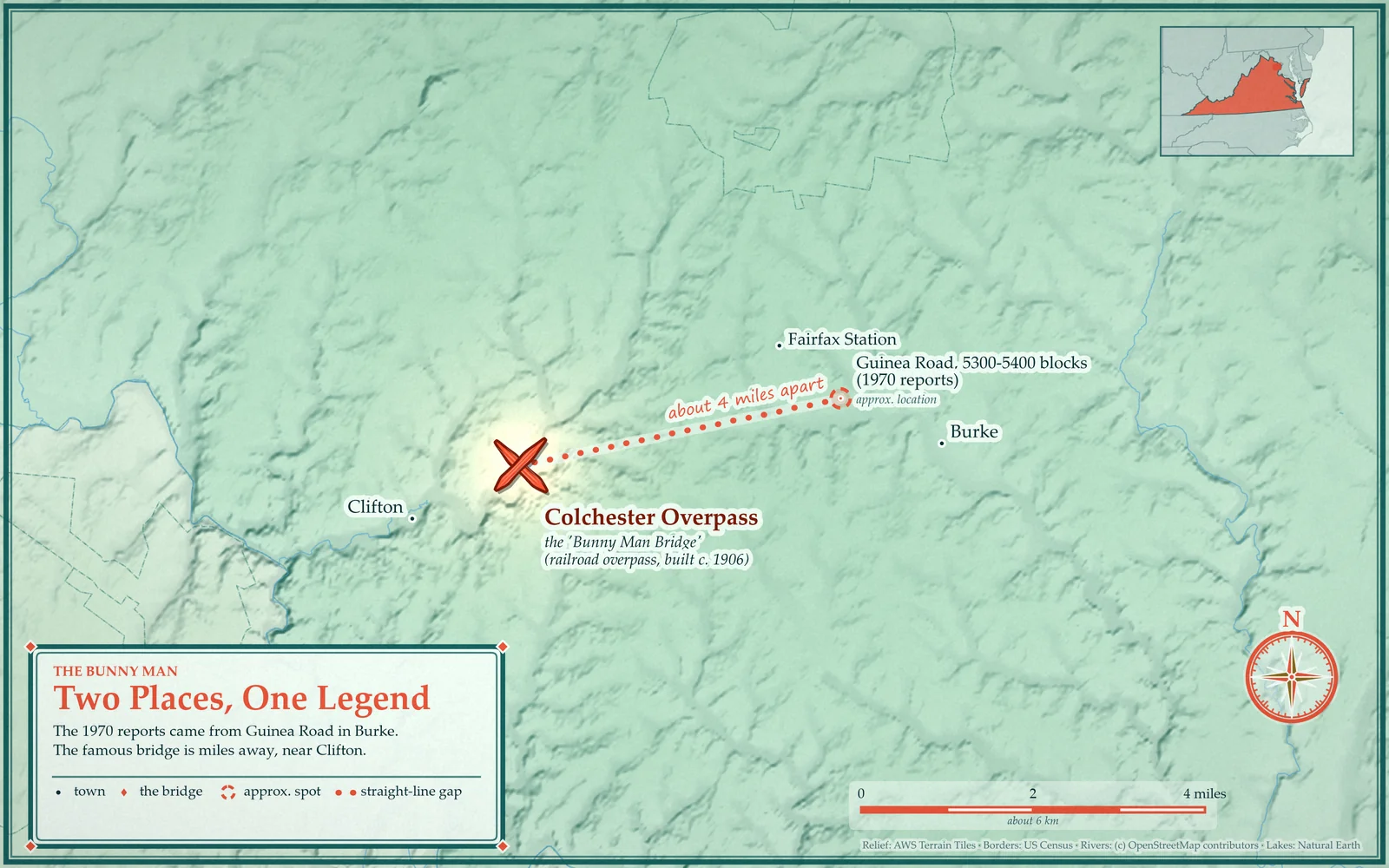
Why the Bunny Man Bridge isn't where it happened
The structure everyone drives out to see is the Colchester Overpass, a single-lane concrete railroad overpass carrying Southern Railway tracks (now a busy commuter and passenger line) over Colchester Road, between Clifton and Fairfax Station. It was built around 1906 near the old Sangster's Station on the Orange and Alexandria Railroad, which has Civil War history of its own. It is a spooky-looking spot, and Conley said as much.
But the 1970 reports never mention it. The Bunny Man was not seen there in 1970. Somewhere in the following years, as teenagers told and retold the story, the tale found itself a more atmospheric stage, and the dead-end road under the tracks fit the bill perfectly.
How the legend grew
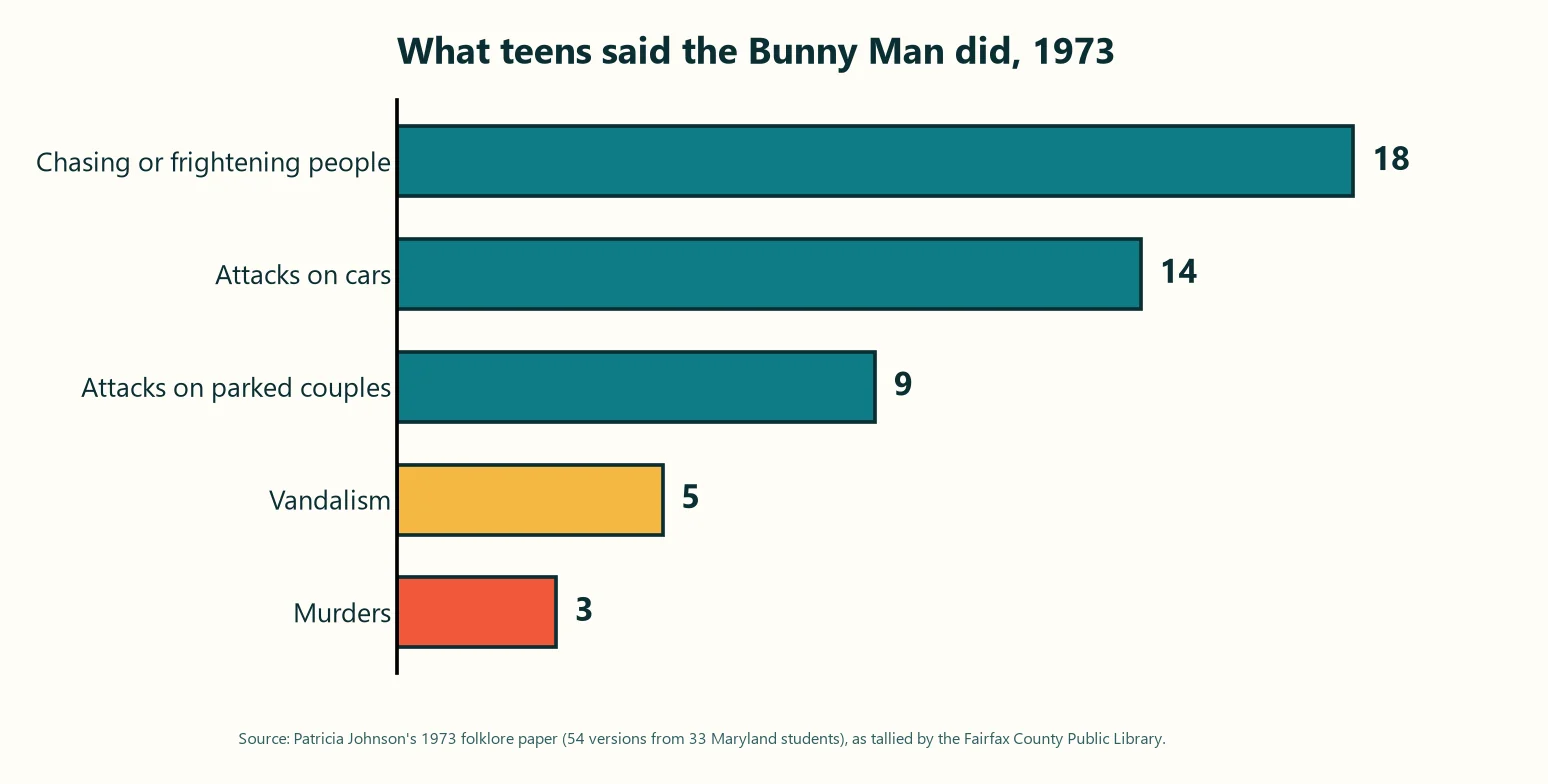
The early retellings are fairly tame: vandalism at lonely construction sites, scares for parked couples on lovers' lanes. In 1973 a student named Patricia Johnson collected 54 versions of the tale from 33 teenagers in Prince George's County, Maryland, for a University of Maryland folklore paper. Most were chases and car attacks. Only a handful had murders, and the Fairfax County library notes that the documented record supports none of them.
The big upgrade arrived around 1999, when a detailed story appeared online claiming that a man (the tale calls him Douglas Grifon) had escaped from an asylum in 1904, killed a string of victims and was hunted down under the bridge, with the body count climbing to dozens. It had names, dates and a "Clifton Town Library" as a source.
Conley checked. There has never been an insane asylum in Fairfax County. Lorton Prison, the other usual suspect in the tale, did not exist in 1904 and was run by Washington, D.C. anyway. The library it cited did not exist. He also ruled out three genuine local murder cases from 1872 to 1973, including the unsolved killing of a woman in Burke, as the source. In his words from a 2017 interview, he could find no evidence the story was told before 1970, and he was "convinced this was the genesis of the story."
Along the way the legend picked up television (a 2001 episode of Scariest Places on Earth), books, low-budget horror films and even a rock opera. A police sergeant told a local paper in 2003 that it was "Fairfax County's 'Blair Witch Project'". Conley's verdict: "It will not die."
The theories, weighed
- A prankster in a costume. The simplest answer, and in 1970 Halloween was a few days off. The figure shouted about trespassing rather than doing anything gruesome, which fits a lark that got out of hand better than a dark secret.
- A reaction to the building boom. Conley has suggested the man may have been lashing out at the development changing rural Fairfax County in the 1960s and 70s. Both sightings were at or near construction, and the figure's catchphrase was about trespassing. That is a theory, not a finding.
- A hoax grown by copycats. Once the Post printed it, plenty of locals could have joined in, which might explain the flood of unverifiable sightings.
- The asylum-and-murders story. There is no record behind it. Nothing in the 1970 police files or newspapers mentions deaths, an escaped patient or the bridge.
Nobody knows who the man was, and after more than fifty years nobody is likely to.
Where it stands today
The Colchester Overpass is still in use, still carrying trains, and still the destination of ghost hunters who show up around Halloween. The trouble is that Colchester Road is a dead-end residential street. In 2003 Fairfax County police barricaded the road at Fairfax Station Road on Halloween night to protect residents' property, and a sergeant said groups of visitors turn up "every Halloween". According to secondary reports, a 14-hour traffic checkpoint in 2011 turned away more than 200 people, some from as far off as the Pennsylvania line. Local neighbors have not always been thrilled with the attention.
If the legend tempts you, treat the road as the private neighborhood it is: the land around the bridge belongs to residents and the railroad, the tracks above are active and off limits, and police have used road closures on Halloween. The story reads just as well from the armchair.
The real Bunny Man trail runs through a library archive instead. The Fairfax County Public Library's research page is the best place to read the original police and newspaper trail.
...and if you find it, remember who encouraged your questionable life choices.
More stories like this one are on YouTube at @TenToeExpress.
Deep dive yourself
- Library Research: Fairfax County History: The Bunny Man Unmasked · Fairfax County Public Library
- Bunny Man · Wikipedia
- Legend Lives on at Bunnyman Bridge · Connection Newspapers, 2003
- The Elusive Trail of the Bunnyman Urban Myth · Burke Connection, 2017
- The Real Bunny Man Story: Virginia, 1970, Guinea Road · Ghosts of DC